

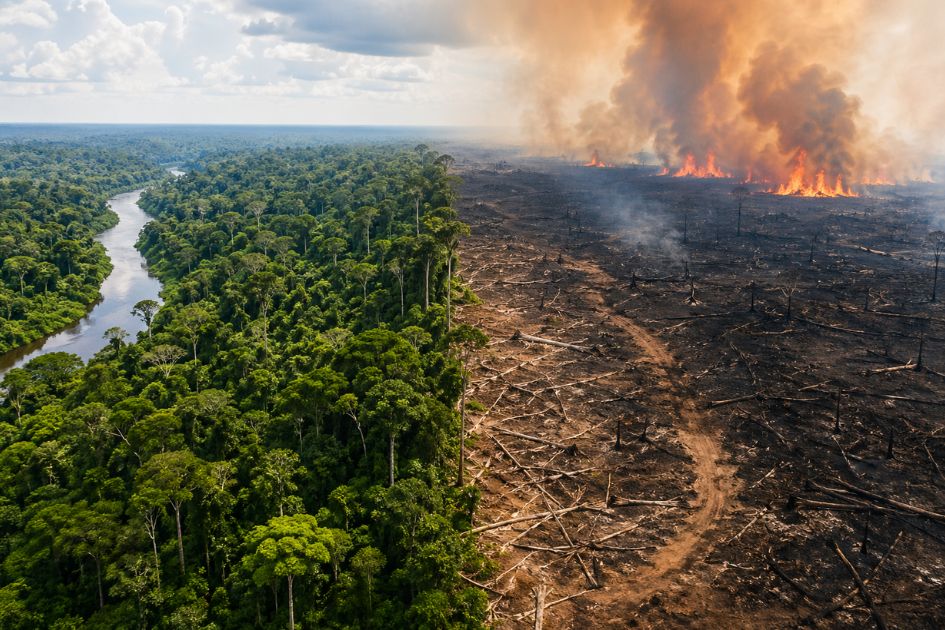



Global rainforest loss dropped sharply in 2025, led by Brazil, but growing fire risks and climate pressures could undermine gains and complicate efforts to meet 2030 deforestation targets.
Tropical rainforest loss fell sharply in 2025, dropping 36 percent from the previous year’s record high, but rising fire risks linked to climate change threaten to reverse progress, according to new global data.
Analysis from the World Resources Institute (WRI) using data from the Global Land Analysis & Discovery Lab shows the world lost 4.3 million hectares of tropical primary rainforest in 2025, an area roughly the size of Denmark.
Despite the decline, forest loss remains 46 percent higher than a decade ago, with primary forests disappearing at a rate of 11 football fields per minute. Current levels are still about 70 percent above what is needed to meet the 2030 global goal of halting and reversing deforestation under the Glasgow Leaders’ Declaration.
“A drop of this scale in a single year is encouraging. It shows what decisive government action can achieve,” said Elizabeth Goldman. “But part of the decline reflects a lull after an extreme fire year. Fires and climate change are feeding off each other, and with El Niño on the horizon for 2026, prevention and response will be critical.”
Brazil leads decline as policies tighten
Much of the global reduction was driven by Brazil, home to the world’s largest rainforest. The country cut non-fire primary forest loss by 41 percent compared with 2024, reaching its lowest level on record.
The drop coincided with stronger environmental enforcement under President Luiz Inácio Lula da Silva, including the revival of the PPCDAm anti-deforestation plan and tougher penalties for environmental crimes.
Although Brazil still records the largest total forest loss due to its size, its rate relative to forest area at 0.5 percent is now lower than several other tropical nations.
“Brazil’s progress shows what is possible when forest protection is treated as a national priority,” said Mirela Sandrini, warning that rising fire risks could undermine gains.
Elsewhere, Indonesia and Malaysia maintained relatively low forest loss rates, while Colombia reversed a spike seen in 2024. Analysts attributed progress to improved governance, recognition of Indigenous land rights and corporate commitments to deforestation-free supply chains.
“Indonesia managed to keep forest loss largely under control in recent years,” said Arief Wijaya, adding that economic pressures could test that progress.
Joaquín Carrizosa described Colombia’s progress as fragile, warning that sustained enforcement and investment would be needed to prevent a reversal.
Fires intensify global risk
While agriculture remains the leading cause of tree cover loss, fires played a major role in 2025, accounting for 42 percent of the 25.5 million hectares of global tree cover loss. That is an area slightly larger than the United Kingdom.
Climate change is increasing fire risk by creating hotter and drier conditions, allowing fires to spread more easily. These fires release large amounts of carbon, further accelerating global warming in a feedback loop.
The most severe fire impacts were seen in Canada, where wildfires burned 5.3 million hectares, making 2025 the country’s second-worst fire year on record. Significant fires were also recorded in southern Europe.
“Climate change and land clearing have shortened the fuse on global forest fires,” said Matthew Hansen. “Without urgent action, we risk pushing forests past recovery.”
Loss remains high in several regions
Forest loss remained elevated in Bolivia, Democratic Republic of the Congo, Peru, Laos and Madagascar, driven by agriculture, mining and local reliance on forests for fuel and food.
Bolivia recorded its second-highest level of primary forest loss, surpassing the Democratic Republic of the Congo despite having significantly less forest area.
“In Bolivia, forest loss is closely tied to agricultural expansion, with fire often used to clear land,” said Stasiek Czaplicki Cabezas.
In the Congo Basin, losses continued across several countries. In the Democratic Republic of the Congo, total loss dipped slightly, but non-fire loss reached a record high, linked to small-scale farming, charcoal production, conflict-related displacement and mining pressures.
“Mining is a far greater indirect driver of deforestation than previously recognized,” said Teodyl Nkuintchua, calling for stronger support for community forest management.
Race to meet 2030 targets
Experts say meeting global forest goals will depend on political will, investment and policy implementation, including funding for initiatives such as the Tropical Forest Forever Facility and enforcement of regulations like the EU Deforestation Regulation.
“The progress we are seeing is heartening, but far from assured,” said Rod Taylor. “The fate of forests depends on decisions being made now.”
With El Niño expected to intensify fire risks and elections approaching in several forest countries, 2026 is seen as a critical test year.
Technology to aid monitoring
WRI said future data releases will be integrated into Global Nature Watch, a new system combining research from Global Forest Watch and Land and Carbon Lab.
The platform aims to make complex land-use data more accessible through a chat-style interface, helping governments and conservation groups respond more quickly to forest loss.
“Now is the moment to turn gains into lasting protection,” said Kelly Levin, noting that improved data access could help detect changes earlier and guide action.
WRI’s annual tree cover loss analysis, based on satellite data at 30 by 30 metre resolution, tracks changes across nearly all global land areas except Antarctica and parts of the Arctic.




