




Field data from six Rajshahi communities showed women remain central to conserving local seed systems as native varieties face pressure from hybrid seeds, chemicals and market dependence.
Farmers, researchers, environmental activists and civil society representatives have called for reform of Bangladesh’s national seed policy to protect native seed diversity, farmers’ seed rights and the traditional knowledge of women farmers in the drought-prone Barind region.
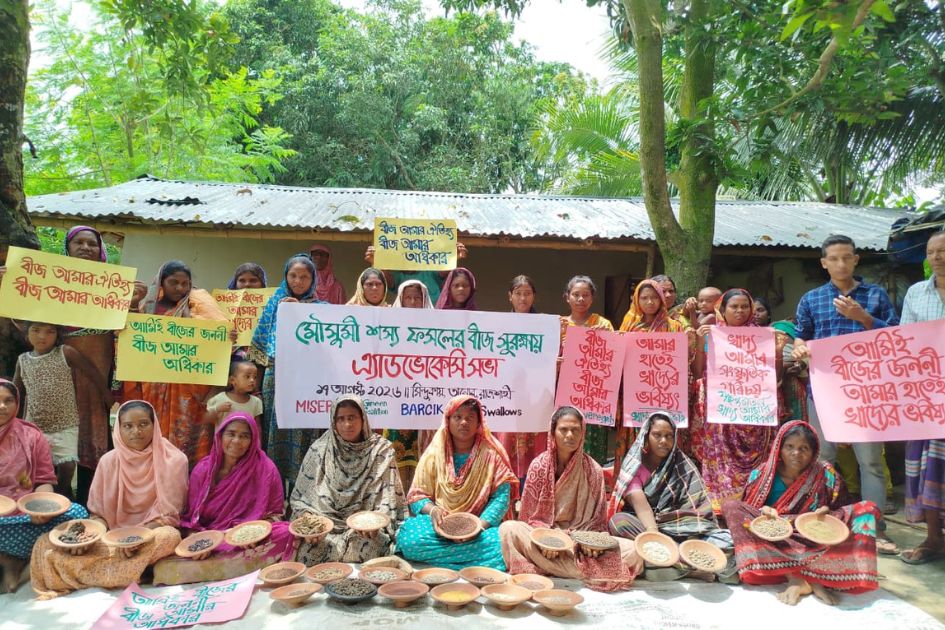
The demand was made on Monday, August 17, 2026, at a community-based policy dialogue on monsoon-season native seed diversity and seed sovereignty in Sindukai village of Tanore upazila in Rajshahi district. The event was organised by development research organisation BARCIK and the Green Coalition.
A participatory field study presented at the dialogue analysed data from monsoon seed exchange festivals held in six communities in Paba and Tanore upazilas of Rajshahi. Local farmers, both men and women, took part in the festivals with seeds preserved at home, exchanged seeds with one another and identified through discussion the names of local seeds and plants that are still available, have disappeared or have become rare.
The field data showed that even when a crop is known by a single name, many local varieties and traits exist within it. It also showed that significant native seed diversity still survives in the Barind region.
In Sindukai community of Tanore, the study found information on four local varieties each of bottle gourd, sweet pumpkin and bean among monsoon vegetables. It also recorded three varieties of chilli, two each of ridge gourd and jute leaf and two varieties of taro.
In Thanatala community, the presence of various local seeds was recorded, including pumpkin, red amaranth, short bean, long bean, kathra bean, bottle gourd, yardlong bean, snake gourd, telakucha, bitter gourd, goralu, jira rice and BR-26 rice.
In Gokul Mathura community, farmers’ memories and discussions identified 29 locally lost or declining food, medicinal and uncultivated plants. In Mohor Hindupura, they identified 27 such plants.
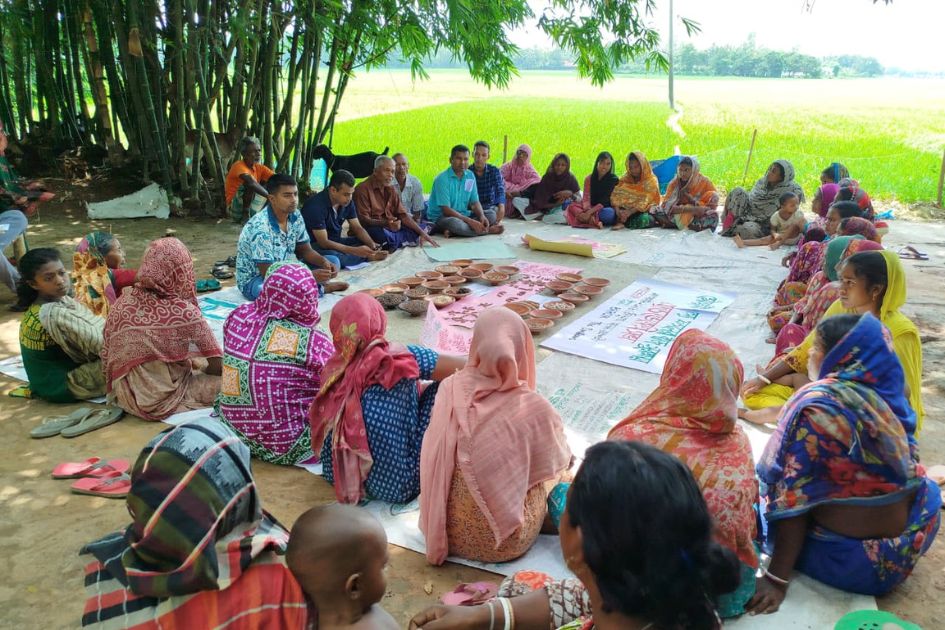
However, farmers and researchers involved in the participatory study cautioned that the figures were not national-level extinction statistics. They said the data reflected plants and seeds that are now absent or have become rare in the local knowledge and memory of the communities concerned.
Mosa Kobuljan, a woman farmer who runs the Haridebpur Agroecology Learning Centre, said the centre maintains living seeds of 160 varieties of different crops. She said the seeds are collected from different villages and exchanged seasonally.
Data from seed fairs in the six villages showed that women are key custodians of local seed systems. The study presented at the dialogue particularly highlighted the role of women farmers. In Madhabpur, 38 of 40 participants were women; in Duboil, 40 of 55 were women; and in Sindukai, 50 of 60 participants were women.
Speakers said women have preserved seeds for generations and have also carried traditional knowledge about which plants to collect seeds from, when to collect them, how to dry and preserve them and which seeds are suitable for use in the next season.
They called for women farmers to be recognised not only as “beneficiaries” of agricultural programmes, but as custodians of local seed knowledge and conservation.
Participants from six villages in the two upazilas said losing seeds did not mean losing only one variety. They said the crisis of local seeds could not be understood if seen only as a problem of agricultural production, as seeds are linked to farmers’ production freedom, the right to choose food, local food culture, agricultural biodiversity, women farmers’ traditional knowledge and local ecological knowledge.
“Our Barind region is drought-prone. These varieties can adapt to this region, so these varieties should be protected nationally,” said farmer Jitendra Nath of Gokul Mathura village.
Farmers’ discussions linked the decline of local seeds to the spread of commercial and hybrid seeds, market dependence, monocropping, chemical agriculture and herbicide use, promotion by agricultural input companies and negative perceptions about local seeds.
Speakers at the dialogue said Bangladesh has a legal framework for seed quality, production, marketing and regulation. The current structure under the Ministry of Agriculture includes the Seeds Act, 2018 and Seed Rules, 2020.
But they said field realities now require community or region-based seed resolutions and community-based seed management. They said national seed policy should address not only which seeds can be sold in the market, but also who will preserve seeds, who will exchange them, whose knowledge will be recognised and how local seed diversity will be protected for future generations.

BARCIK anthropologist and regional coordinator Md Shahidul Islam said community-based seed conservation and the knowledge of farmers, both men and women, must be recognised in seed policies and related laws.
“These farmers have contributed to protecting thousands of years of seed diversity,” he said. “The government should list community-based or region-based native seed diversity and recognise area-based production, conservation and local agricultural researchers.”
Islam presented the report analysing data from monsoon seed exchange festivals in six communities in the two upazilas.
Local farmers put forward eight policy demands at the community-based dialogue.
Speakers said Bangladesh is a signatory to the International Treaty on Plant Genetic Resources for Food and Agriculture. Article 9 of the treaty recognises farmers’ rights, traditional knowledge and farmers’ contributions to the conservation of plant genetic resources.
They called for stronger recognition in Bangladesh’s national seed system of farmers’ own seed conservation, protection of local varieties, seed exchange and participation in seed-related decision-making.
Speakers said seeds should not be viewed only as agricultural inputs. They said seeds are resources for farmers’ rights, biodiversity, food sovereignty and climate adaptation.
“The farmer who saves seeds does not save only a variety. The farmer saves a food system, a knowledge system and the rights of future generations,” they said.
Atiqur Rahman, president of the Barind Youth Forum, said: “We have a seed control system. What is needed now is a governance system for farmers’ seed sovereignty.”
Others present at the dialogue included Sindukai Women’s Organisation president Pari Tudu, Indigenous leader Gones Soren and BARCIK programme officer Amrit Kumar Sarker.




