

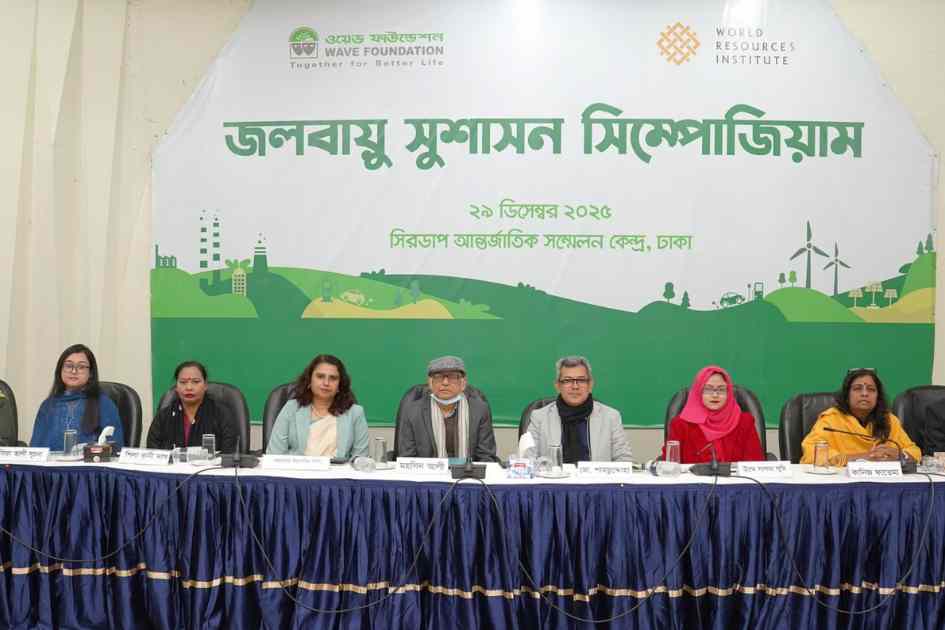

At a Dhaka symposium, Wave Foundation and partners shared audit findings showing gaps in local climate action, urging stronger union councils, inclusive policies and accountable spending to protect coastal communities.
Civil society leaders in Bangladesh have called for strengthening grassroots climate governance, emphasizing citizen participation, gender-inclusive policies and effective use of allocated budgets to address climate change impacts, especially in coastal communities.
The appeal came at the full-day Climate Governance Symposium organized by the national civil society organization Wave Foundation at the International Convention Centre in Dhaka. The event brought together government officials, experts, local leaders, media representatives and youth delegates to discuss the challenges and opportunities in empowering local communities for climate action.
The symposium highlighted the findings of a social audit conducted under the Strengthening Climate Governance with Grassroots Participation in Bangladesh (SCGGP) project, implemented in partnership with the World Resources Institute (WRI). The project has successfully engaged communities across four upazilas and 32 unions in Patuakhali and Barguna districts of Barisal Division to enhance citizen participation in climate governance.
Research presented by Ahmed Borhan, Research Director at the Center for Social Research, revealed significant gaps at the grassroots level. He noted that 82 percent of development projects fail to meet local needs, 70 percent of citizens are unaware of union council activities and 80 percent of projects lack targeted provisions for women and marginalized groups.
During the panel discussion on Challenges and Approaches to Local Partnerships, Shahinara Yasmin Lily, Joint Secretary (Law Wing) of the Ministry of Environment, Forest and Climate Change, stressed the role of citizens, saying that the government is working to provide safe drinking water in rural areas, but citizens also have a responsibility. They must change themselves and take accountability.
Nahid Sultana, Assistant Project Director at the Green Climate Fund under the Department of Women’s Affairs, added that to tackle climate impacts and advance greening initiatives in the country, everyone must work together.
Mohsin Ali, Executive Director of Wave Foundation, highlighted Bangladesh’s vulnerability, noting that even though the country has a minimal role in global emissions, it ranks seventh among countries most affected by climate change. One way to address the situation is by strengthening union councils, increasing allocated budgets and using them effectively.
Md. Shamsuddoha, CEO of CPRD Bangladesh, said there is a gap between planning and implementation. He emphasized the need to coordinate climate plans with global initiatives while empowering union councils to act locally.
The symposium also included a thematic discussion on Climate Migration and Compensation Mechanisms, moderated by Aniruddha Roy, Assistant Director of Wave Foundation. Speakers included Abu Aslam, Portfolio Lead at Water.org South Asia, Farhana Afroz, Program Director at Helvetas Swiss Intercooperation Bangladesh and Ahmad Ibrahim, Climate and Displacement Advisor at BLAST, who discussed the human and policy dimensions of climate displacement.
The day concluded with exhibitions showcasing SCGGP project activities and cultural performances, reflecting the importance of citizen engagement, gender-inclusive policies and local governance in addressing the escalating climate crisis in Bangladesh’s coastal regions.
Speakers emphasized that climate change is no longer only a matter of global warming or natural disasters; it has emerged as a pressing humanitarian and governance challenge, making local citizen participation more crucial than




