

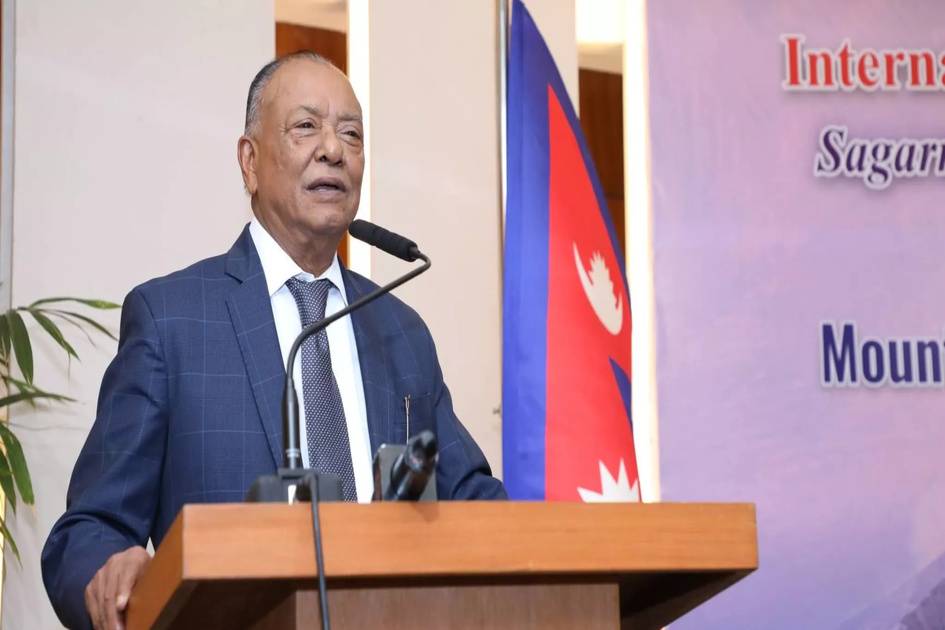

Bangladesh’s Environment, Forest and Climate Change Minister Abdul Awal Mintoo has called for stronger regional cooperation to address the growing impacts of climate change on mountain ecosystems and the millions of people whose lives and livelihoods depend on them across South Asia.
Speaking at a programme marking the 73rd International Sagarmatha (Mount Everest) Day in Dhaka on Thursday, the minister emphasized that climate change is increasingly threatening fragile mountain environments and that countries in the region must work together to confront shared environmental challenges.
“Climate change is affecting mountains and mountain-dependent communities in profound ways. Addressing these challenges requires cooperation among countries and coordinated climate action,” Mintoo said.
The event, organized by the Embassy of Nepal in Bangladesh with support from the Bangla Mountaineering and Trekking Club (BMTC), was held under the theme “Mountains, Milestones and Memories.”
While International Sagarmatha Day commemorates the historic first ascent of Mount Everest, this year’s observance also highlighted the growing climate threats facing mountain ecosystems worldwide.
Scientists have repeatedly warned that rising global temperatures are accelerating glacier melt across the Himalayas, threatening freshwater supplies, biodiversity, ecosystem stability and the livelihoods of millions of people throughout South Asia. Experts note that the consequences of environmental degradation in mountain regions extend far beyond national borders.
Although Bangladesh does not possess mountain ranges comparable to the Himalayas, the country is closely connected to the region through major river systems that originate in the mountains. Changes in Himalayan ecosystems can directly affect water availability, flooding patterns, agriculture and climate resilience across Bangladesh.
The minister also praised mountaineers for promoting environmental awareness, fostering friendship among nations and strengthening people-to-people ties between Bangladesh and Nepal.
A key attraction of the event was the Expedition Video Contest, which featured 16 climbers and trekkers representing various mountaineering and adventure clubs from across Bangladesh. Participants shared personal stories, challenges and experiences from their expeditions through short films and visual storytelling.
The programme also featured a screening of the documentary Pasang: In the Shadow of Everest, which chronicles the inspiring journey of Pasang Lhamu Sherpa, the first Nepali woman to summit Mount Everest and a trailblazer for women in mountaineering.
In a video message, Nepal’s Minister for Foreign Affairs Shisir Khanal described Sagarmatha as a symbol of hope, resilience and human determination. He emphasized the urgent need to protect mountain ecosystems that are increasingly vulnerable to climate change, glacier retreat and environmental degradation.
Nepal’s Ambassador to Bangladesh Ghanshyam Bhandari highlighted the significance of International Sagarmatha Day not only as a celebration of one of humanity’s greatest achievements but also as an opportunity to reflect on the relationship between people and nature.
He reaffirmed Nepal’s commitment to conserving mountain ecosystems and promoting sustainable mountain tourism while emphasizing the growing engagement of Bangladeshi mountaineers in Himalayan expeditions.
“The increasing participation of Bangladeshi mountaineers is further strengthening friendship and people-to-people relations between Nepal and Bangladesh,” the ambassador said.
The event brought together government officials, diplomats, mountaineers, trekkers, environmental advocates, nature photographers, civil society leaders and media representatives.
Among the highlights of the evening was the recognition of Bangladeshi mountaineer Nurunnahar Nimni, who successfully summited Mount Everest on May 27, 2026, becoming only the third Bangladeshi woman to reach the world’s highest peak.
Her achievement has been widely celebrated as a significant milestone for women in adventure sports and mountaineering in Bangladesh, where female participation in high-altitude expeditions remains relatively limited.
In addition, 23 Bangladeshi climbers who successfully summited mountains above 6,000 metres in Nepal during the 2025-26 climbing season were honoured with certificates of appreciation.
The top three entries in the Expedition Video Contest were also recognized. “Sea to Summit” by Ikramul Hasan Shakil secured first place, followed by “Everest and Lhotse” by Dr. Babar Ali and “Summit Is a Woman” by Nishat Majumder and Muntasir Mamun.
Other speakers included BRAC Chairperson Dr Hossain Zillur Rahman, BMTC founder Enam Ul Haque and contest judge Kha Ma Harum.
Experts note that mountain ecosystems are often referred to as the world’s “water towers” because they provide freshwater resources to billions of people globally. However, rising temperatures, glacier retreat, biodiversity loss and ecosystem degradation are placing these critical environments under increasing pressure.
As climate change accelerates across the Himalayas and other mountain regions, speakers at the event emphasized that protecting mountain ecosystems is no longer solely a concern for high-altitude communities. The future of water security, biodiversity conservation, disaster resilience and sustainable development across South Asia increasingly depends on the health of the region’s mountains, making regional cooperation more urgent than ever.




