


Field trials by Agronochain and Krishi Shwapno highlight how partnerships, market access and sustainable financing can help rural innovations reach more farmers.
Two Bangladeshi agritech startups have tested digital solutions with small-scale farmers under a programme backed by the International Fund for Agricultural Development (IFAD) and the European Union, with stakeholders saying that demand, financing and viable business models will be crucial to taking such innovations beyond pilot projects.
Agronochain and Krishi Shwapno tested their solutions in the field alongside projects financed by IFAD and the Government of Bangladesh, working with the Palli Karma-Sahayak Foundation (PKSF) and the Department of Agricultural Extension (DAE), the country’s government agency responsible for agricultural extension services.
The startups presented their implementation journeys, results and lessons at the Innovatech Bangladesh Demo Day in Dhaka, which brought together startups, public institutions, market actors and development partners and marked the close of the programme’s first cycle in Asia.
The event was organised by IFAD and the German Sparkassenstiftung for International Cooperation (DSIK). Innovatech is financed by IFAD and the European Union and implemented by Sparkassenstiftung. The programme helps startups adapt, validate and strengthen digital solutions for small-scale farmers.
“Transforming rural Bangladesh at the scale needed demands strong partnerships between government, innovators and the private sector,” said Valantine Achancho, IFAD Country Director for Bangladesh.
“Programmes like Innovatech complement public investment by bringing practical, market-driven solutions to rural communities. By testing new ideas and reducing investment risks, they help promising innovations grow into solutions that deliver lasting benefits for smallholder farmers and rural entrepreneurs,” he added.
Christina Olsen, Director of Innovatech, said rural communities needed technology that addressed specific problems and worked under the conditions faced by producers.
“Rural areas do not need technology for technology’s sake. They need solutions that address a specific problem, work under the real conditions faced by producers and remain relevant after the project ends. At Innovatech, we start with demand and then bring startups and producers together so that solutions are adapted to the people who will actually use them,” she said.
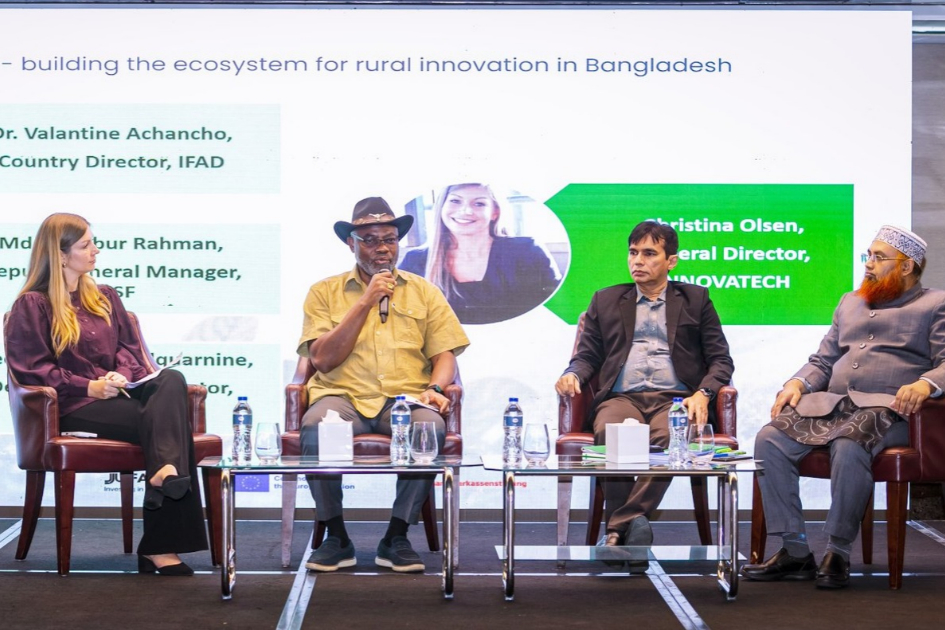
A panel discussion at the event highlighted challenges involved in moving digital solutions from pilot projects to wider use. Participants said technology alone was rarely the main constraint, pointing instead to demand from rural communities, institutions willing to adopt the solutions, viable business models, access to markets and a clear pathway for financing and ownership once project support ends.
The discussions also stressed the need for the private sector to be engaged as a full partner.
Bangladesh is part of Innovatech 2.0, which between 2024 and 2026 gave more than 32,000 rural households in Bangladesh, Bolivia, El Salvador, Guatemala, Honduras and Peru access to digital solutions developed by 15 tech startups.
The solutions helped participating households connect to markets and financial services, manage their crops, strengthen traceability and adopt more sustainable practices.
The programme connected the companies with 811 rural organizations, with nearly 17,000 women and more than 11,300 young people taking part. Two out of every three participating producer organizations adopted agroecological practices.
Across both editions, Innovatech has supported around 30 startups whose solutions have benefited more than 50,000 rural households.