

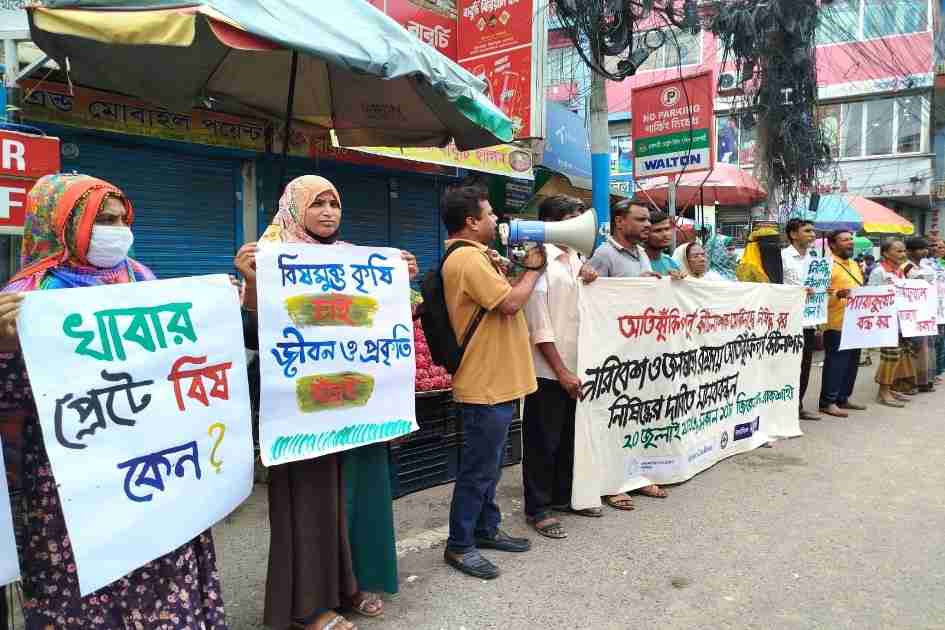



Rajshahi campaigners linked pesticide residues to declining fish, pollinators and soil health, urging agroecology, stronger residue testing and farmer support for safer alternatives.
Environmental activists, farmers and civil society representatives in northwestern Bangladesh on Monday demanded a phased ban on highly hazardous pesticides, including paraquat, saying the chemicals pose serious risks to public health, biodiversity and the country’s safe food system.
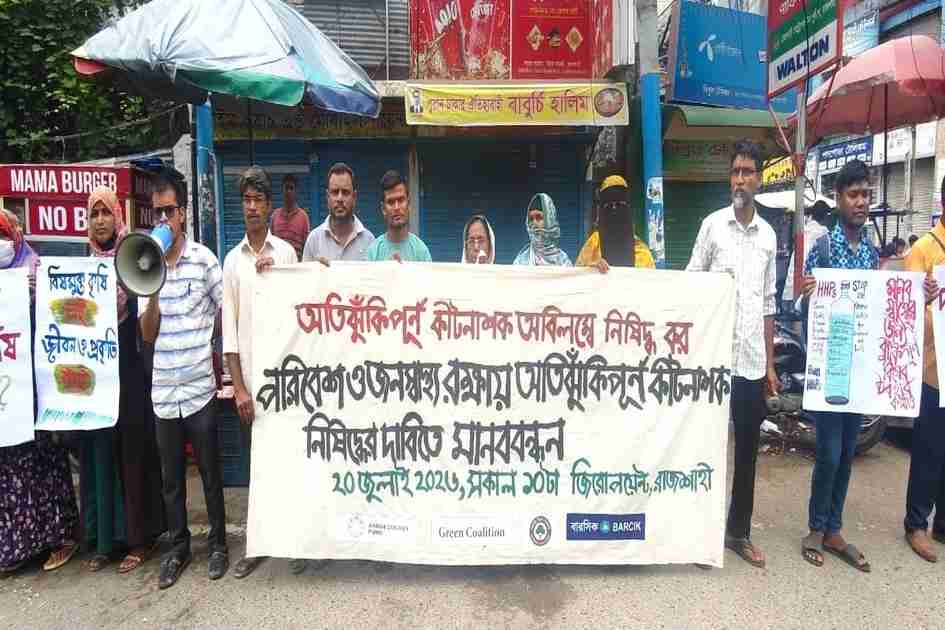
The demand was made at a human chain held at 10:00 am at Shaheb Bazar Zero Point in Rajshahi, a major city in northwestern Bangladesh, jointly organised by development research organisation BARCIK, Barendra Youth Forum and Green Coalition.
Farmers, women farmers, environmental activists, youth representatives, researchers, members of civil society and representatives of different social and cultural organisations joined the protest.
The event was chaired by Rahima Begum, president of Green Coalition’s Paba upazila unit, and moderated by Md Atikur Rahman, president of Barendra Youth Forum.
Speakers said that various chemical pesticides used for years in the name of increasing food production were harming not only pests, but also people, bees, fish, birds, soil, water and the broader ecosystem.
They said pesticides identified as Highly Hazardous Pesticides, or HHPs, by the World Health Organization and the United Nations Food and Agriculture Organization were causing serious crises including cancer, hormonal disorders, reproductive health risks, damage to the nervous system and environmental pollution.
The speakers cited a 2025 study by PAN Asia Pacific, which found that among 96 types of pesticides used in four Asian countries, including Bangladesh, 53 were identified as highly hazardous pesticides.
They said the impact of these chemicals was not confined to farmers’ fields. Through toxic residues in food, water pollution, declining soil fertility, the death of pollinators and damage to aquatic biodiversity, they had become a threat to society as a whole and to future generations.
Drawing on international experience, the speakers said many countries had made significant progress in controlling highly hazardous pesticides and expanding alternative farming methods.
They said Bangladesh, as a member of the Rotterdam Convention and the Stockholm Convention, was obliged to play a responsible role in implementing its international commitments.
“Earlier, whenever we cast nets in canals and wetlands, different kinds of local fish would be caught,” said Abu Sama, general secretary of the Naohata Fishermen’s Association.
“Now poisonous water from farmland kills fish fry, and fish have also declined. As there are no fish, our income has fallen, and we are having to choose other occupations. So these toxic pesticides must be stopped,” he said.
Upen Robidas, president of the Adivasi Youth Council, said the food culture of indigenous communities depended on biodiversity in forests, land and wetlands.
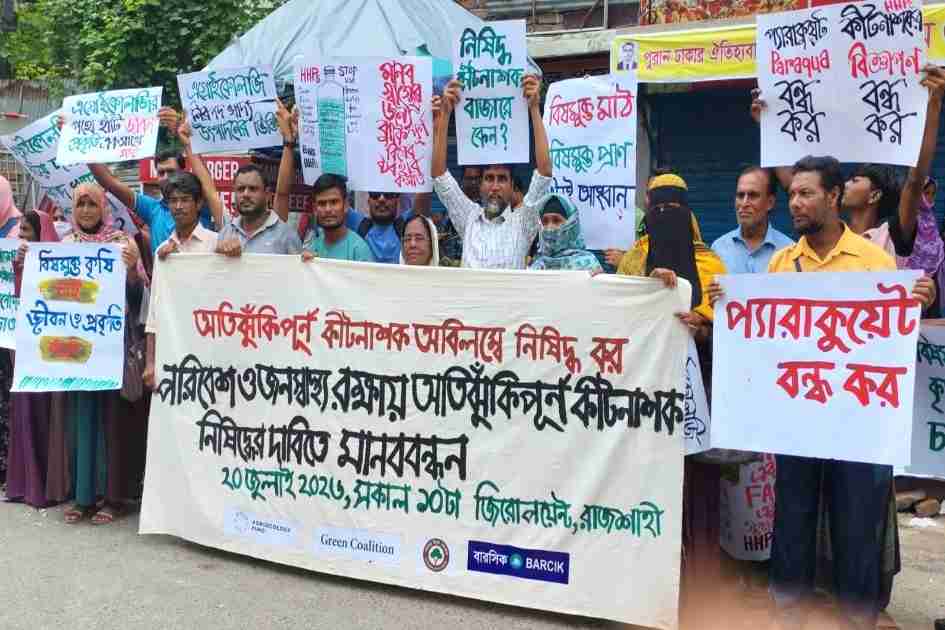
“But excessive pesticide use is rapidly wiping out wild leafy vegetables, medicinal plants, local fish, snails, crabs and other natural foods,” he said.
“This is seriously damaging our food diversity, nutrition and cultural heritage. Therefore, we demand a ban on highly hazardous pesticides and national priority for agroecology-based farming,” he added.
Md Atikur Rahman, president of Barendra Youth Forum, said decisions must be taken immediately to stop the use of risky and highly hazardous pesticides to secure the future.
“Agriculture dependent on pesticides and chemicals can never be sustainable,” he said.
“We want a farming system where safe food, biodiversity conservation and climate justice are ensured together. Agroecology is the most effective path for that transformation,” he added.
Shahidul Islam, an anthropologist and researcher at BARCIK, said scientific links had been established between the pesticides identified as Highly Hazardous Pesticides by the WHO and FAO and cancer, damage to the nervous system, hormonal disorders and the destruction of biodiversity.
“Many countries in the world have made significant progress in controlling highly hazardous pesticides and expanding alternative farming methods,” he said.
“In Bangladesh too, the scientific reassessment and phased banning of highly hazardous pesticides according to international standards is now a demand of the time,” he added.
Islam said banning highly hazardous pesticides did not mean weakening agriculture.
“Rather, it means making agriculture more sustainable, profitable and environment-friendly,” he said.
“Agroecology, integrated pest management, biological pest control, local seed conservation and agroecology-based farming practices can be the foundation of safe food and a climate-resilient agricultural system,” he added.
Md Mizanur Rahman, a farmer and general secretary of Green Coalition’s Paba upazila unit, said farmers wanted to produce safe food, but often had to depend on chemical pesticides because of the lack of easily available alternative technology, training and market support.
“If the government provides support for agroecology, IPM and biological pest management, we can move further towards producing poison-free food,” he said.
Sultana Khatun, a farmer practising agroecology and operator of an Agroecology Learning Center, said agroecology was not only a farming method, but also a philosophy that built a fair relationship between nature, farmers and consumers.
“Production is possible through local seeds, organic fertilisers, biodiversity and biological pest management,” she said.
“We have proved this in the field. So now is the right time to move away from highly hazardous pesticides and adopt a national agroecology transformation programme,” she added.
From the human chain, Rahima Begum presented a 15-point set of demands.
The key demands included scientific reassessment of all pesticides used in Bangladesh, a phased ban on HHPs according to WHO-FAO standards, strengthening the national programme for testing pesticide residues in food, nationwide expansion of agroecology through the agricultural extension system, subsidies and training for farmers on safe alternative technologies, conservation of bees and pollinators, introduction of a national poisoning surveillance system and adoption of a “national agroecology transformation programme”.
The speakers said the demand to ban highly hazardous pesticides was not the demand of any single organisation, but a demand for public health, safe food, the environment, biodiversity, farmers’ rights and the security of future generations.
They said Bangladesh could build a safe, productive and climate-resilient food system through a scientific, participatory and justice-based agricultural transformation.




