

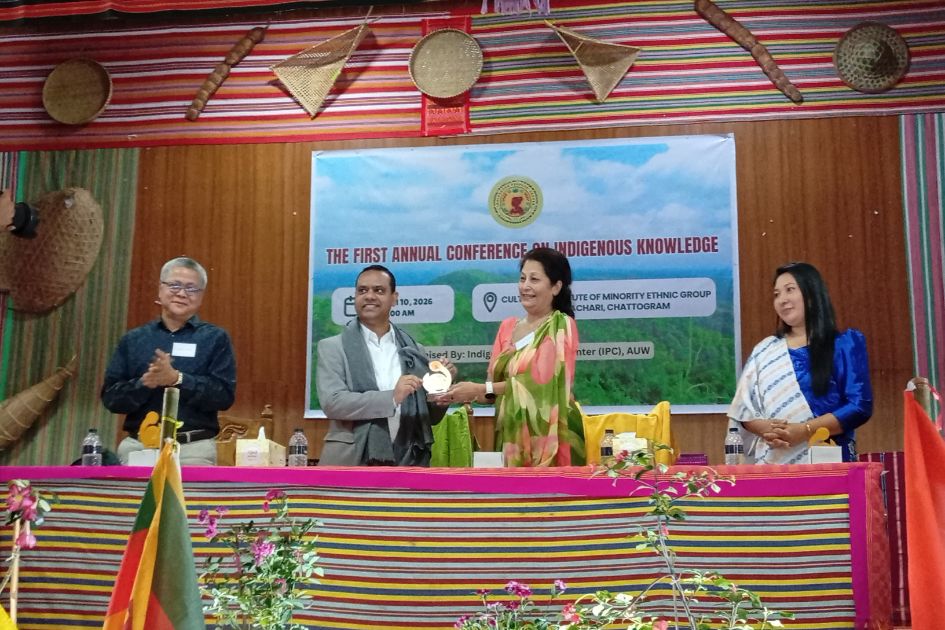



Scholars and indigenous leaders gathered in Khagrachari to address the rapid loss of cultural knowledge, calling for urgent action to preserve languages, traditions and community-led practices.
Academics, researchers and indigenous community leaders gathered in the hill district of Khagrachari, a hill district in southeastern Bangladesh, on Friday for a major conference focused on preserving rapidly disappearing cultural knowledge, languages and traditional practices.
Organised by the Indigenous Peoples’ Center (IPC) of Asian University for Women, the day-long Conference on Indigenous Knowledge took place at the Cultural Institute of Minority Ethnic Groups, bringing together participants from Bangladesh, Nepal, Bhutan, Sri Lanka and northeast India.
The event opened with a traditional Krawi Mro musical performance using the plung, setting a tone that emphasised living traditions rather than archival preservation. Prof. Sangita Rayamajhi, director of IPC and convenor of the conference, said the aim was to connect community-held knowledge with academic research before it disappears.
“Many traditions are fading with time. The younger generation must learn them and NGOs must take action urgently before they are lost forever,” said Rani Ukhengching Marma of the Mong Circle and co-director of IPC.
Plenary speaker Priyatar Chakma, district programme implementation analyst at the United Nations Development Programme in Khagrachari, shared a personal account from the 1990s, recalling how indigenous women often gave birth alone without medical support due to isolation. He said the loss of traditional knowledge is not only cultural but can also have life-threatening consequences.
Chief guest Md. Anwar Sadat, deputy commissioner and district magistrate of Khagrachari, expressed support for the conference and indicated engagement from district authorities on indigenous issues.
The conference featured three thematic sessions covering culture, gender and the environment.
The morning session on culture, art and literature presented nine papers, including discussions on Fourth Cinema as a platform for indigenous voices in Bangladesh, efforts by the Marma diaspora to strengthen written traditions for language preservation and research on Jhum cultivation, seed preservation and natural resource management in the Chittagong Hill Tracts. A short film on the Garia Dance of the Tripura community and a study of Magar folk dances in western Nepal added a cultural dimension, while the session concluded with a live Marma dance performance.
A notable presentation examined the lived experiences of indigenous transgender, intersex and gender-diverse individuals in the Chittagong Hill Tracts, a topic rarely explored in both indigenous and gender studies in Bangladesh.
The afternoon session focused on women, health and the environment. Papers highlighted the impact of climate stress on food supply chains in Rangamati, disparities in child healthcare-seeking behaviour between Chakma and Bengali communities in Khagrachari and the influence of water access on women’s health in the region. Another study argued for biodiversity restoration through traditional laws and stronger participation of indigenous women, positioning them as key environmental stewards.
“Digital tools and community-based documentation offer a real path to language survival, but only if communities lead the process themselves,” said Hla Thoaiching Marma, referring to the Krishti Initiative for indigenous language revival.
The final session addressed environmental issues, including multilingual education challenges in the Chittagong Hill Tracts, eco-friendly practices of the Khani tribes of Tamil Nadu and socio-cultural transformations among indigenous communities in Sri Lanka.
Organisers said the conference would continue into a second day with a field visit to a community forest for a palm plantation session supported by the Green Bangle Project, followed by a trip to the Alutila Tourist Cave Park. Activities were coordinated by IPC coordinator Mipru Marma.
The IPC at Asian University for Women works to document and promote indigenous cultures, languages and knowledge systems across Asia, with a particular focus on communities in Bangladesh’s Chittagong Hill Tracts.




