

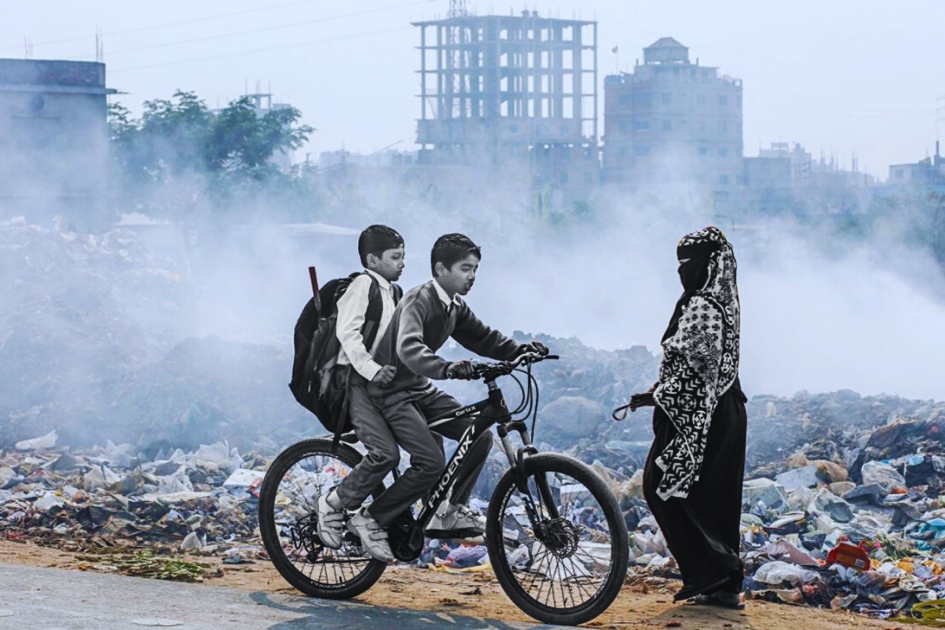

World Bank warns toxic air across South Asia kills nearly a million people yearly, drains economies and hits Bangladesh hardest, urging urgent regional cooperation and a transition to clean energy.
Air pollution across South Asia’s Indo-Gangetic Plain and Himalayan Foothills has become a major development emergency, exposing nearly one billion people to unhealthy air and causing about one million premature deaths every year, according to the World Bank.
Bangladesh is among the worst-affected countries, with air quality in Dhaka and other major cities reaching hazardous levels during the winter months.
The World Bank estimates that air pollution is costing South Asia nearly 10 percent of its annual gross domestic product through healthcare expenses, lost working hours and reduced labour productivity. The damage threatens long-term economic growth and human capital development.
The findings are detailed in the World Bank report Breathing Change: Solutions for Clean Air in the Indo-Gangetic Plain and Himalayan Foothills, which identifies parts of Bangladesh, Bhutan, India, Nepal and Pakistan as the main pollution hotspots in the region.
The World Bank said coordinated action across South Asia could significantly reduce pollution, protect public health and secure cleaner air for future generations. Experts and activists also stressed the need for a just transition from fossil fuels to renewable energy and stronger regional cooperation.
In Bangladesh, major pollution sources include the use of solid fuels for cooking and heating, emissions from brick kilns and factories without proper filters, old and unfit vehicles, construction dust, crop residue burning, poor fertilizer management and open waste burning.
Dhaka’s air quality deteriorates sharply in winter, exposing low-income communities, outdoor workers and children to dangerous levels of fine particulate matter such as PM2.5.
Large infrastructure projects, including metro rail lines and elevated expressways, have intensified dust pollution in the capital. At the same time, most brick kilns continue to operate using coal and wood, releasing toxic smoke into the air.
Weak enforcement has allowed many unfit vehicles to remain on the roads, while open waste burning continues in many neighbourhoods, adding to the pollution burden.
Pollution levels improve during the monsoon but surge again in January and February due to transboundary air movement from northern India. This polluted air combines with domestic emissions and worsens conditions in Bangladesh.
World Bank Senior Environmental Economist Martin Heger said the crisis can still be addressed if action is taken now. “The solutions are within reach and based on solid evidence,” he said. “What is needed is coordinated and sustained action across sectors.”
Anne-Janet Gloable, the World Bank’s South Asia Environment Practice Manager, said clean air requires cooperation at all levels. “No single country can solve this problem alone,” she said. “Strong financing, effective policies and regional collaboration are essential.”
Bangladesh Meteorological Department meteorologist Dr Abul Kalam Mallik said cross-border pollution plays a major role during winter. “Polluted air from Delhi and nearby Indian states enters Bangladesh through high-pressure systems,” he said. “These air masses carry PM10 and PM2.5 particles that significantly worsen air quality.”
Dhaka University chemistry professor Abdus Salam said the Indo-Gangetic region is among the most polluted areas in the world. “Coal-based power plants, rapid urbanization and growing fossil fuel use are driving this crisis,” he said. “Air pollution crosses borders, making regional cooperation unavoidable.”
Sohanur Rahman, Executive Coordinator of YouthNet Global, said air pollution has become a justice issue, not just an environmental one. “Children, the urban poor and outdoor workers are paying the highest price for policies that fail to protect clean air,” he said. “For inclusive and sustainable development, clean air must be treated as a basic right and the shift to renewable energy must be fast, fair and people-centred.”




