

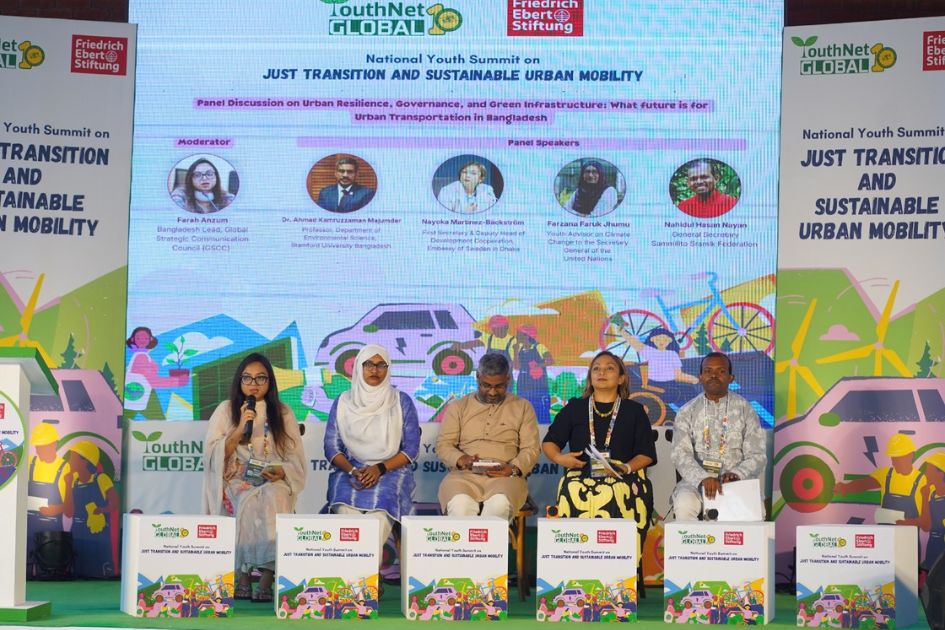



Experts, youth leaders and labour representatives urged stronger governance, cleaner transport, worker protection and inclusive policymaking to ensure Bangladesh’s transition towards sustainable, climate-resilient urban mobility leaves no one behind.
Experts, youth representatives and labour leaders have called for urgent reforms in Bangladesh’s urban transport sector, warning that weak enforcement, outdated infrastructure, pollution and limited participation of workers and vulnerable communities are slowing progress toward safe, clean and inclusive mobility systems.
The concerns were raised during the panel discussion titled “Urban Resilience, Governance and Green Infrastructure” at the National Youth Summit on Just Transition and Sustainable Urban Mobility in Bangladesh, organized by YouthNet Global in partnership with Friedrich-Ebert-Stiftung (FES) Bangladesh at Aloki Convention Centre in Dhaka.
The panel brought together experts, youth leaders and labour representatives to discuss public transport reform, environmental governance, green infrastructure, worker protection and the need for inclusive decision-making in Bangladesh’s transport transition.
Nayoka Martinez-Bäckström, First Secretary and Deputy Head of Development Cooperation at the Embassy of Sweden, called for a fundamental rethink of Bangladesh’s urban mobility approach, drawing lessons from South American cities while emphasizing the importance of adapting solutions to local realities.
“Bangladesh should rationalize the use of EV buses, improve footpaths and promote bicycling as part of green and resilient urban mobility,” she said.
She warned that infrastructure expansion alone cannot solve Dhaka’s congestion crisis and stressed the need for integrated transport planning that prioritizes public transport, walking and cycling.
“While cars may move on flyovers, the areas beneath them often remain highly congested,” she said, adding that many buses in Dhaka are 20 to 25 years old and require urgent replacement.
Highlighting the importance of equity and safety, Martinez-Bäckström stressed that future transport systems must place vulnerable road users at the centre of planning.
“The safety of women, children, pedestrians and older people must be central to future transport planning,” she said, pointing to the everyday challenges faced by commuters in overcrowded and unsafe transport systems.
Transport policy expert Dr. Ahmad Kamruzzaman Majumder, Professor of Environmental Science at Stamford University Bangladesh, highlighted the environmental challenges created by weak regulatory enforcement and continued dependence on fossil fuels in urban transport.
“We are creating opportunities for polluters to pollute our urban environment comfortably,” he said, calling for stronger fuel standards, improved environmental governance and the introduction of low-sulphur fuel in the transport sector.
He emphasized that a cleaner transport future requires both technological transformation and stronger accountability mechanisms to reduce pollution and protect public health.
Youth and climate advocate Farzana Faruk Jhumu, a member of the UN Secretary-General’s Youth Advisory Group on Climate Change, highlighted the importance of meaningful youth participation in transport policymaking.
Criticizing recent increases in bicycle prices, she said such decisions could discourage environmentally friendly transport options.
“I feel saddened to see that the price of the bicycle, one of the most environmentally friendly vehicles, has increased in the budget,” she said.
She stressed that young people must be involved from the beginning of policy development rather than being consulted after decisions have already been made.
“Youth engagement in policymaking is often very limited. In many cases, young people are invited only after the policy preparation process has already been completed,” she said.
Trade union representative Nahidul Hasan Nayon highlighted the challenges faced by transport workers, including the absence of reliable data, insufficient labour protections and limited consultation during major sectoral changes.
“We do not even have a proper socio-demographic database of transport workers,” he said, calling for comprehensive data collection, improved skills development and stronger labour rights.
He criticized the lack of consultation with workers during transport reforms.
“We are never properly informed about government decisions regarding the transportation sector,” he said, adding that workers must be considered partners in the transition rather than obstacles to change.
Referring to the Dhaka-Gazipur transport project, Nayon called for stronger stakeholder engagement, better skills development opportunities and improved job security measures for transport workers.
He also supported fiscal decentralization, stating that “regional budgeting systems should be introduced so local people can share their needs and priorities,” ensuring more inclusive planning.
The panel discussion was part of the broader National Youth Summit on Just Transition and Sustainable Urban Mobility, which brought together policymakers, diplomats, academics, youth leaders, development partners and workers to explore pathways for a fair and climate-resilient transport transition.
The summit was inaugurated by Mohammad Navid Safiullah, Additional Secretary of the Climate Change Wing of the Ministry of Environment, Forest and Climate Change. Opening the event, Dr. Felix Gerdes, Resident Representative of Friedrich-Ebert-Stiftung (FES) Bangladesh, emphasized the importance of inclusive dialogue and multi-stakeholder cooperation in addressing climate and urban mobility challenges.
Setting the context, Sohanur Rahman, Executive Coordinator of YouthNet Global, stressed that young people must be meaningfully involved in shaping climate and transport policies.
Delivering the keynote address, Dr. Md. Hafizur Rahman, Professor and Head of the Department of Environmental Science at Independent University, Bangladesh, highlighted the role of youth leadership in building a low-carbon, equitable and climate-resilient transport system.
The concluding session featured European Union Ambassador to Bangladesh Michael Miller, who congratulated YouthNet Global on its 10-year journey and highlighted the importance of youth-led climate action, sustainable infrastructure and inclusive policymaking. He emphasized that future transport systems must be safe, accessible, affordable, smart, resilient and low-emission while protecting workers and vulnerable communities.
Special guest Jannis Hussain, Deputy Head of Cooperation at the German Embassy in Dhaka, highlighted Germany’s partnership with Bangladesh in advancing climate action, sustainable development and just transition pathways.
Priyo Pranto, Project Officer for Just Transitions at the International Labour Organization (ILO) Bangladesh, highlighted Bangladesh’s leadership in including just transition as a dedicated chapter in its NDC, making it the first country in Asia to incorporate such a framework. He emphasized the importance of safe battery recycling systems, tackling lead pollution and addressing e-waste challenges as part of the green transition.
The summit featured several interactive activities designed to move beyond discussion and encourage collective action. Participants visited exhibition stalls showcasing youth-led green transport innovations and cultural exhibits representing Bangladesh’s eight divisions, highlighting local perspectives on sustainability, mobility and climate resilience.
A Green City Lab, facilitated by Amir Hamza Xihad, founder of MakaTeam, engaged participants through a gamified learning session where young people explored innovative approaches to sustainable transportation and greener cities.
The Youth Policy Lab, facilitated by Aruba Faruque, Deputy Executive Coordinator of YouthNet Global, brought together youth leaders, transport workers and stakeholders to co-create policy recommendations on sustainable urban mobility, workers’ rights and climate justice. The recommendations were presented during the summit’s concluding session.
The summit concluded with a shared recognition that Bangladesh’s transport transition must go beyond reducing emissions. Participants emphasized that future mobility systems must create safer streets, protect workers’ livelihoods, reduce pollution and ensure meaningful participation of youth and vulnerable communities in shaping the future of Bangladesh’s cities.




