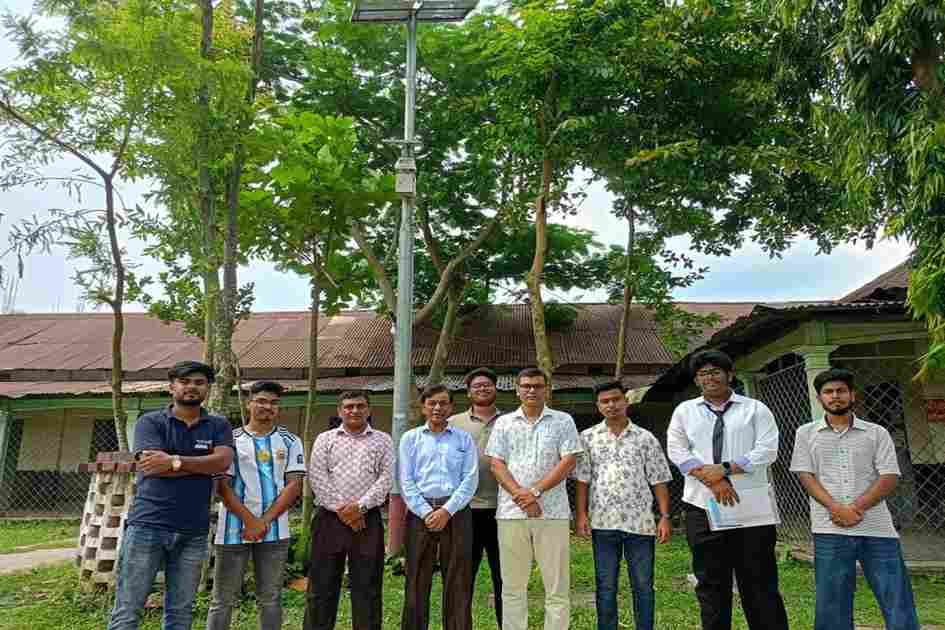



The initiative links campus-based monitoring with student training and research, aiming to strengthen local pollution data, environmental awareness and planning through a wider clean air network.
An air quality monitoring machine has been installed and made operational at Gaibandha Government College in northern Bangladesh under a Memorandum of Understanding between the Center for Atmospheric Pollution Studies and the National University, officials said.
The device will allow regular monitoring of air quality and data collection across Gaibandha district, according to the statement.
The data will be used to analyse air pollution levels, support research, assess environmental risks and contribute to evidence-based policymaking at local and national levels. It will also provide technical infrastructure for students, teachers and researchers involved in environmental research and education.
As part of the initiative, the Inter-University Clean Air Network has been established to connect educational institutions across Bangladesh through a unified platform and expand coordinated air quality monitoring nationwide.
Through the network, students will receive hands-on training in operating monitoring equipment, collecting and analysing data and applying environmental research methodologies, laying the groundwork for a broader national air monitoring network.
Professor Dr Ahmad Kamruzzaman Majumder, chairman of the Center for Atmospheric Pollution Studies, said clean air was essential for sustainable development.
“Ensuring clean air is one of the essential preconditions for sustainable development. Air pollution has emerged as a serious challenge for public health, the environment, and the economy. In this context, expanding air quality monitoring systems in the country’s educational institutions and involving students in research-based activities is the need of the hour,” he said.
Ms. Marziat Rahman, lead researcher at the Center for Atmospheric Pollution Studies, said the installation would allow reliable and continuous data collection on air quality in Gaibandha district.
“This data will make an important contribution to research, raising public awareness, and effective environmental management and policymaking. In addition, through the Inter University Clean Air Network, opportunities for student training will be created, enabling them to become directly involved in hands-on air quality monitoring and research work,” she said.
“We hope this initiative will inspire the expansion of air quality monitoring networks in other educational institutions across the country as well,” she added.
Professor Md Abdur Rashid, principal of Gaibandha Government College, said the commissioning of the machine was a significant step for the institution.
“The installation and commissioning of the air quality monitoring machine at Gaibandha Government College is a highly significant initiative. For this, I extend my heartfelt thanks to the Center for Atmospheric Pollution Studies (CAPS), the National University, and everyone involved. We believe that the data obtained through this device will play an important role in research on air pollution, raising environmental awareness, and effective planning,” he said.
Mohammad Mejbahul Haque, a fourth-year Honours student in the Department of Economics at Gaibandha Government College, welcomed the initiative.
“I extend my heartfelt gratitude to the concerned authorities and everyone involved in this timely initiative to install an ‘Air Quality Monitoring Device’ at the college. This device will make it much easier to regularly monitor air quality, collect environmental data, and use that data for research, raising public awareness, and formulating effective environmental plans,” he said.
“I believe this initiative will play a major role in building a healthy, clean, and sustainable environment in Gaibandha and its surrounding areas, and will stand as an exemplary model for environmental conservation,” he added.