

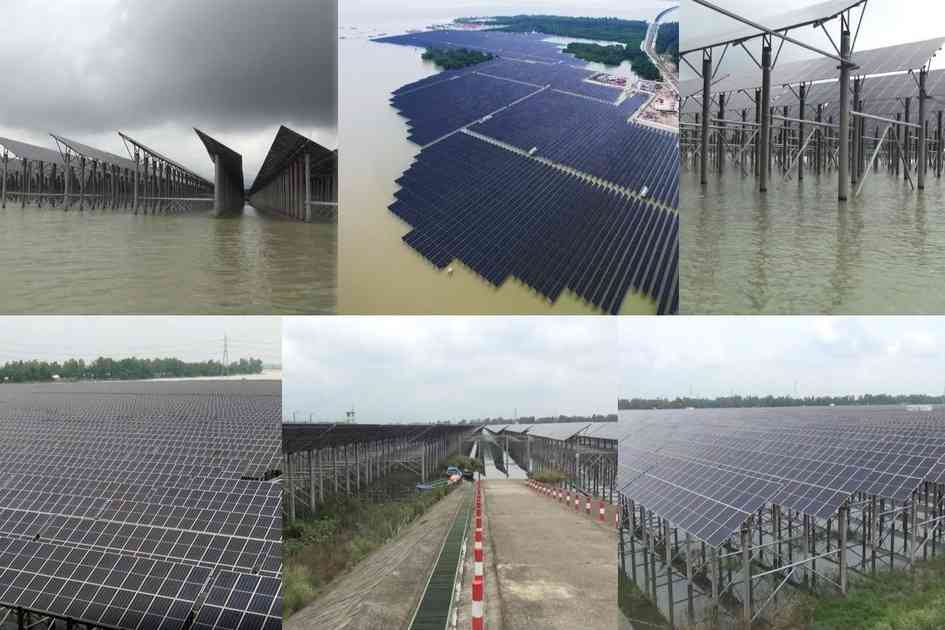



Built on leased Jamuna Bridge Authority land, the Sirajganj project combines grid-scale solar generation with expansion plans, agrivoltaics and livelihood activities as officials seek to cut fossil fuel dependence.
Solar facility on the Jamuna floodplains generates over 213,000MWh of clean electricity as Bangladesh expands efforts to reduce fossil fuel dependence.
A solar power project built on the floodplains of Bangladesh’s Jamuna River is emerging as a symbol of the country’s transition towards renewable energy, generating more than 213,000 megawatt-hours of clean electricity within its first two years of operation.
Located on the western bank of the Jamuna River, the Sirajganj 68MW Solar Park has transformed previously unused land into a major renewable energy facility, adding clean power to Bangladesh’s national grid while helping reduce carbon emissions.
During the monsoon season, when the surrounding floodplain fills with water from the overflowing Jamuna, the rows of solar panels create a striking landscape, highlighting how unused riverine land can be repurposed for sustainable development.
For Bangladesh, one of the world’s most climate-vulnerable countries, expanding renewable energy is becoming both an economic necessity and a climate response. The country is seeking alternatives to imported fossil fuels amid global energy price volatility while working to reduce greenhouse gas emissions.
The Sirajganj solar project has already become a milestone in Bangladesh’s renewable energy journey. Since beginning commercial operation on 14 July 2024, the facility has supplied clean electricity to the national grid without relying on conventional fuels.
The project was developed on 214 acres of unused land leased from the Jamuna Bridge Authority by the Bangladesh China Renewable Energy Company Limited (BCRECL), a joint venture between Bangladesh’s state-owned North West Power Generation Company Limited (NWPGCL) and China’s China National Machinery Import and Export Corporation (CMC).
Although the facility has an installed capacity of 75 megawatts, it supplies 68MW of electricity to the national grid under an agreement with the Bangladesh Power Development Board, the state agency responsible for power development and distribution. The project has achieved a plant factor of around 16 to 22 percent, according to officials.
“Unlike fossil fuel-based power plants, our generation process does not require any fuel,” said Tanbir Rahman, project director of the Sirajganj Solar Park. “The global fuel crisis and environmental impacts associated with fossil fuels do not affect our operation. Every day, we generate electricity from sunlight.”
According to project officials, the solar park has generated 213,343 International Renewable Energy Certificates and helped reduce approximately 142,942 tonnes of carbon dioxide emissions.
Technology behind the clean energy facility
The solar park contains 156,576 monocrystalline bifacial photovoltaic modules, each with a capacity of 545 kilowatt peak. The total installed capacity is 85.33MW peak on the DC side and 75MW on the AC side.
The facility includes 72 inverters, 12 inverter stations and a 100MVA main transformer. Electricity generated from the panels is converted through inverter stations and transmitted through a 10.38-kilometre-long 132kV double-circuit transmission line before entering the national grid.
Project officials said solar power generation is more cost-effective than electricity produced from imported fuel-based power plants, while also avoiding the environmental impacts associated with fossil fuel use.
Expanding solar capacity along the Jamuna
The success of the Sirajganj solar park has encouraged plans for large-scale renewable energy expansion along the Jamuna River corridor.
Authorities are considering developing additional solar projects on nearly 900 acres of unused land, with a combined potential capacity of around 435MW.
“We have another 70 acres of unused land west of the existing solar park where a 35MW solar project is planned,” said Rahman. “There is also around 800 to 900 acres of land in the Crossbar 3 area where we are planning a solar park of nearly 400MW capacity.”
He added that BCRECL has set a long-term target of developing 3,000MW of renewable energy capacity through solar and other clean energy projects.
Renewable energy and a just transition
The expansion of renewable energy is not only about replacing fossil fuels but also about ensuring that communities, workers and vulnerable groups benefit from the transition.
Sohanur Rahman, executive coordinator of YouthNet Global, said a successful clean energy transition must be inclusive and community-centred.
“Renewable energy offers Bangladesh a historic opportunity to address climate change, strengthen energy security and create new economic opportunities. But the transition must be just, ensuring that local communities, young people and vulnerable groups are not left behind. A truly sustainable energy future must combine climate action with equity, decent livelihoods and meaningful participation of communities,” he said.
Beyond electricity generation, the solar park is also being used for experimental agricultural activities to explore the multiple use of land.
After the monsoon season, winter vegetables are cultivated beneath the solar panels, while sheep farming has also been introduced as part of efforts to combine renewable energy production with local livelihoods.
Such approaches reflect a growing global interest in integrating renewable energy infrastructure with agriculture, known as agrivoltaics.
Saidur Rahman Bacchu, president of the Sirajganj Chamber of Commerce and Industry, said the project has created new opportunities for the region.
“Sirajganj’s western Jamuna region has enormous potential for renewable energy. Expanding solar projects in this area can help reduce electricity shortages and strengthen Bangladesh’s energy security,” he said.
Energy experts say expanding solar capacity on unused land could help Bangladesh reduce its dependence on imported fossil fuels. However, they also point out that challenges such as grid integration, financing, land management and long-term investment remain important factors in scaling up renewable energy.
Supporting Bangladesh’s clean energy ambition
Bangladesh has announced ambitious plans to increase renewable energy capacity as part of its response to climate change and energy security challenges. The government has set a target of developing 10,000MW of solar power capacity by 2030.
The country’s renewable energy expansion also aligns with global efforts to accelerate clean energy transitions, particularly in climate-vulnerable nations that face rising risks from extreme weather events.
With abundant sunlight, unused riverine land and growing investment in renewable infrastructure, projects like the Sirajganj Solar Park demonstrate how Bangladesh is attempting to turn climate challenges into opportunities for sustainable development.
Standing beside the constantly changing Jamuna River, the solar park represents more than a power generation facility. It reflects Bangladesh’s ambition to build a cleaner, more resilient and energy-secure future.




