

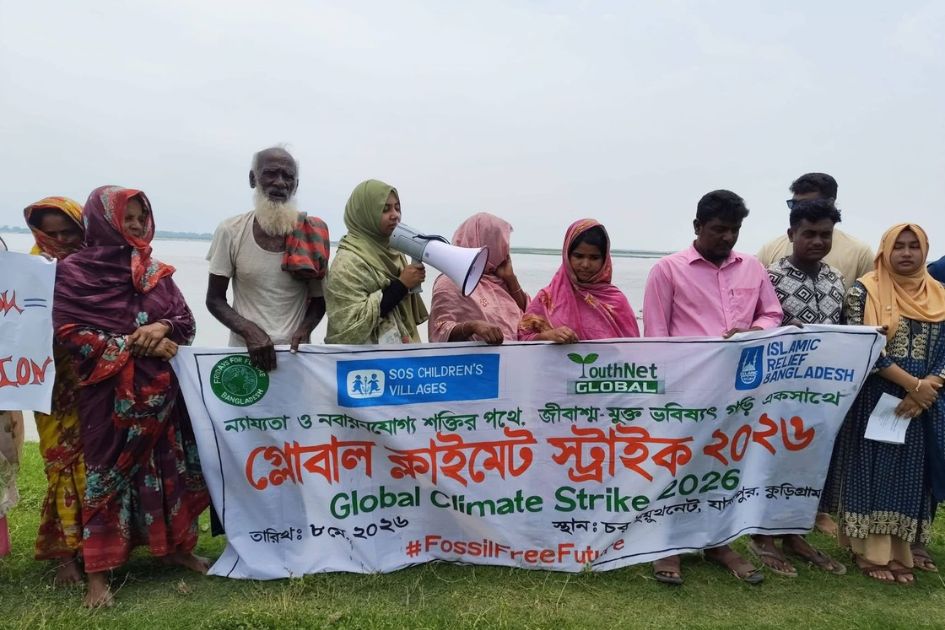



Young climate activists in Kurigram staged a strike demanding renewable energy and climate justice, highlighting the growing vulnerability of char communities facing erosion, floods and extreme weather linked to climate change.
Against the backdrop of the mighty Brahmaputra River and its erosion-ravaged riverbanks, young climate activists in northern Bangladesh staged a climate strike on Friday demanding an urgent transition from fossil fuels to renewable energy as climate impacts continue to intensify across vulnerable communities.
Holding banners and chanting slogans for climate justice, the activists gathered at Char YouthNet Village in Jatrapur Union of Kurigram district, a remote riverine settlement situated on a char, meaning a moving sandbar formed through river sedimentation and erosion. The programme was held under the theme, “Towards justice and renewable energy, let us build a fossil fuel-free future together.”
The programme was organised by YouthNet Global as part of a growing wave of youth-led climate mobilisation in Bangladesh calling for cleaner energy policies, climate justice and stronger action against global warming.
Speakers at the event said communities living in char areas and erosion-prone regions along the Brahmaputra are among the worst victims of climate change despite contributing the least to global carbon emissions.
“People in the char areas are constantly battling river erosion, floods and extreme weather,” said Sujan Mohanta, regional coordinator of YouthNet Global. “For vulnerable communities like ours, a transition to renewable energy is no longer just an environmental demand, it is a necessity for survival.”
The young activists urged governments and global leaders to rapidly reduce dependence on fossil fuels and accelerate investments in solar and other renewable energy sources.
They also criticised industrialised nations for their disproportionate contribution to global warming through decades of excessive greenhouse gas emissions, warning that delayed climate action could lead to devastating consequences worldwide.
Fahmida Islam, assistant programme officer at SOS Children’s Village Kurigram, said young people must become more organised and actively engaged in climate action to protect future generations.
“Protecting the future requires immediate and effective action on climate change,” she said.
Among those attending the programme were Sultana Raziya, field officer at Islamic Relief Bangladesh, YouthNet Global district coordinator Marzia Medha and youth activists Rakibul Islam, Nazmul Hossain, Rifat Russell, Jubayer, Bayezid, Sayma Sultana and Fahim.
Sohanur Rahman, executive coordinator of YouthNet Global, said the transition away from fossil fuels must be people-led and rooted in justice rather than driven by corporate interests.
“A just transition means leaving no one behind. Climate-vulnerable communities, especially people living in chars and frontline disaster zones, must be at the centre of decision-making,” he said.
“Renewable energy should serve people and the planet, not corporate capture and profit-driven exploitation,” he added.




