

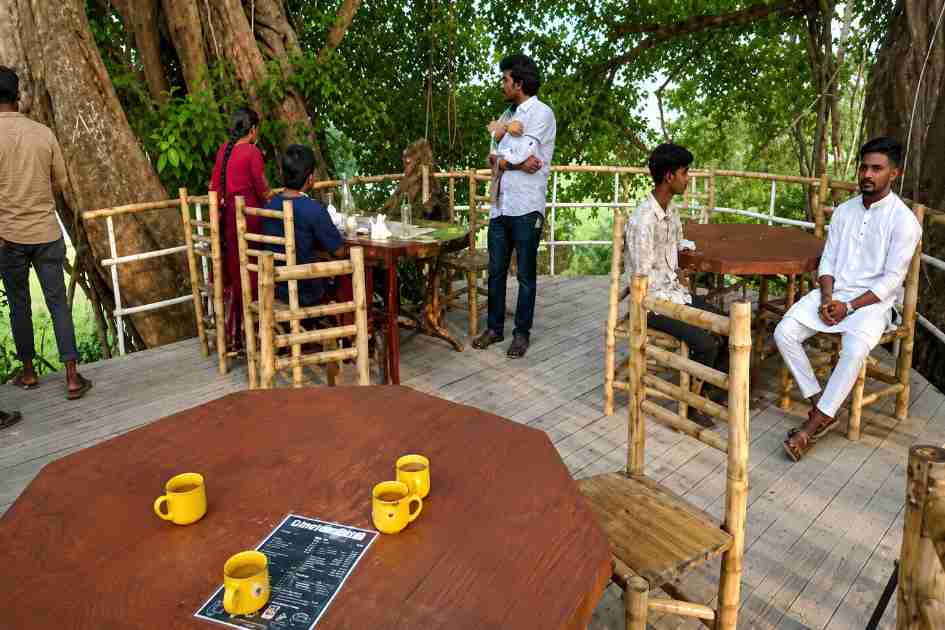



A restaurant built on a century-old banyan tree in Jhenaidah is attracting crowds, but residents and environmentalists warn the growing human activity is driving away birds and threatening the tree’s survival.
A restaurant built on the branches of a century-old banyan tree in southwestern Bangladesh is drawing crowds from far and wide, but residents and environmental activists say the growing human presence has driven away the birds that once filled the tree with constant chirping.
The restaurant, called Brikkho Bilash Cafe and Restaurant, stands beside a road in the Ghoradaha area of Charatola Bazar in Harinakundu upazila of Jhenaidah. The unusual eatery was set up by two local young men on the sprawling banyan tree beside Kapashhatia Baor, long known to locals as a shady spot and a habitat for birds.
Residents said large numbers of visitors are now coming there every day with family members from distant places. Some come to eat while others come simply to see the restaurant. Visitors are moving from branch to branch and eating while seated on the tree itself.
Entrepreneurs behind the venture insisted they were not doing anything that would harm the tree or the environment. But leaders of environmental organisations said turning the century-old banyan into a restaurant was effectively arranging its death.
The restaurant is located about 13 kilometres from Jhenaidah town, just beside Charatola Bazar on the Jhenaidah-Harinakundu road. It can also be reached easily through the Katlamari-Charatola road via Holidhani Bazar.
A visit to the site showed the upper part of the tree still covered in green leaves, with branches of different sizes stretching around it. Beneath the canopy, about 25 feet above the ground, the branches have been joined together with bamboo and wood to create the restaurant structure. Abandoned nests of mynas and other birds are still hanging from the branches. Fast food items are being prepared underneath the tree.
Visitors have to climb a staircase attached to the trunk to reach the restaurant. Upstairs, chairs and tables have been arranged for customers. Five or six college-going teenagers were seen sitting on the tree and enjoying themselves. But the sound of birds chirping was absent.
A student of Jhenaidah Government KC College said that he said the place felt attractive, but a restaurant on the tree would damage it and obstruct its natural growth. He added that the tree provides shade and shelters many species of birds, but building what was effectively a hotel there would disrupt that natural balance.
Not everyone shared that concern. Mahima, a resident of Chaklapara in Jhenaidah town, said she was delighted after visiting the restaurant. “I never imagined something like this would be built in our area. Now many people are coming and the area is becoming known,” she told .
Mizanur Rahman, district convener of the Forest and Biodiversity Conservation Committee, said building a restaurant on the century-old banyan was wrong in every way. He said the tree would slowly move toward death because of the constant flow of people for food, litter being thrown beneath it, cooking activities below, pruning of branches to make the place more usable and the tying of bamboo and wood to the branches in ways that would stop the tree from growing freely. He said the birds that once lived there would also be forced to leave because of the human activity.
One of the restaurant’s entrepreneurs, Abir Hasan, said he used to work at a clothing shop in Dakbangla Bazar in Jhenaidah after passing his higher secondary examinations. He said he later built the restaurant based on an idea of his own. He chose the century-old banyan tree standing on one edge of land owned by Abdar Molla in Ghoradaha village and started work there.
Claiming they were not doing anything that would harm the tree, Hasan said the place had previously been unclean and they had cleaned it up before starting the restaurant. He said three rooms had also been built below for customers to sit and eat, while one seating area had been made on the tree branches. Some visitors were eating there while others were going up to look around and then coming down to eat.
Abdul Hakim, the elected member of Ward No. 9 under the local Kapashhatia union council, said the restaurant had been built before Eid al-Fitr and was still operating. Asked whether the tree was being damaged, he said they had not noticed any harm for now.
Jhenaidah Forest Department acting officer Zakir Hossain, however, said it should never have been allowed. He said the tree would suffer serious damage. He added that they had never before heard of or seen a restaurant on a tree and that for this reason there was no scope under forest laws to take action against those responsible. He said he would inform district administration officials about the matter.
Muntasir Rahman, assistant director of the Department of Environment in Jhenaidah, said a tree was not a place for entertainment. He said the tree provides oxygen, gives birds a nesting place and offers timber benefits to people, and those benefits would be lost.
Rathindra Nath Roy, deputy director of the local government division at the Jhenaidah district administration, said authorities would examine whether the tree stood on privately owned land or on government land.




