

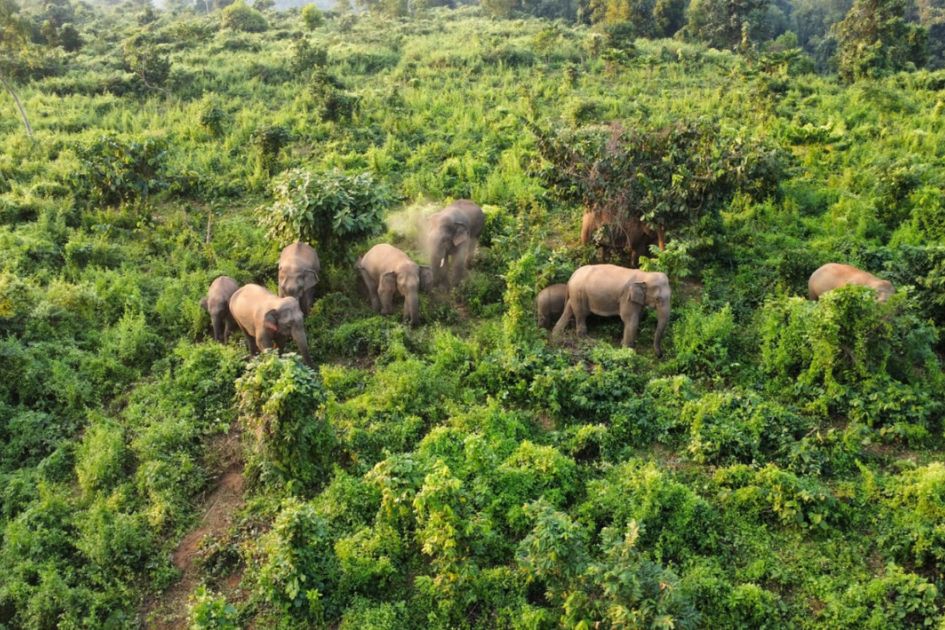



New conservation measures in Sherpur have reduced human-elephant conflict, but farmers seek faster compensation while experts stress habitat restoration and coordinated long-term action to secure peaceful coexistence.
Women hurried through hillside paddy fields in Bangladesh’s Sherpur border villages last Tuesday, cutting rice as quickly as possible while children watched from nearby embankments.
“The herd of elephants is in the hills. We are harvesting now before they come over,” said Rajib Koch of Gajni upazila.
For decades, such scenes have reflected a constant struggle for farming communities living along the Garo Hills, where wild elephant herds regularly descend from forests to raid crops and destroy fields cultivated through months of labour and borrowed money.
Farmers once relied on electrified fencing, torches, firecrackers and sticks to drive away the animals, measures that at times resulted in elephants being injured or killed.
A series of conservation measures introduced during Bangladesh’s interim government has since reduced clashes between humans and elephants in the border region, though officials and conservationists say permanent coexistence will require long-term habitat restoration and stronger coordination.
Under projects funded by the Bangladesh Climate Change Trust Fund and a dedicated elephant conservation programme, authorities introduced compensation allowances for crop losses caused by elephants.
Elephant Response Teams (ERTs) were trained and deployed to intercept herds before they entered populated areas, while awareness campaigns promoting coexistence were carried out across affected communities.
Forest officials also planted shrub species favoured by elephants within forest areas in an effort to keep the animals inside the tree line.
Syeda Rizwana Hasan, who served as adviser to the Ministry of Environment, Forest and Climate Change under the interim government, said authorities also pursued legal action against people involved in harming elephants.
“During our tenure, legal action was taken against several individuals and some were imprisoned,” said Rizwana, who is also chief executive of the Bangladesh Environmental Lawyers Association (BELA). The cases involved harassment, injury and killing of elephants.
She said the interim government had also begun building support for a multi-ministry response involving agriculture, forestry and district administrations to address what she described as a deeper habitat crisis.
Kazi Muhammad Nurul Karim, divisional forest officer of the Mymensingh Forest Division, said the current government has continued all of the measures introduced during the interim administration.
“All the initiatives undertaken during the interim government’s tenure remain in operation,” he said. “ERT training continues. Community awareness work continues. The compensation mechanism remains in place.”
Despite the initiatives, many farmers say the compensation system remains inadequate.
Mejes Sangma, a Garo farmer from Andharupara village, spends nights in a watchtower beside his field with tin sheets, torches and a shrinking supply of kerosene to ward off elephants.
“Although the Forest Department provides compensation for damaged crops, not everyone receives it,” he said.
Halim Uddin from Daodhara said the payments were both insufficient and delayed.
“The government compensation does not even cover a quarter of the damage. Occasionally, some farmers receive it, but that too comes after a long delay,” he said.
Forest officials argue that some dissatisfaction stems from legal restrictions.
Tanvir Ahmed Emon, assistant conservator of forests at the Rangtia range in Sherpur, said the department cannot compensate farmers who are illegally cultivating khas land or forest department property, a practice he described as common in the area.
Nurul Karim said most of the current harvesting season had already passed without major incidents.
“Around 80-90% of the paddy has already been harvested this season. The remaining 10% is still in the fields, and farmers are now bringing that in,” he said. “Compared to previous years, deaths from human-elephant conflict have also been relatively fewer.”
He said the issue is also shaped by cross-border movement.
“The elephants come from Meghalaya in India. But because of the barbed-wire fencing along the border, they can no longer move back. They have been living here for many years now,” he added.
Rizwana Hasan said Bangladesh must now move beyond short-term responses and adopt lasting measures similar to those implemented in other countries facing comparable conflicts.
For the current season, she called for guaranteed crop compensation within three to seven days and stricter enforcement against electric fencing.
“Farmers often connect electric wires around their fields, and the current is strong enough to kill elephants,” she said. “This practice must be stopped.”
She also said harassment of elephants should be treated strictly under the country’s updated wildlife law.
“Elephants do not attack unless they are provoked. They are harassed throughout the day, and then at night they come and attack,” she said.
Her long-term proposal includes creating designated feeding zones within forest areas where elephants can feed without entering cropland. Farmers cultivating those designated plots would receive compensation in return.
Suman Mia, ranger of the Balijuri Range, said expanding the cultivation of elephant-friendly plants could further reduce attacks on nearby communities.
“If elephant-friendly plants were cultivated on a much larger scale, attacks on localities could be significantly reduced,” he said.
Md Mahmudul Haque Rubel, a BNP member of parliament for Sherpur-3, called for rapid government action to establish a permanent solution.
Rizwana Hasan said the issue ultimately comes down to understanding the animals’ needs.
“Elephants certainly do not wish to come into human settlements to be beaten with sticks or frightened by fire. They come out of necessity and hunger,” she said. “If we can keep them well-fed and restore their habitat, then the work we do for elephant conservation here will become an example for other countries.”
According to the Forest Department, more than 100 elephants divided into three herds currently inhabit the Sherpur border region.
This post is republished from THE BUSINESS STANDARD.




