




ACC papers allege Forest Department postings cost up to Tk 5 million and say investigators found plantations on only 160 of 510 hectares in Cox’s Bazar, prompting calls for an audit.
The World Bank said its supervision of Bangladesh’s $175 million Sustainable Forests and Livelihoods Project found no fiduciary irregularities. Anti-Corruption Commission papers, however, describe an alleged cash-for-posting system inside the Forest Department and serious plantation and governance failures at a project site in Cox’s Bazar.
Two pages from a partial ACC enforcement report, obtained by The Climate Watch after its earlier investigation into the project, say forest officers were allegedly required to pay as much as Tk 5 million, about $40,600, to secure desirable postings. Some officers were also allegedly required to make monthly payments after their normal tenure expired.
The same papers give a site-by-site account of plantation work in Joarianala Beat in Ramu, where investigators reported finding seedlings on only 160 hectares of a 510-hectare programme for the 2022-23 financial year. That indicates an apparent plantation gap of 350 hectares, or 68.6 percent of the area designated for the work.
M Zakir Hossain Khan, co-founder and managing director of Change Initiative and a civil society observer at the Climate Investment Funds, said the Bank’s and ACC’s findings were not necessarily contradictory because the reviews examined different risks. The Bank focused on financial management and procurement systems, he said, while the ACC examined whether plantations existed and whether misconduct may have occurred.
The allegations remain preliminary. The enforcement report recommends further investigation; it is not a finding of criminal liability.
Khan said, “A forest project cannot be considered a success just because money was properly accounted for. The true audit is in the field: where are the trees, how many survived, who received the money, and is nature better off?”
An alleged cash-for-posting tariff
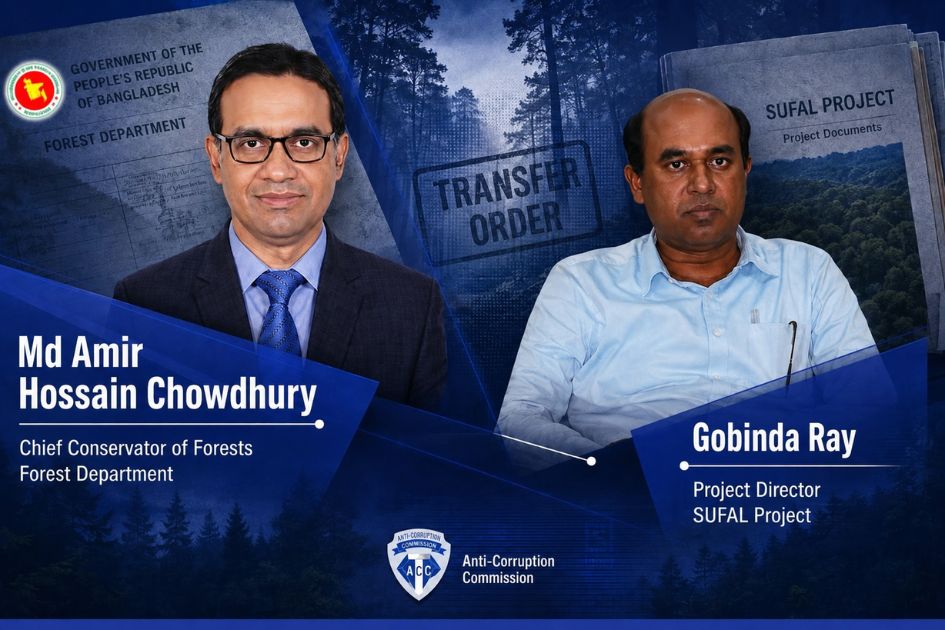
The papers stem from an ACC enforcement drive at Forest Department headquarters on 24 February 2025. During the operation, a two-member team collected statements, records and other information from Chief Conservator of Forests Md Amir Hossain Chowdhury; Gobinda Ray, a deputy chief conservator who served as SUFAL project director; and other officials, according to the report.
Transfers and postings are supposed to follow the Forest Department Officers and Employees Transfer Policy, 2004. In practice, the report says, forest ranges, stations and divisional offices were allegedly divided into three categories according to their perceived desirability, with different prices attached.
For a two-year posting as a range officer, the report lists alleged payments of Tk 1.5 million, about $12,200, for a first-category posting; at least Tk 1 million, about $8,100, for a second-category posting; and Tk 500,000, about $4,100, for a third-category posting.
For a one-year posting at a check post or station, the alleged prices were Tk 2 million, about $16,200, for the first category; Tk 1 million for the second; and Tk 500,000 for the third.
The largest amounts were associated with two-year postings as divisional forest officers: Tk 5 million for a first-category division, Tk 3 million, about $24,400, for a second-category division, and Tk 2 million for a third-category division.
Range officers, station officers and divisional forest officers were also allegedly required to make monthly payments after their fixed posting periods ended and until they received new assignments, the papers say.
The report concluded that the 2004 transfer policy was frequently breached and that transfers and postings were made in exchange for money. But the available pages do not identify who set the alleged rates, who collected the money, or which officers made particular payments. They do not say that Chowdhury or Ray personally received any of the listed amounts.
The allegations concerning Chowdhury and Ray relate to their leadership and supervisory responsibilities. The ACC has separately said it found preliminary evidence of negligence by the chief conservator and the SUFAL project director.
At the end of the enforcement report, the box indicating that the allegations had substance is marked “yes”. The recommended action is further investigation rather than the immediate filing of a criminal case.
M Zakir Hossain Khan said that, if verified, paying for a public posting would create incentives extending far beyond the initial bribe. “It means not just bribery. It means an investment and recovery scheme of corruption,” he said. An officer who paid for a posting could feel pressure to recover the cost through plantation budgets, contracts, timber movements or other discretionary decisions, he added.
He recommended digital posting systems, fixed tenures, asset reviews and an investigation tracing both payers and the money trail.
Three plantation blocks, the same pattern
The ACC documents also provide a more detailed breakdown of the plantation gap previously reported by The Climate Watch in Joarianala Beat.
Under SUFAL, 872 hectares of nurseries and plantations were planned in the beat over two financial years: 510 hectares in 2022-23 and another 362 hectares in 2023-24.
For the 510-hectare programme, the ACC papers divide the designated land into three blocks. In the first, 170 hectares were measured for plantation work, but investigators reported finding seedlings on only about 50 hectares. The second covered 140 hectares, with seedlings reportedly planted on about 40 hectares. In the third, 200 hectares were designated, but investigators found plantation work on about 70 hectares.
Together, the figures amount to plantation work on 160 of the allocated 510 hectares, leaving an apparent gap of 350 hectares. Investigators therefore reported finding plantations on fewer than one in every three hectares earmarked for the work.
The report alleges that Joarianala range officer KM Kabir Uddin failed to plant the full allocated area and misappropriated plantation funds. That allegation is subject to further investigation and has not been adjudicated.
At some locations, investigators reported finding only two lines of seedlings planted along boundaries. Other designated sites reportedly had no plantation. The papers say weeds and undergrowth were not properly cleared and that fertiliser, pesticides and other required materials were not used.
The plantation areas were also allegedly not cleaned or maintained after planting. Many seedlings died during their first year, and investigators said they could not find evidence of the required year-round maintenance.
Government signboards listed the number and species of trees planted, but investigators reported finding no corresponding evidence at some sites. The report alleges that senior officials overlooked the irregularities and that funds allocated for plantations and nurseries were misappropriated. It does not quantify an alleged financial loss.
The report says a similar pattern appeared in the separate 362-hectare programme for 2023-24, including seedlings planted only along boundaries, signboards without corresponding plantations, and sapling deaths linked to poor maintenance. The available pages do not quantify how many of those 362 hectares were planted. The 350-hectare apparent gap applies only to the 510-hectare program for 2022-23.
Different oversight, different conclusions
The World Bank’s International Development Association approved a $175 million credit for SUFAL in 2018. Responding to The Climate Watch’s earlier investigation, the Bank said it had not received or reviewed the ACC enforcement report and therefore could not comment on the Joarianala findings.
The Bank said remote-sensing verification covered more than 65 percent of the project area and led it to reduce the reported restored or reforested area from 103,960 hectares to 92,431 hectares. That was a downward revision of 11,529 hectares, or about 11.1 percent.
It also said site visits found satisfactory plantation survival and that its supervision had identified no fiduciary irregularities. The Bank did not confirm whether the 510-hectare and 362-hectare Ramu programmes were included in its final project-wide restoration total.

A World Bank Independent Evaluation Group review rated SUFAL’s overall outcome satisfactory and cited an average plantation survival rate of 86 percent as of April 2025. But it rated the project’s monitoring and evaluation quality “Modest”, citing persistent discrepancies between digitally reported plantation areas and conditions on the ground.
The review said plantation work began 22 months before the digital site-specific planning platform became operational. It also said Bank supervision should have been more proactive in addressing data-quality shortcomings and noted significant delays in resolving audit observations, particularly those related to works.
M Zakir Hossain Khan said the different findings could be understood by recognising the limits of each review. A system-level fiduciary assessment may not reveal whether every reported plantation exists or survives, while a field enforcement drive does not by itself establish project-wide financial failure.
Even so, he said the scale of the Joarianala discrepancy was too large to dismiss as an ordinary implementation problem. It did not prove that SUFAL failed everywhere, he said, but it was a major warning sign, especially alongside concerns about the following year’s 362-hectare program.
Call for an independent audit
M Zakir Hossain Khan called for a full verification of the Ramu schemes and a risk-based review across the wider project. He said credibility now required an independent audit combining financial records, geospatial evidence and field inspection, conducted by multidisciplinary local experts with a record of resisting corruption.
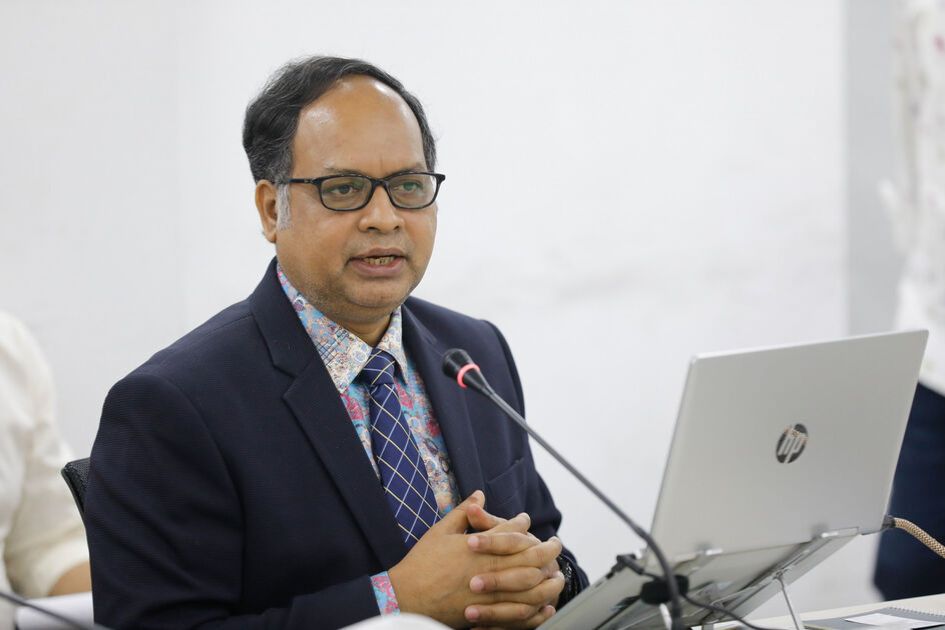
Future plantation payments should be based on survival rather than paperwork or photographs taken on planting day, he said. Each site should have a geotagged boundary, satellite or drone verification, field inspection and publicly disclosed survival assessments after six, 12 and 24 months.
No substantial final payment should be made until tree survival is independently confirmed on the ground, he added. Youth-led community stewardship and local enterprise models could help plant and monitor forests while increasing public scrutiny.
Khan warned that proven corruption in an internationally financed forest project could increase the cost of Bangladesh’s future access to climate and biodiversity finance by prompting donors to demand stronger safeguards, independent verification and tighter disbursement conditions.
He recommended disclosure of project records, a forensic audit, recovery of proven losses, prosecution where warranted, blacklisting of corrupt contractors, restoration of damaged sites and direct participation by forest-dependent communities in monitoring.
“It must be investigated by the World Bank as well as the local authorities and action must be taken against the whole chain,” Khan said. “It not only tarnishes the image of the country but also deceives the whole nation.”
ACC says deeper investigation is under way
Akhtarul Islam, deputy director for public relations at the ACC, previously said that the Commission had found preliminary evidence of negligence by the project’s senior leadership.
“The Anti-Corruption Commission has initially found evidence of the negligence of the project director and chief conservator of forests in the SUFAL Project,” Islam said. “After the investigation, the investigation team submitted a report to the Anti-Corruption Commission. In view of that, a deeper and more in-depth investigation is under way.”
Islam said the Commission was examining alleged irregularities not only in SUFAL but also in other Forest Department projects. The ACC says relevant records have been collected and that legal action will be considered after verification.
Unresolved questions include who benefited from the alleged posting market, whether the payments distorted project decisions, how plantation areas were certified, and whether the reported trees existed and survived.
M Zakir Hossain Khan said, “We must stop paying for plantation claims and start paying for verifiable, surviving forests.”




