




What Nepal’s Flash Flood Teaches Us About a Warming Cryosphere
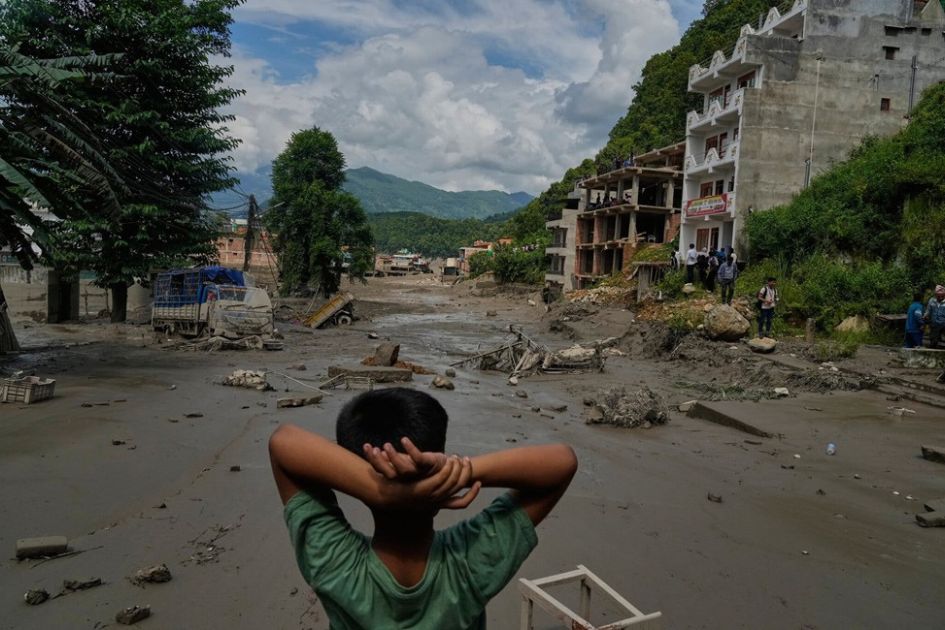
A vital highway linking Nepal to Tibetthe death toll has surpassed 1,000 people confirmed dead nearly 5,000 people still missing, hundreds of bodies have washed downstream into India, travelling over 240 kilometres from the disaster site. On the morning of 26 August 2026, a wall of ice, rock, mud and water tore down the Lende Khola and Trishuli valleys in Nepal, travelling nearly 100 kilometres and burying towns, bridges, hydropower plants and. As of September 1, 2026 just six days after the catastrophe in Nepal and Tibet combined, with and rescue teams still searching cut-off areas. More than 10,000 people have been rescued so far, including 252 foreign nationals. Nepal’s hospitals and morgues are overwhelmed; authorities report critical shortages of storage facilities for the dead and mounting risks of disease outbreaks. The weather was clear; there was no storm to blame. What triggered the catastrophe, scientists are now confirming, was the sudden failure of a massive glacier-clad slope near the Nepal–China border, destabilized by rapid warming and climate change.
This was not a freak accident. It was the latest, deadliest entry in a growing ledger of Himalayan cryosphere disasters, and it demands that we finally reckon with how climate change is rewriting the rules of mountain hazard. It is also Nepal’s deadliest natural disaster since the April 2015 earthquake, which killed approximately 9,000 people.
What actually happened
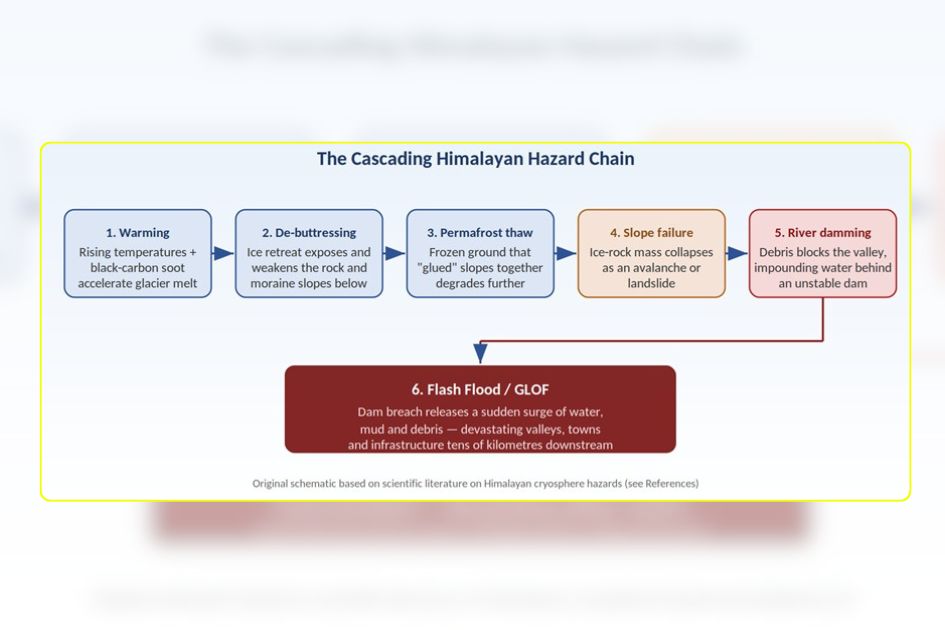
Early reporting oscillated between calling this a classic glacial lake outburst flood (GLOF) and something more complex. The clearest current reconstruction describes a cascading disaster: an ice-rock mass broke away from a glacier-adjacent slope in the Langtang region, the resulting avalanche briefly dammed the Lende Khola, and the dam’s failure sent a debris-laden surge downstream with enough force to register as a magnitude-5.2 event on seismometers. Whether a pre-existing glacial lake was also involved remains under investigation.
What is not in dispute is the pattern. Nepal has experienced a succession of major cryosphere-related flood disasters in recent years: the August 2024 cascading GLOF in Thame near Everest, the July 2025 supraglacial-lake outburst that caused flooding along the Bhotekoshi River, and now the August 2026 Lende Khola disaster. Regionally, the October 2023 South Lhonak GLOF in Sikkim and the August 2025 Dharali debris-flow disaster in Uttarakhand point to a broader pattern of sudden, high-magnitude water-and-debris releases from increasingly unstable high-altitude environments. The precise triggers differ from glacial-lake outbursts and ice-rock avalanches to intense rainfall and landslides but the underlying hazard landscape is becoming more complex and difficult to predict.
The changing physics of ice
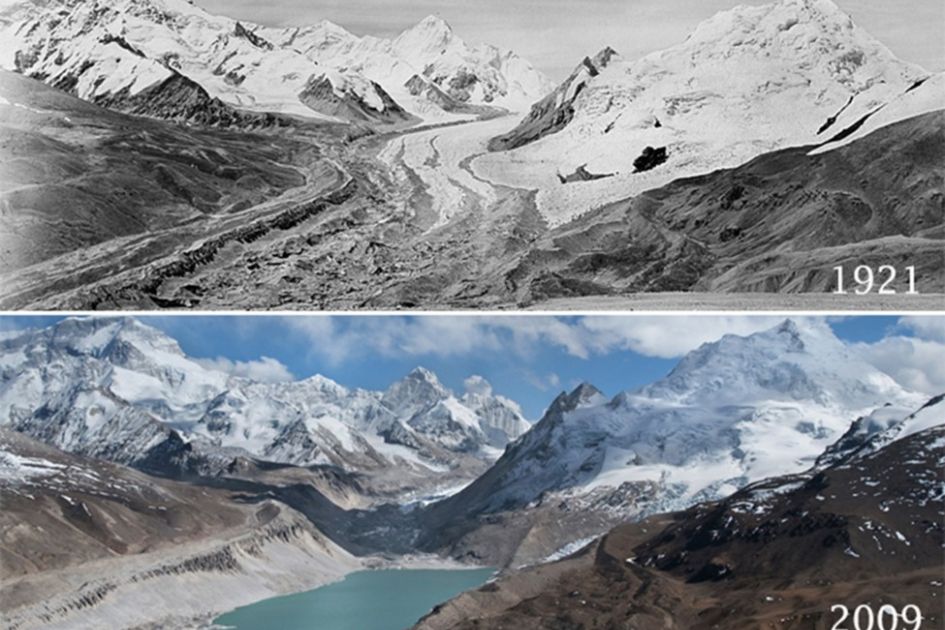
To understand why these events are multiplying, it helps to understand what is happening to Himalayan ice. Glaciers across the Hindu Kush Himalaya are losing mass at an accelerating rate, with ice-loss rates roughly doubling since 2000, per research from the Kathmandu-based International Centre for Integrated Mountain Development (ICIMOD). That melt is not just shrinking rivers of ice; it is destabilizing the mountains themselves.
Three linked processes drive the damage. First, retreating glaciers expose and de-buttress the rock slopes and moraine walls they once physically supported, leaving steep faces suddenly unstable. Second, mountain permafrost—frozen ground that has “glued” rock and sediment together for millennia is thawing, weakening slopes and triggering the kind of failure now implicated in the Langtang disaster. Third, meltwater pools behind unstable moraine and ice dams to form new, expanding glacial lakes. Nepal alone has an estimated 1,466 glacial lakes, 21 of them classified as dangerous.
A lesser-known accelerant is black carbon. Soot from cookstoves, brick kilns, diesel engines and crop burning across the Indo-Gangetic plains drifts into the mountains and darkens snow and ice, increasing solar absorption. A 2025 study found black carbon responsible for nearly a third of glacial mass loss on the southern Tibetan Plateau between 2007 and 2016 striking, given that, unlike carbon dioxide, it persists in the atmosphere for mere days. That short lifespan is a sliver of good news: cutting black carbon could yield cooling benefits within years, not decades.
A Monitoring Blind Spot
Perhaps the most damning detail from the August 2026 disaster is that the failed slope was, in the words of one Stimson Center fellow, a monitoring “blind spot” terrain geologist had largely ignored because it hadn’t previously hosted a dangerous glacial lake. Nepal’s Department of Hydrology and Meteorology and international scientists have focused for years on known high-risk lakes such as Tsho Rolpa and Imja Tsho, where mitigation work has happened. But climate change is now generating hazards in places without institutional memory of danger, faster than ground-based surveying can keep up across remote, high-altitude, often transboundary terrain.
What Can Actually Be Done
Himalayan nations are not starting from zero. Nepal pioneered engineered lake-lowering in the 1990s at Tsho Rolpa, and in 2016 lowered Imja Tsho’s water level while installing a community-based early warning system, backed by UNDP and the Global Environment Facility. A newer $36 million Green Climate Fund project now extends this model to four more high-risk lakes Thulagi, Lower Barun, Lumding Tsho and Hongu 2 combining controlled water-level reduction with eco-engineering and expanded sensors. Scientists have also proposed a dedicated Himalayan Glacial Lake Monitoring Network combining satellite remote sensing, in-situ sensors and hydrodynamic modelling exactly what could close the blind spot that proved fatal this August.
These measures need to move from pilot projects to systemic infrastructure, fast. That means: expanding real-time monitoring beyond the shortlist of “known” dangerous lakes to the entire high-altitude slope system; treating transboundary data-sharing with China and India as a safety requirement rather than a diplomatic afterthought, since major Himalayan rivers cross borders before reaching at-risk communities; investing in community-based early warning sirens, mobile alerts and drills in every valley downstream of glacial terrain; enforcing genuine no-build and relocation zones along known flood corridors instead of letting hotels and hydropower keep expanding into harm’s way; and cutting black carbon emissions from brick kilns, cookstoves and diesel engines as a fast, cheap lever on melt while the world tackles the slower problem of greenhouse gas reduction.
The Reckoning
Nepal contributes a negligible share of global greenhouse gas emissions, yet it is absorbing some of the sharpest consequences of a warming planet, one collapsing slope at a time. The mountains are not simply melting quietly in the background of climate change; they are becoming actively, unpredictably dangerous, and the institutions meant to protect people living beneath them are still playing catch-up. The August 2026 flood should be the moment that changes not another disaster mourned and filed away until the next one strikes a valley nobody thought to watch.
The author is a development worker, working in the field of climate justice and gender justice.




