

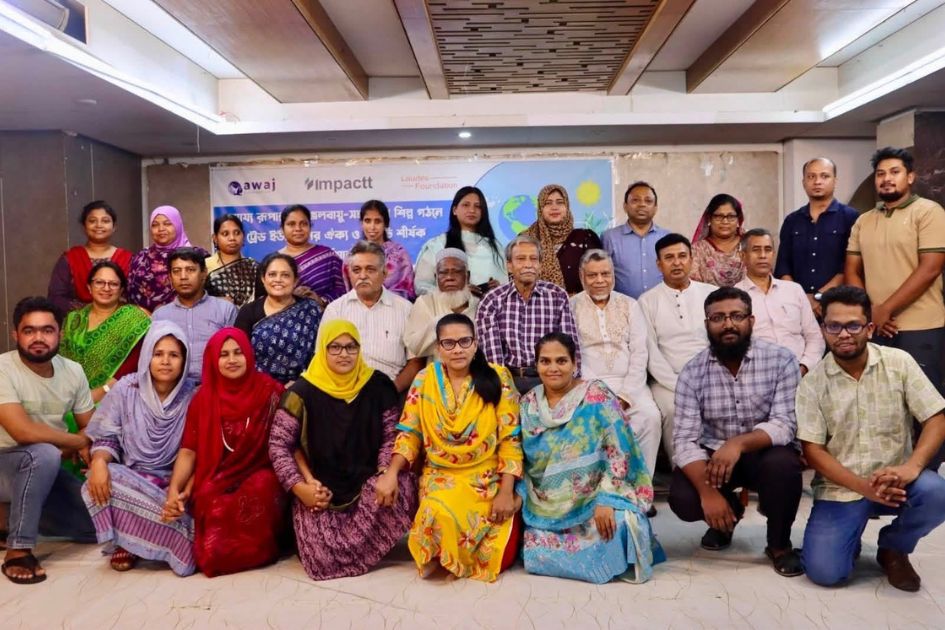



Trade union leaders, labour advocates and civil society representatives urged stronger worker participation in Bangladesh’s climate and industrial policies, highlighting the need for social dialogue, skills development and workplace protections during the country’s green transition.
Bangladesh’s trade union leaders are calling for a stronger role in shaping the country’s climate transition as rising temperatures, automation and global supply chain changes create new challenges for millions of workers who power one of the world’s largest apparel industries.
The call came at a participatory workshop titled “Strengthening Trade Union Solidarity for a Just Transition and Climate-Resilient Industrial Transformation,” organised by Awaj Foundation with support from Laudes Foundation on Monday at a hotel in Uttara, Dhaka.
The workshop brought together 32 representatives, including veteran and young trade union leaders, representatives from IndustriALL Global Union Bangladesh Council (IBC), worker organisations and civil society actors. The dialogue provided a platform for intergenerational learning, collective reflection and collaboration towards a fair, inclusive and climate-resilient industrial future. The session was facilitated by YouthNet Global Executive Coordinator Sohanur Rahman.
In her opening remarks, Awaj Foundation Executive Director Nazma Akter, a former child garment worker and long-time labour rights advocate, highlighted the urgent need for a Just Transition framework that protects workers’ rights in Bangladesh’s ready-made garment (RMG) sector amid growing climate risks, automation and technological transformation.
Drawing from her own experience as a worker who witnessed the evolution of Bangladesh’s garment industry, Nazma Akter emphasised that those who built the sector must not be excluded from its green transformation.
Awaj Foundation has advocated for a Just Transition framework that connects labour rights, climate justice and workplace protections, ensuring that green economic changes and technological advancement do not further marginalise low-income factory workers.
The foundation highlighted three key areas for building workforce resilience: living wages that enable workers and their families to adapt financially to environmental and economic disruptions; safe workplaces with stronger occupational health and safety standards while addressing gender-based violence; and circular economy practices that reduce environmental impacts while creating new livelihood pathways through sustainable materials such as jute, bamboo and clay.
Bangladesh’s garment sector is deeply connected to global supply chains and provides livelihoods for millions of workers. With international brands and consumers increasingly demanding low-carbon and ethical production systems, Bangladesh faces the challenge of meeting climate goals while protecting the rights and livelihoods of the workers who sustain the industry.
Participants discussed how climate change is already affecting workers through rising temperatures, extreme heat exposure, workplace health risks, changing production realities and growing concerns over employment security.
Women workers, who represent a significant share of Bangladesh’s garment workforce, face additional challenges, including workplace safety risks, gender-based violence and unequal access to skills development opportunities. Participants stressed that gender-responsive approaches must be integrated into climate and industrial policies.
“Climate change is no longer a distant environmental challenge; it is becoming a workplace reality for millions of workers. A successful transition must protect livelihoods while creating opportunities for decent green jobs,” said Nazma Akter.
Workers and trade union representatives highlighted three major priorities emerging from the discussions: job security, meaningful social dialogue and skills development for the future of work.
Job security remains a major concern
Workers raised concerns about potential job losses, extreme heat, occupational health risks and uncertainty linked to changing industrial practices. Participants emphasised that climate policies must not increase vulnerabilities among workers who are already facing economic and environmental pressures.
They noted that rising heat inside factories, health concerns and changing workplace conditions are becoming everyday realities, requiring stronger protections, social safety measures and climate-resilient workplaces.
Social dialogue is essential for a fair transition
Trade union leaders stressed that stronger worker representation, collective bargaining and meaningful social dialogue are critical to ensuring that industrial transformation remains equitable and inclusive.
Participants said workers must not be treated only as beneficiaries of climate policies but as active partners in designing solutions. They called for stronger cooperation among governments, employers, trade unions, civil society organisations and development partners.
Skills development will shape the future of work
The workshop highlighted the importance of training, awareness-building and reskilling opportunities to prepare workers for emerging green industries, new technologies and changing labour market demands.
Participants stressed that investments in workers’ skills will be essential to ensuring decent employment opportunities while supporting Bangladesh’s transition towards a sustainable economy.
The discussions also examined how workers’ priorities can be reflected in Bangladesh’s Nationally Determined Contribution (NDC 3.0) implementation process and in emerging global conversations on Just Transition finance and worker protection following the UN Climate Summit COP30, ahead of the COP31 climate negotiations.
Through group discussions, Power Walk activities and open dialogue, participants developed collective recommendations to strengthen worker-led climate action and build stronger collaboration among trade unions, civil society organisations and development partners.
“A Just Transition is not only about transforming industries; it is about protecting people, ensuring decent work and creating a future where no worker is left behind,” YouthNet Global Executive Coordinator Sohanur Rahman said.
YouthNet Global said it will continue working with partners to advance climate justice, decent work and inclusive climate solutions that place young people, workers and vulnerable communities at the heart of climate action.
As countries and industries accelerate efforts to address climate change, Bangladesh’s experience highlights a wider global lesson: climate action will only succeed when workers, communities and vulnerable groups are treated as partners in transformation rather than as costs of transition.
For Bangladesh’s garment sector and the millions of workers connected to it, the pathway to a greener future will depend not only on reducing emissions but also on protecting rights, ensuring decent work and building an economy where no one is left behind.




