

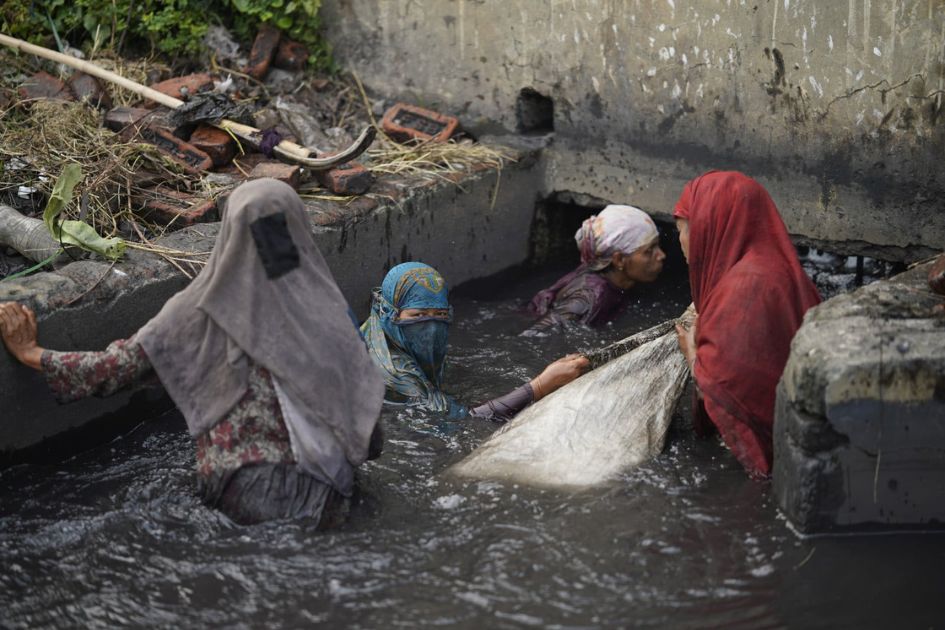

For nearly two decades, women near Bangladesh’s only coal mine have relied on collecting waste coal residue, sustaining families through hazardous informal labour while remaining excluded from jobs, protections and recognition.
For nearly two decades, women in northern Bangladesh have survived by collecting waste coal residue from a drainage channel beside the Barapukuria Coal Mining Company, turning industrial discharge into a lifeline for their families while remaining largely absent from official accounts of the country’s energy sector.
The women stand knee-deep in polluted water for hours each day, pulling out fine coal particles washed out during mining operations. The material, treated as waste by the mine, has become the foundation of an informal economy that supports dozens of families living nearby.
“We have never gone to bed hungry because of this work,” said Morsheda Begum, 58. “People may call it shameful, but they do not understand our reality.”
Invisible labour beside a state-owned mine
The Barapukuria Coal Mining Company, a state-owned enterprise, is Bangladesh’s only operational underground coal mine and a key part of the country’s energy supply chain. Yet the communities surrounding it describe a parallel reality shaped by exclusion, pollution and informal survival work.
Along a narrow drainage channel beside the mine, more than 30 women work at a time, organised into rotating groups that operate without contracts, safety equipment or formal recognition. Each group works one day a week, often for up to 12 hours.
Over time, the women have developed their own system of labour division. Some collect coal residue directly from the water using nets, others haul it to the bank while a few manage storage and coordination before sale. The arrangement, they say, works only because of strict informal rules enforced by the workers themselves.
“There is no supervisor. We manage everything ourselves,” said Rashida Khatun, 47. “We had to organise it. Otherwise, this work would not survive.”
A hidden economy
By the end of a working day, a group can collect around 550 to 600 kilograms of coal residue. Local buyers, mainly connected to brick kilns, purchase the material as fuel for brick production.
A single group earns around Tk7,000 to Tk8,000 per day, which is shared equally among members. Each woman typically takes home Tk250 to Tk300 for a day’s labour.
The income is modest, but for many households in the area it is essential for survival.
“This money pays for food, medicine and school fees,” said Rina Akhter, 52. “Without it, we would not survive.”
Health risks in contaminated water
The women work in a drainage channel that carries industrial effluents from the mine and, according to local accounts, sewage from surrounding areas. The water is warm due to underground thermal processes and heavily polluted.
Medical risks linked to prolonged exposure include skin diseases, fungal infections, respiratory illnesses and potential long-term effects from toxic substances often found in mining runoff.
However, none of the workers have access to occupational health services or regular medical screening linked to their work.
“My feet are always in pain. I have sores that come and go,” said Amena Sultana, 55. “When I cannot afford medicine, I go back into the water and continue working.”
Exclusion despite proximity
Although they live beside the mine, many women say they are excluded from formal employment opportunities within the facility. They claim that even low-paid jobs such as cleaning and maintenance are filled by workers brought in from outside the area.
“We live here, we breathe this air, yet we are not considered even for basic jobs,” said Kulsum Banu, 61. “We survive in polluted water while others are hired to clean inside.”
A senior official of the Barapukuria Coal Mining Company, speaking anonymously, rejected the allegation, saying most employees are local residents and recruitment is based on operational needs.
“About 95 percent of workers are from the locality,” the official said. “We cannot employ more people than required.”
A system built by necessity
Residents say the practice began around two decades ago after mining expansion increased wastewater discharge into the drainage channel. With no formal intervention, women in the area organised themselves, creating a structured rotation system to manage access and prevent conflict.
No NGO or government programme initiated the system. It evolved locally, shaped entirely by necessity.
“There was no one to organise us, so we did it ourselves,” said Rina Akhter. “Now it works because everyone follows the rules.”
Men are largely absent from this work, with locals citing both alternative labour opportunities and social perceptions that have shaped the activity as women’s work.
Just transition gap
The women’s reality also raises wider questions about Bangladesh’s energy transition and whether it is leaving vulnerable communities behind.
Climate and labour experts argue that a “just transition” requires not only shifting from fossil fuels to cleaner energy but also ensuring that communities dependent on extractive industries are protected through jobs, health safeguards and social security.
“Any transition that ignores people living at the frontline of energy production is incomplete,” said Sohanur Rahman, Executive Coordinator of YouthNet Global. “These women are effectively part of the mine’s waste system, yet they remain outside labour rights, health protection and policy recognition. A just transition must start with acknowledging and protecting them.”
Survival and the cost of invisibility
The income generated from this informal economy sustains households where formal employment is scarce and social safety nets are limited. Many women are the primary or sole earners supporting children, grandchildren or ill family members.
“If I stop, my grandchildren will go hungry,” said Morsheda Begum. “That is the truth of it.”
As industrial activity continues beside them, the women remain outside official labour statistics and environmental assessments despite their work being directly tied to the mine’s waste stream.
The contrast is stark: a state-owned project powering national development on one side and an unrecognised workforce sustaining itself through its by-products on the other.
As evening falls over Dinajpur, the women continue working in the polluted water, their presence largely unseen in formal records but central to the survival of the communities living in the mine’s shadow.




