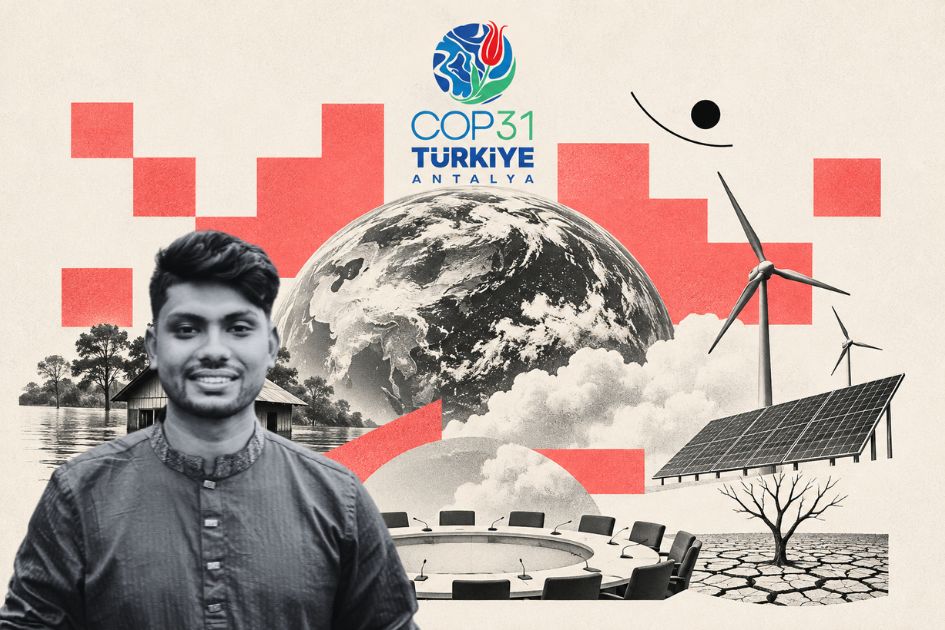



Drawing on frontline flood response and youth advocacy, the Bangladeshi delegate will push for grant-based finance, direct community access and meaningful youth representation at COP31.
During the devastating floods in Bangladesh’s Feni district in August 2024, Jubayer Islam had money in his pocket but could not buy food. Markets had collapsed, supplies were unavailable, and he and fellow volunteers survived on dry food for three days.
The experience fundamentally changed his understanding of climate vulnerability and the importance of functioning local systems during disasters.
Islam, Executive Director of Climate Frontier and a youth representative in Bangladesh’s government delegation to COP31, said the experience demonstrated why climate finance must reach vulnerable communities quickly and effectively.
“Money is only a promise of access to a working system,” Islam told The Climate Watch, reflecting on the disaster.
During the 14-day emergency response, Islam worked alongside local volunteers to help keep approximately 1,800 people safe and provide assistance to around 14,000 others.
He said the response succeeded largely because local communities understood the roads, people and immediate needs better than outside organisations.
As he prepares to attend the 31st United Nations Climate Change Conference (COP31), scheduled for November 9-20 in Antalya, Türkiye, Islam wants to bring those frontline experiences into international climate negotiations.
He said young people from the Global South must have a meaningful role in decisions about climate finance, adaptation and loss and damage, particularly because their communities are already experiencing some of the most severe consequences of global warming.
Climate finance must reach communities
One of Islam’s main priorities at COP31 will be improving access to international climate finance, particularly for developing countries such as Bangladesh.
He argued that financial commitments alone would not protect vulnerable communities unless funding mechanisms became faster, simpler and more accessible.
According to the United Nations Environment Programme’s Adaptation Gap Report 2025, developing countries will require an estimated $310 billion to $365 billion annually for climate adaptation by 2035. However, international public adaptation finance reached only $26 billion in 2023.
The gap highlights the growing financial pressure on countries confronting floods, cyclones, droughts, rising sea levels and other climate-related disasters.
At COP30 in Belém, Brazil, countries called for efforts to at least triple adaptation finance by 2035 and adopted indicators to measure progress towards the Global Goal on Adaptation. However, major questions remain about how those commitments will translate into accessible funding.
Islam said Bangladesh should use the Antalya negotiations to demand grant-based financing rather than loans that increase the debt burdens of climate-vulnerable countries.
He identified three immediate priorities: providing grants instead of debt-generating loans, ensuring direct access to finance for local governments and community organisations, and simplifying funding procedures.
Complicated applications, high transaction costs and lengthy approval processes often prevent grassroots organisations from accessing international climate funds, even when they are directly involved in disaster preparedness and adaptation.
Islam said international financial mechanisms should recognise the capacities of smaller organisations and help communities implement locally designed climate solutions without unnecessary administrative barriers.
Youth must be partners, not beneficiaries
Beyond climate finance, Islam is advocating stronger institutional participation for young people in national delegations and international negotiations.
He said youth participation should extend beyond symbolic representation at conferences and side events to meaningful involvement in policy development and decision-making.
“Young people are often first on the ground in a disaster,” he said.
Islam has been closely involved in organising Bangladesh’s Local Conference of Youth (LCOY), which provides a platform for young people to develop national climate priorities.
The fifth edition of LCOY Bangladesh, held on September 30 and October 1, 2026, brought together around 300 young participants from climate-vulnerable communities.
The gathering produced a National Youth Statement, subsequently submitted to the government, outlining demands on climate justice, adaptation, loss and damage, finance and youth participation.
Islam said he intends to carry the statement into discussions during COP31.
Among its central demands are direct access to climate finance for local communities, Indigenous peoples and youth-led grassroots organisations, alongside reduced financial and administrative barriers.
The statement also calls for structured, adequately funded youth participation in national climate delegations and policymaking processes.
According to Islam, young people should be recognised as contributors to climate solutions rather than merely as beneficiaries of programmes designed by others.
He said Bangladesh’s inclusion of youth delegates in international climate negotiations represents progress, but sustained institutional arrangements are necessary to ensure that their participation influences policy.
Taking frontline experiences to Antalya
Islam said his work at COP31 will focus particularly on adaptation, climate finance and loss and damage negotiations.
He plans to contribute to Bangladesh’s negotiating priorities through field-based evidence while coordinating with youth representatives from other climate-vulnerable countries to strengthen common demands.
He also intends to communicate developments from the negotiations to youth networks in accessible language so that communities can understand decisions affecting their futures.
Drawing on eight years of engagement with climate-affected communities, including those in Barishal, Shyamnagar and the hills of Rangamati, Islam wants international negotiators to understand the human consequences behind climate statistics.
He stressed that climate negotiations must address the everyday realities of families losing homes, farmers struggling with changing weather patterns and communities facing repeated disasters.
The participation of young people with practical experience, he argued, could help connect global agreements with local priorities and strengthen accountability for climate commitments.
He also highlighted the importance of collaboration among youth organisations across the Global South, including through national and regional youth conferences that contribute to the Global Youth Statement presented during UN climate negotiations.
Climate protection is a shared responsibility
For Islam, the lessons of the Feni floods extend beyond Bangladesh.
He believes the breakdown of essential systems during climate disasters demonstrates that economic resources alone cannot guarantee protection against escalating environmental risks.
Even wealthy countries, he argued, cannot assume that financial strength will fully shield them from the consequences of a worsening climate crisis.
He said supporting adaptation and resilience in vulnerable countries should not be treated as an act of charity but as part of a shared global responsibility.
As governments prepare to gather in Antalya, Islam hopes COP31 will deliver more than renewed promises, particularly by making climate finance accessible and giving young people from vulnerable countries a stronger role in shaping decisions.
His central message is that the effectiveness of climate action should ultimately be judged by whether commitments reach the people most exposed to climate risks, rather than by the size of the financial pledges announced at international conferences.