




Tech giants promise sustainability through new cooling systems, recycling and offsetting in India. But around their sites, minimal transparency, no standard reporting and growing water stress abound.
This is part four of a four-part series. Parts two and three also dive deep into India’s data center boom and its environmental costs.
In the first three parts of this series, Down To Earth (DTE) traced India’s rapidly expanding data center industry, a pillar of the country’s digital and artificial ambitions (AI) ambitions, in regions like Greater Noida and Bengaluru where local communities are already struggling for access to clean water.
In this final part, DTE examines the other side of the story: how the industry’s biggest players report (and often obscure) their water use, the technologies they claim will make them “water-neutral”, and why experts say those promises don’t always hold water.
DTE reviewed the Environmental, Social and Governance (ESG) reports of India’s top data center operators—Nxtra by Airtel, AdaniConneX, STT, NTT, CtrlS and Sify—and found a consistent and troubling pattern: a pervasive lack of transparency in how these firms report their water use.
As demand for digital infrastructure soars, fueled by the explosive growth of generative AI platforms such as ChatGPT and Gemini (read Part 1 of this series)—data centers are expanding at breakneck speed across India. But despite their vast water requirements, companies are revealing little about how much they consume, where it comes from, or what impact it has on local water resources.
Local and International data center players in India
| Category | Names |
| Global Data Center operators | Microsoft, Amazon, NTT Global Data Centers (Netmagic Solutions), ST Telemedia Global Data Centres, Iron Mountain, and Equinix |
| Indian data center operators | CtrlS, Pi Datacenters, BSNL (Nextgen Infinite), Web Werks, Airtel (Nxtra Data Centers), AdaniConnex, and Sify Technologies |
| New announcements | Google (collaboration with AdaniConnex), Tata Consultancy Services and Reliance Enterprises |
Credit: DTE.
Absent water consumption figures
ESG reports from the companies use two key terms, water consumption and water withdrawal, which sound similar but mean different things. Consumption refers to water lost during operations, usually through evaporation in cooling systems, while withdrawal refers to water drawn from natural or municipal sources (surface, underground, reclaimed or treated potable water) that may later be returned to them.
Nxtra by Airtel operates 15 hyperscale data centers across eight Indian cities—facilities that typically span over 10,000 square feet. In its 2025 ESG report, the company disclosed a total water consumption of 216,357 kiloliters (KL), including 9,876 KL drawn from groundwater and 191,152 KL purchased from third-party sources, with no reported use of surface water. However, Nxtra did not release consumption figures for 2023 or 2024, leaving a crucial gap that makes it impossible to track changes or assess whether its water use has risen over time.
AdaniConneX, a joint venture between the Adani Group and EdgeConneX, has no standalone ESG report. Instead, its parent company Adani Enterprises Ltd reported total water withdrawals across all its business operations—mining, airports, solar manufacturing, wind, copper, roads, data centers, defense and digital labs—at 4,390 million liters in 2025, a 59% increase from 2022. The report does not disclose how much of this was used for data centers, even though 2022 was the year AdaniConneX began operations in Chennai.
STT GDC India, a subsidiary of the Singapore-headquartered ST Telemedia Global Data Centres, operates 30 facilities across India. Its 2024 ESG report shows a total water withdrawal of 1,149,020 KL, up 8.5% from 2023 (1,059,011 KL). While no country-specific data is available for 2024, its 2023 report revealed that 419,204 KL of water was withdrawn from India, 40% of its global total and up 17% from the previous year.
Headquartered in England, NTT operates in 20 countries and regions across the Americas, Asia Pacific, Europe, the Middle East, Africa and India, where it runs 15 facilities. According to its 2024 Sustainability Report, the company withdrew 413,779 kiloliters of water in 2023, consuming 203,297 KL of it. However, its 2025 report omits any mention of water withdrawal or consumption, raising questions about the company’s transparency and year-on-year reporting consistency.
Sify Technologies, which runs 14 AI-ready data centers with a combined IT capacity of roughly 200 MW, reported withdrawing 6,132,323 KL of water in 2023-24, up 5% from the previous year. Its 2024-25 report shows a sharp fall to 306,916 KL.
CtrlS, an India-based operator, reported water consumption of 409,037 KL in 2023-24, down from 468,330 KL the previous year.
None of these reports provide data center-level details, and apart from STT’s 2024 report, no global operators disclose country-level figures.
Imperfect technologies
How much water a data center uses depends largely on its cooling technology. The most common is evaporative cooling, which uses water to remove heat but requires constant replenishment, especially in hot or dry climates. The alternative is air-cooled chillers, which dissipate heat using fans and consume little or no water, though they demand far more electricity.
The trade-off is that evaporative systems are generally more energy-efficient but less water-efficient, Shaolei Ren, associate professor of electrical and computer engineering at the University of California, Riverside, told DTE. Water-cooling systems are often cheaper but can strain water resources in areas where the resource is less abundant, for example, Bengaluru or Noida.
“Air-based cooling systems don’t use water directly but still have an indirect water footprint through the electricity required to power them, explained Melissa Scanlan, Lynde B. Uihlein Endowed Chair in Water Policy, professor and director of the Center for Water Policy at the University of Wisconsin–Milwaukee.
If the electricity source is fossil fuel-based, the environmental burden remains high. For example, Yotta Data Center park in Greater Noida runs 30 diesel generator sets of 2.25 megawatts (MW). In 2020, the company received environment clearance from the State Level Environment Impact Assessment Authority to replace gas generators with diesel generators since the Data Center Building will host critical information and data from Government and Defense. Hence continuous operation is extremely critical. The committee set a condition that the installed diesel generator should use low sulfur diesel type and conform to Environment (Protection) Rules prescribed for air and noise emission standards. Low sulfur fuel reduces air pollutants like small particulate and black carbon emission and does not directly reduce carbon dioxide emissions.
About 78% of India’s power generation in 2024 was fossil-fuel based.
Further, traditional air cooling can no longer efficiently mitigate the escalating heat produced by the ever-increasing power densities of modern processors used for AI workload. Liquid cooling technologies like liquid immersion cooling, which involves bathing servers, chips and other components in a specialized dielectric (or non-conductive) fluid, which absorbs the heat from the chips and transfers it to a heat exchanger, where it is cooled down before flowing back into the tank.
However, the technology has higher upfront costs than conventional direct liquid cooling, but provides significant energy savings and significantly less water than other approaches, according to an article by Environmental and Energy Study Institute, a US-based nonprofit.
Nxtra and Adani claim to use air-based chillers; STT says it prefers air-cooled systems in water-scarce regions; NTT reports using advanced cooling techniques, including liquid immersion “where feasible”; Sify claims to have saved “billions of gallons” through water-free cooling but provides no data to support the claim; and CtrlS reports reducing its water footprint by 119,662 KL annually by switching from water- to air-cooled systems, without specifying how many facilities adopted the change.
All the sustainability reports are unclear on how many data center facilities have switched to newer technologies and how the switch has impacted their water and energy consumption.
Yotta Data Services Pvt Ltd believes that liquid cooling is central to the future of AI data centers. “The industry’s real direction is water-neutral data centers: air-cooled + liquid-cooled + closed-loop systems, not water-cooled towers,” the company stated.
But as companies make ambitious claims about “water-neutral” or “water-positive” facilities, researchers warn that transparency remains weak, and independent verification is almost non-existent. Even global tech firms are reluctant to open their sustainability claims to scrutiny. Microsoft, for example, says its pilot cooling technology at one data center reduced water use by more than 124.9 million liters, without opening it for review by independent academic researchers.
Water usage effectiveness
Many ESG reports reviewed by DTE refer to water usage effectiveness (WUE), which is a metric developed by The Green Grid, a nonprofit industry consortium, to measure data center water efficiency. Expressed in liters per kilowatt-hour (L/kWh), WUE is calculated by dividing a data center’s total water consumption by the total energy it uses over the same period. A score of zero represents ideal efficiency.
“WUE is a useful starting point for quantifying water consumption,” said Ren. “But it doesn’t capture everything. The typical WUE value is reported on an annual basis, which does not reflect peak water demand. Those peaks can be particularly problematic for local water infrastructure.”
Ren also said that WUE also does not account for local water stress levels, which are critical for understanding real impacts. But there is no single standardized method of calculating WUE. This, he said, can create confusion and make comparisons difficult. “More consistent reporting methods would be helpful.”
Not every company discloses its WUE, and those that do offer little context (see table). “Modern hyperscale DCs—including ours [Yotta, which does not publicly mention WUE]—are built to operate at extremely low WUE and avoid reliance on freshwater entirely,” Yotta told DTE.
Published Water Use Effectiveness (WUE) of major data center operators
| Company | WUE in (l/kWh) or % |
| Nxtra | No published data |
| AdaniConnex | No published data |
| CtrlS | No published data |
| STT | 0.73 in 2024 |
| NTT | 0.72 (entire data center portfolio) and 1.42 (evaporative sites) in 2024 |
| Sify | 1 |
Credit: DTE.
Reusing water and offsetting claims
Recycling and reusing water is often presented as the most sustainable solution, but the reality is more complex. Water quality is critical. Reclaimed or treated water, if improperly managed, can cause corrosion, scaling and microbial growth in cooling equipment. “Recycling water helps, but in the Indian context, the water quality standards need to be improved to ensure the right chemical parameters are met,” Shashank Palur, manager and hydrologist with the Urban Water program at WELL Labs, Bengaluru, told DTE.
Yotta Data Services Pvt Ltd also calls for standardization. “We expect the national Data Centre Policy to set clear standards for non-potable water usage, wastewater recycling, and cooling efficiency, ensuring that capacity growth does not come at the cost of community water security,” Yotta told DTE.
Nxtra says it recycled 15,329 KL of water in 2025 through advanced sewage treatment systems and aims for 100 per cent recycling in its hyperscale data centers to become “water-neutral”. Nxtra does not specify whether the recycled water is used for cooling. AdaniConneX mentions using treated water and rainwater harvesting, without providing any clarity. STT said its Pune facility reuses high Total Dissolved Solids water “multiple times before replacement” but does not define limits. CtrlS claims “water positivity” through innovative recycling and sustainable operational policies, though this appears to apply mainly to sanitation and landscaping.
More recently, companies have popularized the concept of “water offsetting”, which is compensating for water use in one location by replenishing or restoring water elsewhere. Microsoft and Amazon are leading advocates, pledging to become water positive by 2030 and 2027 respectively, meaning they will return more water to communities than they consume.
Microsoft has invested in at least eight projects in India, partnering with nongovernmental organizations to either restore lakes or enhance availability of groundwater, according to the company’s water replenishment portfolio.
Amazon has announced similar commitments. In 2024, it pledged to return more water to Indian communities than it uses by 2027. The company has invested in restoration projects at Yamare Lake near Bengaluru and Sai Reddy Lake near Hyderabad—both once vital local water sources that gradually vanished. Since early 2025, the involves desilting, rebuilding bunds [artificial embankments], and repairing inlet and outlet structures. The two projects are expected to replenish over 570 million liters of water annually, 270 million to Yamare and nearly 300 million to Sai Reddy.
During a visit to Yamare Lake, DTE found restoration work ongoing. “We supply groundwater to homes in eight villages, including Yamare, but levels are falling. Water is now available only at 100 feet,” says Praveen Kumar, Panchayat Development Officer. “The lake’s revival could help improve groundwater recharge.”

Issues with offsetting, however, remain unaddressed. “Although companies are raising water levels in some water-scarce areas, these efforts don’t address localized depletion where their data centers operate,” said Labanya Prakash Jena, consultant on sustainable finance at the Institute for Energy Economics and Financial Analysis (IEEFA). “If a data center causes depletion in Whitefield, that cannot be offset by restoring a lake elsewhere. It’s an ineffective approach.”
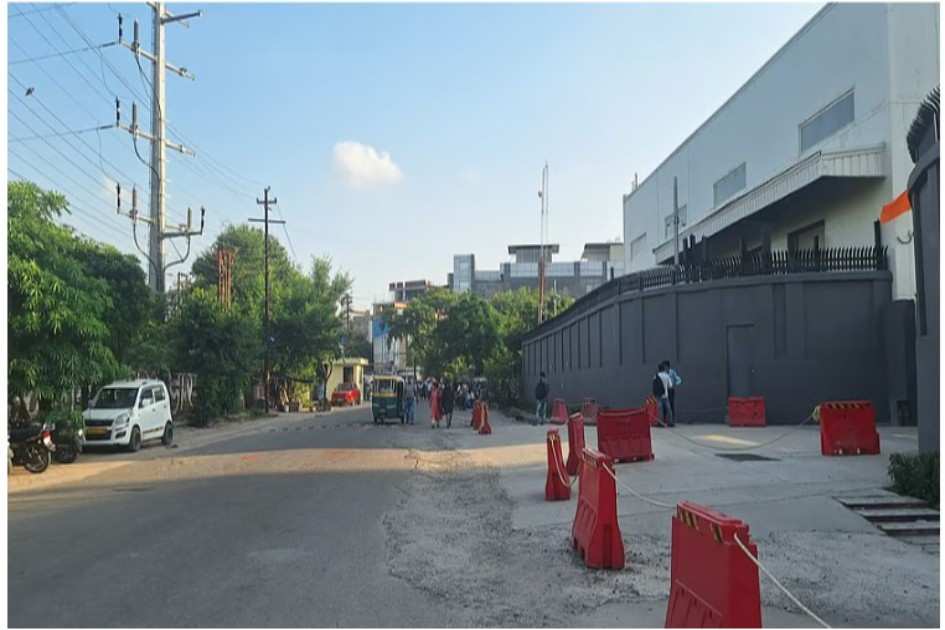
For residents, the debate over technology and offsetting feels distant. In Tusiana Village, Greater Noida—home to Yotta’s 20-acre data center park—retired resident Rattu Singh puts it simply: “If there’s no water in our village tomorrow, what can we do? The government should think about us, too.”
The report was produced with support from Internews’ Earth Journalism Network as part of the “Dark Side of the Boom” collaborative reporting project on resource-intensive digital technology in Asia. It was lightly edited for length and clarity. The original story can be found here. Part one can be found here.




