

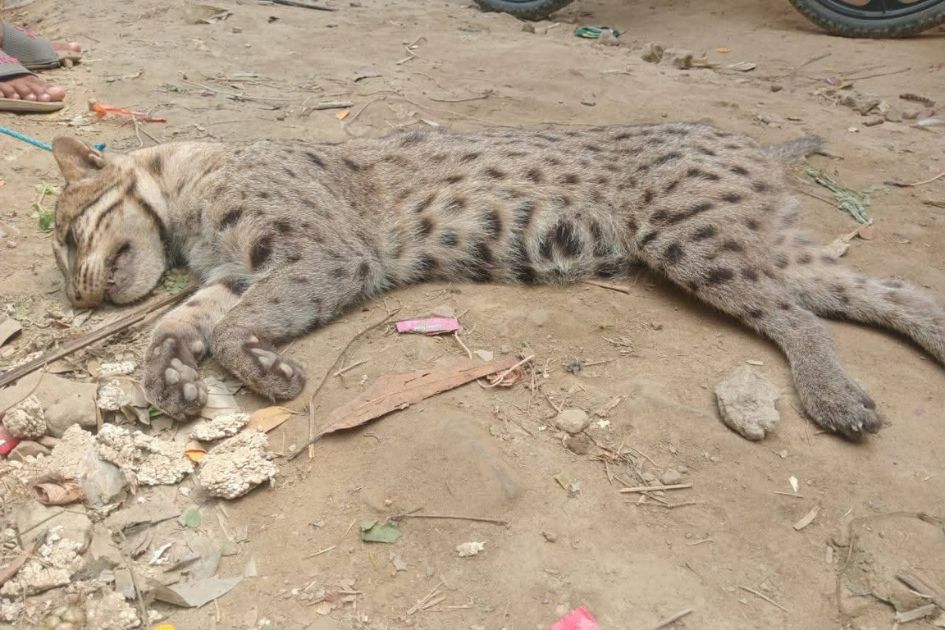



A minimal fine for killing a protected fishing cat in Chattogram has sparked outrage, with conservationists warning weak enforcement risks undermining Bangladesh’s updated wildlife protection law.
Authorities in southeastern Bangladesh have fined a man just 2,000 taka, about $18, for brutally killing a protected fishing cat, triggering criticism from wildlife officials and conservationists who say the punishment undermines the law.
The incident took place in Sandwip upazila of Chattogram, where the accused, Shahidul Islam, tied the animal to an electric pole and beat it to death after accusing it of eating chickens from his farm, officials said.
A mobile court led by Upazila Nirbahi Officer Mongchingnu Marma handed down the fine on Tuesday after the case came to light through social media. The suspect was detained by the Sandwip range officer of the forest department and brought to the UNO office before the court proceeding.
Under Bangladesh’s Wildlife Conservation and Security Act 2026, killing a fishing cat is a non-bailable offence punishable by up to one year in prison or a fine of up to 50,000 taka or both. However, the court imposed only a monetary penalty and released the accused.
The killing occurred in the morning in front of a farm in Bishiriya Residential Lane near Fazr Hat in Haramia union. Witnesses said the animal was tied to a power pole and beaten to death.
Speaking to reporters, UNO Mongchingnu Marma said villagers killed the animal after it preyed on farm chickens. “They have been fined and warned. If such an offence is repeated, legal action and imprisonment will follow,” he said.
When asked about the legal provisions, he stated that the law allows for a maximum fine of 20,000 taka.
Wildlife officials disputed that claim. Chattogram Wildlife and Biodiversity Conservation Officer Dipanwita Bhattacharya said amendments to the law passed in parliament in March 2026, replacing the 2012 act, clearly stipulate up to one year in jail and a fine of up to 50,000 taka for such offences. She added that the crime is non-bailable.
The light penalty has drawn sharp criticism. Bhattacharya described the 2,000 taka fine as grossly inadequate for a serious offence, warning that lenient punishment would fail to deter wildlife killings.
Conservationists echoed the concern. Siddiqur Rahman Rabbi, president of the Bangladesh Nature Conservation Alliance, said expectations had risen after the new law was passed. “We believed wildlife killings would decline. But without proper enforcement, such crimes cannot be controlled,” he said.




