

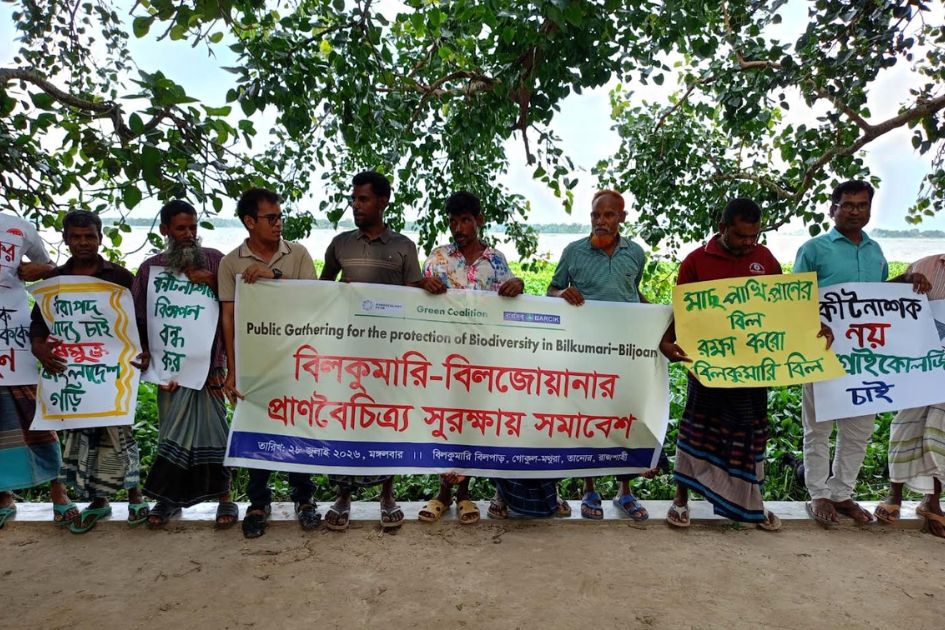



Speakers urged authorities to turn the sanctuary declaration into practical conservation by enforcing existing laws, curbing destructive fishing practices and pesticide pollution, and ensuring community participation in long-term wetland management.
Environmentalists, farmers, fishers and civil society representatives on Tuesday called for the effective protection and management of Bilkumari-Biljoayana, a wetland in northwestern Bangladesh that was officially declared a “wetland-dependent wildlife sanctuary” on May 7 last year.
The public gathering was held on the banks of the wetland in Gokul-Mathura village of Tanore upazila in Rajshahi district. It was jointly organised by the Bangladesh Resource Center for Indigenous Knowledge (BARCIK), a development research organisation, and Green Coalition.
Participants said Bilkumari-Biljoayana is one of the most important freshwater wetlands in northern Bangladesh, providing habitat for indigenous fish, waterbirds, amphibians, reptiles, aquatic plants and numerous other aquatic species. They said the wetland also plays a vital role in groundwater recharge, agricultural production, food security, climate resilience and the livelihoods of local communities, making its conservation essential for both environmental protection and sustainable development.
Speakers said that although the government had declared Bilkumari-Biljoayana a “wetland-dependent wildlife sanctuary”, effective implementation of the designation was still not visible on the ground. They called for the enforcement of the Biodiversity Act, 2017 and relevant environmental and fisheries laws, including demarcating the sanctuary’s boundaries, preparing an integrated management plan, conducting regular biodiversity monitoring, ensuring community participation and strengthening surveillance and law enforcement to stop illegal activities.
The gathering also heard that the greatest threats to the wetland’s aquatic biodiversity are the use of China duari (mosquito-net) fishing nets, current nets, poisoned bait and electric shock fishing. Participants said these destructive methods kill not only large fish but also fish eggs, fry and other aquatic organisms. They added that excessive use of highly hazardous pesticides on surrounding farmland enters the wetland through rainwater and irrigation, severely affecting indigenous fish, frogs, snails, aquatic insects and other aquatic life. As a result, populations of native fish species including koi, shing, magur, tengra, punti, taki, gojar, patashi, bheda and kholisha are declining at an alarming rate.
Amrit Sarkar, programme officer at BARCIK and an agriculturalist, said, “Declaring Bilkumari-Biljoayana a ‘wetland-dependent wildlife sanctuary’ is an important step. Now the priority is to effectively enforce the law, stop illegal fishing and control pesticide pollution to conserve the wetland’s natural ecosystem.”
Fisher Abu Samad said, “The use of China duari nets, current nets, poisoned bait and electric shock fishing is causing indigenous fish to disappear rapidly. If the wetland survives, fishers will survive, so strict action must be taken against these illegal methods. The supply of China duari nets in the market must be stopped and only then will their use end.”
Md. Atikur Rahman Atik, an environmental campaigner and president of the Barendra Youth Forum, said, “The declaration of a protected area must be effective not only on paper but also in reality. By stopping the use of China duari nets, current nets, poisoned bait, electric shock fishing and highly hazardous pesticides, Bilkumari-Biljoayana should be developed as a model for wetland conservation in northern Bangladesh.”
Rubel Hossain Mintu, president of Swapnachari Social Development Organisation, said, “Protecting biodiversity is not only an environmental issue, it is a question of our future. Until the laws governing protected areas are implemented, young people will continue awareness campaigns and movements.”
Harunur Rashid, a farmer practising agroecology, said, “If the wetland’s biodiversity is protected, agriculture will also survive. Through safe and agroecology-based farming, it is possible to protect the wetland, people and nature together.”
The gathering put forward several demands, including the swift implementation of all legal provisions related to the sanctuary designation, the preparation of an integrated conservation and management plan for Bilkumari-Biljoayana, regular operations to completely stop fishing with China duari nets, current nets, poisoned bait and electric shock, control of highly hazardous pesticide use in surrounding areas while expanding agroecology-based farming, protection and restoration of breeding grounds for indigenous fish as well as aquatic plants and waterbird habitats, formation of a co-management committee with local community participation, regular scientific monitoring of the wetland’s biodiversity and an immediate halt to encroachment, land filling, pollution and all activities obstructing the wetland’s natural water flow.
Participants also called on Bangladesh’s Ministry of Environment, Forest and Climate Change, the Department of Environment, the Department of Fisheries, the district administration, the upazila administration and all relevant authorities to effectively enforce the sanctuary’s legal status, stop illegal fishing, control pesticide pollution and establish a long-term conservation management system with the participation of local communities.
They said protecting Bilkumari-Biljoayana means safeguarding biodiversity, food security, agriculture and future generations.




