

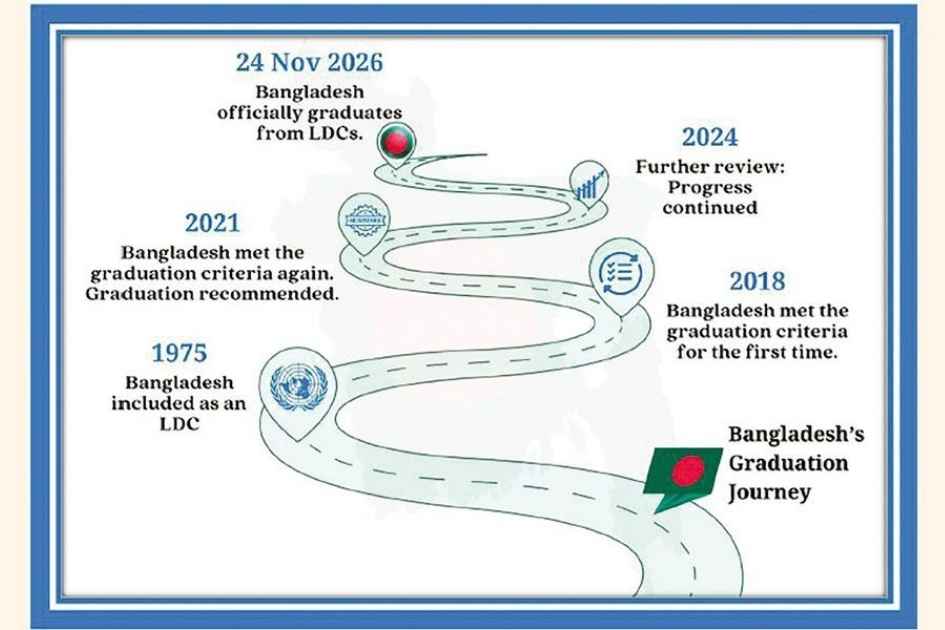



The UN has postponed the Bangladesh LDC graduation assessment ahead of elections, as the government, businesses, and civil society debate risks, labor protections, trade losses, and the timing of the 2026 transition decision-making process.
A high-level United Nations delegation scheduled to visit Bangladesh to review the country’s preparedness for graduation from the Least Developed Country category has been postponed at the request of the interim government ahead of the national parliamentary election.
The delegation, led by UN Under-Secretary-General and Secretary-General of the Fifth UN Conference on LDCs Rabab Fatima, was expected to evaluate Bangladesh’s readiness for graduation and present an independent preparatory assessment report on January 21. Officials at the Ministry of Commerce and the Economic Relations Division said the visit may take place after a newly elected government assumes office. However, no new date has yet been confirmed.
Observers note that other countries facing graduation, such as Laos and Nepal, have not requested delays, highlighting the critical choices Bangladesh’s next government will face.
As Bangladesh approaches its November 2026 graduation, analysts, business leaders, civil society and youth emphasize the need for careful planning and collaboration. Ensuring labor rights, inclusive governance, diversified economic growth and climate-resilient development will be critical to securing a just and sustainable transition that benefits workers, communities, businesses and the nation as a whole.
Bangladesh reaffirmed that it meets all three criteria required for graduation from the United Nations’ Least Developed Countries category, according to its Annual Report 2025 submitted to the UN Committee for Development Policy in November 2025. The report notes that “despite various challenges, as of September 2025, Bangladesh has maintained a satisfactory position across all three LDC graduation indicators,” which include per capita gross national income, the human assets index and the economic and environmental vulnerability index.
Bangladesh’s progress comes amid considerable domestic and global pressures, including the Ukraine war, Red Sea shipping disruptions, last year’s student-led popular uprising and U.S.-imposed reciprocal tariffs. The government has prioritized restoring macroeconomic stability while keeping Sustainable Development Goals on track though risks remain. The report emphasizes, “Over the past four years, Bangladesh has met all graduation criteria despite multiple shocks.” Following a five-year preparatory period that began in 2021, Bangladesh is set to formally graduate from the LDC category on November 24, 2026.
Analysts stress that ensuring labor rights, social protections and inclusive governance will determine whether LDC graduation results in a just, sustainable and climate-resilient transition that benefits workers, communities, businesses and civil society.
Some business groups had urged the government to request a postponement of graduation, citing experiences from other countries and the need for additional preparation. UN-CDP members, including Dr Debapriya Bhattacharya, suggested Bangladesh could formally apply for a delay or use the Enhanced Monitoring Mechanism.
Bangladesh’s graduation from LDC status is closely watched internationally. As the world’s second-largest apparel exporter, the country’s transition affects global trade, climate-aligned industrial development and socio-economic resilience. Analysts warn that millions of laborers in climate-vulnerable and export-oriented sectors could face risks from changes in trade benefits and economic structures.
Commerce Secretary Mahbubur Rahman said, “The UN may not visit now but their assessment report will guide our next steps. We are committed to preparing Bangladesh carefully for graduation.”
Last November, the UN collected data from multiple ministries and agencies to assess macroeconomic stability, trade impacts, labor standards and strategies for implementing the Smooth Transition Strategy, a framework designed to manage economic, social and trade-related risks during the post-LDC transition.
Bangladesh’s formal graduation from the LDC category will depend on the political decision of the next elected government following the national polls in February.
Political voices underline the stakes for labor and industry. The Bangladesh Nationalist Party, the country’s main opposition party, has highlighted potential risks of LDC graduation. Led by Chairman Tarique Rahman, the BNP has historically positioned itself as a pro-business nationalist party advocating for economic growth while emphasizing social safeguards.
In a social media post on September 16, 2025, Tarique Rahman said, “Bangladesh is on the path to graduate from the UN’s Least Developed Country category in November 2026. Graduation is not just a milestone. It comes with risks and challenges which we need to be honest about, directly affecting our economy and people.” He added that the country could face several challenges, including the loss of trade preferences that could hurt garment exports and competitiveness, shrinking access to concessional loans and aid, the loss of WTO trade privileges, including flexibility on subsidies and medicine patents and the vulnerability of the economy due to over-dependence on one sector.
He called for urgent measures to safeguard domestic businesses. He said Bangladesh needs to diversify exports beyond garments into ICT, pharmaceuticals and other value-added sectors. He added that public institutions must be strengthened to ensure financial discipline. Investment in productivity, trade logistics and modern infrastructure is essential, he said, and foreign commitments on trade facilities and green financing must also be implemented. He emphasized, “Let us not leave our workers, farmers and youth behind in a vulnerable place. Bangladesh needs real, tangible progress and opportunities for its citizens before it can reap the benefits of graduating.”
Officials noted that international factors, including the positions of the United States and European Union member states, could influence the process. Chief Adviser’s Special Assistant Anisuzzaman Chowdhury said, “Business leaders are calling for a delay and some political parties support it without fully understanding the context. If weaker nations can graduate from the LDC category, why should Bangladesh seek postponement?” He added, “The interim government will not request a delay but the elected government can decide. Large conferences before elections cannot be organized effectively.”
The LDC Graduation Annual Report also reflects on how centralized and oligarchic governance over the past 15 years affected the economy, highlighting corruption, nepotism and monopolistic control. Following the July 2024 popular uprising, the interim government implemented measures to stabilize the macroeconomy, including pegging the exchange rate, adjusting interest rates and rationalizing public expenditures. By mid-2025, these reforms, alongside revenue and banking sector adjustments, began yielding signs of recovery, with improved GDP growth, easing inflation trends and moderate increases in foreign currency reserves.
Comparisons with post-uprising economies such as Indonesia in 1998 and Sri Lanka in 2022 suggest Bangladesh’s recovery has been comparatively swift. Investor confidence surged in July 2025, with the Dhaka Stock Exchange rising 12.5 percent, ranking third regionally after Vietnam and Thailand, before stabilizing in subsequent months.
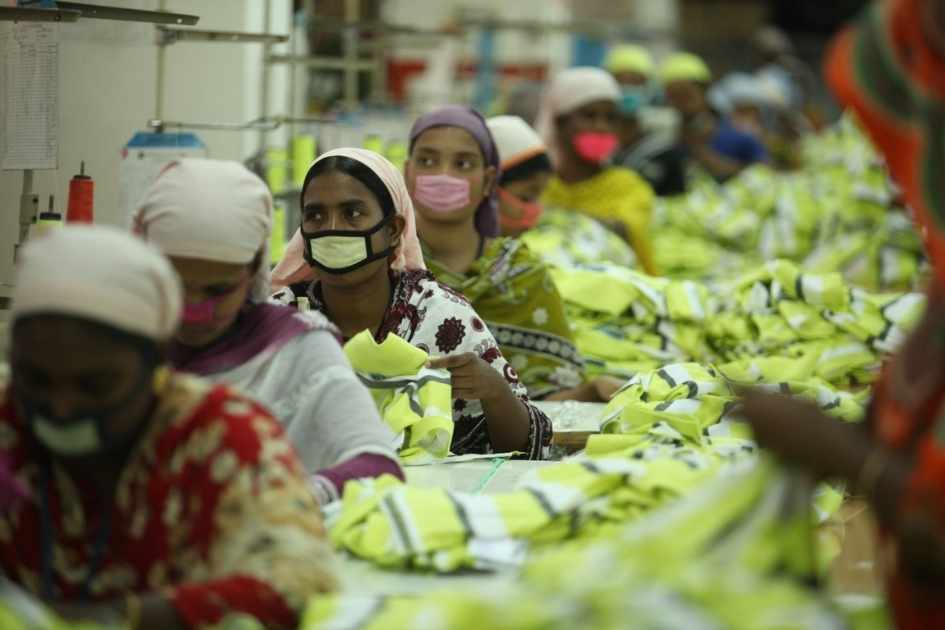
Industry leaders have voiced concerns over the pace of Bangladesh’s LDC graduation. Sixteen major trade bodies, including the Federation of Bangladesh Chambers of Commerce and Industry and the Bangladesh Garment Manufacturers and Exporters Association, have called for a postponement. They emphasized that extending the graduation timeline by five to six years would allow both the government and private sector to make necessary preparations, including export diversification, building human capital and attracting quality foreign investment.
ICC Bangladesh President Mahbubur Rahman said, “Our entrepreneurs and business chambers strongly support graduation. However, we stress the need for a five to six-year deferral. During this time, the government and private sector can take necessary steps and this will prevent future challenges.” He added that without diversifying the export basket and fully developing existing potentials, the country would struggle to move forward.
Md Fazlul Hoque, former BGMEA president, noted, “Our factories face structural challenges. Other countries in this group enjoy uninterrupted energy, low-interest loans and reliable infrastructure. Without similar support, workers and industries could struggle to remain competitive.”
Civil society and youth organizations are emphasizing labor protections, social inclusion and climate resilience. Sohanur Rahman, Executive Coordinator of YouthNet Global, said, “Bangladesh’s graduation is a critical moment for workers, youth and communities. We must ensure that labor rights, gender equality and climate-resilient practices are embedded in every sector.” He added that civil society and government must work together to provide training, fair wages and safe working environments so that no one is left behind during this transition. He said, “We need a strategy that protects workers, strengthens civil society and helps businesses adapt to new trade and climate realities. If we ignore this, the costs will fall on the most vulnerable.”
Labor rights remain a pressing concern amid economic recovery. On January 12, Sultan Uddin Ahmed, Executive Director of BILS and head of the Labor Reform Commission, presented a 15-point charter advocating protections for all workers. These include legal recognition for both formal and informal laborers, ending temporary outsourcing, establishing balanced wage structures, mandating equal pay for women, men, disabled and indigenous workers, extending maternity leave to six months and taking action to end child labor.
Nazrul Islam Khan, convener of the National Advocacy Alliance for Labor Rights and a member of the Bangladesh Nationalist Party National Standing Committee, said, “These 15 points are fully within the Constitution and existing laws. Policymakers must remember that the labor force drives the nation.” The Alliance brings together trade unions, labor organizations and civil society groups and formulated its recommendations based on the Labor Reform Commission’s proposals and the Sustainable and Competitive Labour Platform framework.
Farah Kabir, Country Director of ActionAid Bangladesh, highlighted the urgency posed by declining aid. She said, “Critical projects are under threat due to funding shortages. Women, children and marginalized communities face the highest risks.” She emphasized that immediate and coordinated action is essential to prevent growing inequality and protect livelihoods.
NGO Affairs Bureau data shows aid to NGOs fell to $655 million last year, an 11.6 percent decline from 2020. Sudden donor policy changes and rising trade tariffs have further impacted vulnerable communities.
Dr Khondaker Golam Moazzem suggested exploring south-south funding, implementing CSR policies led by the Finance Ministry and dedicating resources for rights-based development. Professor Dr Sharmin Nilormi of Jahangirnagar University emphasized practical implementation, saying, “Graduation requires strong monitoring of labor conditions, effective training and ensuring CSOs can support workers in adapting to industrial changes.” She added, “Planning alone will not protect communities.”
Bangladesh’s simultaneous focus on LDC graduation, macroeconomic stabilization and labor rights reform reflects a nation navigating complex domestic and international challenges. While debates continue over the pace of graduation, the government remains committed to achieving this milestone on schedule, signaling its readiness to transition from a least developed to a developing country on the global stage.
“As Bangladesh prepares to graduate from Least Developed Country status in 2026, we face rising global protectionism and the loss of key trade privileges. We need a more resilient, competitive and reform-focused development model to navigate an increasingly fragmented global trade landscape,” said Mohammad Abdur Razzaque, chairman of the Research and Policy Integration for Development (RAPID).




