

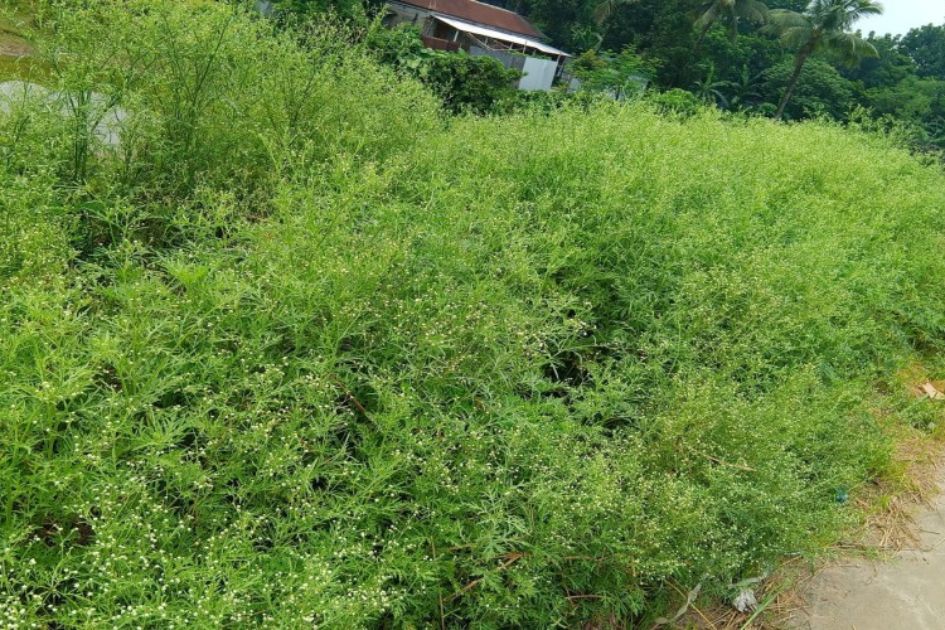



The invasive parthenium weed is spreading rapidly across Sirajganj, threatening biodiversity, agriculture, livestock and public health, while authorities intensify control measures and urge greater public awareness to contain its expansion.
The rapid spread of the toxic parthenium weed across parts of Sirajganj district in northern Bangladesh is posing an increasing threat to biodiversity, agriculture, livestock and public health, prompting authorities to step up efforts to contain the invasive plant.
Parthenium, a fast-growing poisonous weed that resembles a coriander plant, is now spreading across fallow land, cropland and roadsides in several districts of Bangladesh. In Sirajganj district, located in the Rajshahi Division of North Bengal, the weed has expanded rapidly in at least the upazilas of Raiganj, Tarash, Kamarkhand and Kazipur. Its presence is particularly noticeable along highways.
Although the plant, which grows about two to three feet tall, appears attractive with its small white flowers blooming among green leaves, experts warn that it conceals a serious environmental and health hazard.
The Department of Agricultural Extension in Kamarkhand has already begun spraying affected areas as part of efforts to remove the weed.
Agricultural experts and health specialists said parthenium is native to North and South America but has now become established in Bangladesh. They warned that unless it is brought under control immediately, it could become a major threat to agriculture, the environment, livestock and public health.
Despite the growing risk, most people remain unaware of the plant’s name and its harmful effects.
Although the weed survives for only three to four months, it flowers and produces seeds several times during its life cycle. A single plant can release thousands of seeds that spread to new locations through wind, water, vehicles and animals.
The weed was rarely seen only a few years ago but is now appearing around many agricultural fields across the district.
Sirajganj District Livestock Officer Dr KM Anwarul Haque said parthenium is extremely harmful to livestock. Animals that consume the weed may suffer from digestive disorders, fever, weakness and various diseases. He warned that the plant is so poisonous that livestock may die soon after eating it.
He said livestock farmers are being made aware of the dangers of parthenium through upazila-level livestock offices.
AKM Monjure Maula, deputy director of the District Department of Agricultural Extension, said parthenium has officially been identified as a poisonous weed and that the Ministry of Agriculture is aware of its harmful effects.
He said it is believed that the weed entered Bangladesh through seeds carried on the wheels of trucks arriving via the country’s land ports. The plant is generally found in greater concentrations along highways.
During workshops, farmers are being advised to burn parthenium weeds to prevent further spread, he said, adding that the invasive plant can be eradicated through coordinated government action.
This post is republished from Bangla News 24 BD.




