




If Burmese scam compounds that have somehow shrugged off thousands of bullets can remain standing, how could anyone believe flicking a switch on utilities would bring them down?
Bangkok, Thailand
In only his 28th day in office, the newly appointed Thai Prime Minister, Anutin Charnvirakul, received an urgent request to help a group of his citizens who were reportedly trapped in a scam center just a few kilometers from the country border checkpoint adjacent to Myanmar.
It occurred only a few months after the crackdown in February, which involved China, Thailand, and Myanmar. These countries had been pressuring Shwe Kokko, one of the most notorious scam centers in Southeast Asia, located in Myanmar’s Karen state bordering Thailand.

Three countries believed those scam centers would fall to their knees. Without proper utilities, how could the compound, the size of a city with 300,000 residents, survive?
But an urgent request made to the Thai Prime Minister seven months later proved otherwise.
Scam centers have become a massive problem for Thai-Burmese relations, as has the so-called ‘pig butchering’ of millions of digital victims around the world they house.
But little thought has been given to how much energy is needed to power these sophisticated, tech park-style compounds, which utilize high-powered servers, scores of terminals, and hundreds of human employees working day and night.
And the public is probably even less aware of how dirty the energy they run on can be.
Karen State, Myanmar
Anton*, a chef in Shwe Kokko, said the situation in the town is similar to everyday life before the Thai government’s intervention earlier this year. Even after another dramatic raid in late October that drove nearly 2,000 people to flee, existing businesses appear to be operating normally.
“Those Chinese online scams rely on big generators they quickly acquired right after the cut; my restaurant runs as usual, the karaoke parlors do the same. Customers come a bit less frequently because some of them relocate to other nearby towns,” she said, referring to over ten scam towns lying a few kilometers away.
Sound of roaring generators in Shwe Kokko, Myanmar recorded from the Thai side of the border / Credit: Kannikar Petchkaew `
On the bank of the 20-meter-wide Moei River, which runs along the countries’ border, residents on the Thai side hear the loud noise of generators day and night. The town, once sparkling and luminescent with lights and fireworks, now appears dim.
But business roars along.
“You will no longer see fireworks celebrating the jackpot winning in the casino as you often did. But the business just runs as usual. The casinos could spin and scam [operations] can run without demanding big power,” says a karaoke parlor manager.
When interviewed, Banpot Kokiatcharoen, the honorary president of the Tak Chamber of Commerce, overseeing trade on this border, was not surprised to find no record of diesel generators being exported from Thailand.
“All arrived directly from China or other countries as in-transit cargo. Even bottled soda in the grocery in Shwe Kokko is from China,” said Kokiatcharoen.
Amorn Nayom, a cross-country truck driver, observed the same while spending days waiting near the border after the Myanmar authorities ordered the temporary closure of the border in August.
“Trucks that have been stranded here mostly carry in-transit goods. We tug them from the port and go straight to Myanmar, don’t even know what exactly is inside.” On his truck lay a 40-foot container he had tugged from a Chinese container yard at Laem Chabang deep-sea port, destined for Shwe Kokko.
Under international customs rules, transit cargo bound for another destination is exempt from import duties, taxes, and inspections, provided it is transported in sealed containers, supported by customs guarantees and electronic documentation to ensure the goods remain intact.
The investigation found that the scam compounds had not only not been brought to their knees, but were thriving. Instead, satellite images from October revealed the most recent development in Shwe Koko and KK Park, with multiple blocks of new buildings and infrastructure popping up following the crackdown.

An ASPI report, Scamland Myanmar, reveals the explosive growth of dedicated scam compounds along the Thailand-Myanmar border since 2021, with the number increasing from 11 to 30 (almost 300%), including an average of 13.5 acres constructed per month over the past four years.
Since cement powder and ready-mixed concrete are not on the ban list of exports across the border, Thailand exports an average of 30,000 tons of it to Myanmar each month, as well as nearly 3,000 tons of rebar. These materials are used in heavy construction.
The 2024 Global State of Scams Report reveals that in 2023 alone, cyber scams have siphoned off a staggering US$1.03 trillion from unsuspecting victims worldwide. The United Nations Office on Drugs and Crime (UNODC) estimated that the annual profits of such scams approach $40 billion, with a 600% surge in AI-generated content tied to fraud in Southeast Asia alone.
Diesel-powered scams
In late September, Pongthep*, a Thai citizen with unpaid debt to a loanshark, left his home, telling his mother he would be looking for a new job in Bangkok, which is two hours away. He arrived a few days later at the Yulong Bay Park scam compound in Mywaddy, Myanmar, a few kilometers from the official Thai checkpoint.
Pongthep had set foot in a newly relocated center from Laos upon his arrival. “Golden Cobra’s Saffron Flower Forest” features a modern four-story, circular-shaped office equipped with hundreds of computers, an extensive collection of cellphones, and a secure internet connection. Over 500 workers toil under a Chinese management team that oversees operations through Google Translate and a Telegram group chat.
To Pongthep, the company appears well-organized; every worker wears an ID card featuring the logo of a mythical lion over their chest, stating their name and department – in Pongthep’s case, “Advisor.” The company provides a canteen where food is served free of charge, as well as free boarding in rows of apartments.
During the Chinese Golden Week, the compound’s boss gave small gifts to his employees.
But the job description is stark: to scam unsuspecting victims.
“We started by creating fake social profiles. Taking random pictures and videos from the internet, then making them our own. Each account should be active on multiple online platforms, including Instagram, TikTok, and Facebook, just like everyone else does. We work 9-10 hours a day doing just this,” explained Pongthep. Every worker in his section has two cellphones each to work on, with a crew standing by to recharge them.
While the company may be new, the cyber scam model is not. Operations like the one in Yulong Bay Park have been ongoing since 2022, according to Justice For Myanmar, a covert activist group that investigates and exposes the Myanmar military’s business networks and corruption. And shareholders in the founding company include leaders of the separatist Karen Border Guard Force (BGF), which controls the area.
Pongthep was a bit surprised when asked if his office ever faced a power shortage or outage: “The whole town has over a hundred diesel generators that work continuously. We don’t have that issue. Charging rooms have hundreds of chargers, and an air conditioner runs in every operation room. “

In the resident area, generators will stop between 5 and 8 am for maintenance and refueling, he said, but the office buildings have lines of large generators that take turns running for 24 hours.
We won’t rush
Emelda* is from the Philippines and has been working at WD Company in the KK5 scam compound, also under BGF control, for nine months. Her workplace was untouched by any raids.
Each month, Emelda discovers 200 profiles of primarily US nationals using various online platforms: Facebook, LinkedIn, Instagram, and Nextdoor. Then, she is instructed to deliver three “potential” profiles to her Chinese supervisors for “the next steps.”
Recent Thai government records indicate that 1 million incidents of cyber scamming, such as pig butchering, have been identified annually. The damages exceed 89 billion Thai baht (US$2.5 billion). Some 73% of the population has been targeted by online criminals, with half having fallen for this kind of fraud.
In a June interview, Lieutenant-Colonel Naing Maung Zhaw, the spokesperson for BGF, told Prachatai that all scamming operations switched to diesel generators and began acquiring internet via Starlink, the satellite-based provider, immediately after the cut.
When Prachatai visited his army compound, two large diesel generators were clearly visible, and Lt. Col. Zhaw’s office was equipped with a strong internet signal.
Targets differ in each scam center department. Pongthep ’s target is women in their fifties. The idea is to make acquaintances and lure victims into “investing” in a lucrative business. According to Pongthep, it can take weeks or even months to extract large sums of money from a target.
Manuel*, a Filipino man in his mid-twenties who works in the same compound, explained: “We persuade them to invest in Bitcoin or crypto. Tell them how much money we have made, repeatedly convince them of a big fortune. We won’t rush. If they show any hesitation, we change the subject. Bring them up in small talk, hobbies, or amusing gossip.”
Apart from US$800 monthly salary, almost three times the minimum wage in his country, he has been promised a commission as high as 12% for every $30,000 he obtains from dupes .
“The commission is why scammers always suck every drop of blood from their victims,” he explains.
Dr. Ivan Franchesini from the University of Melbourne, who has studied scam centers in Southeast Asia for years and co-authored the book Scam: Inside Southeast Asia’s Cybercrime Compounds, shares findings from his extensive research, emphasizing that scam centers require careful, discreet organization, like every modern business.
“It’s not that they thrive in places where everything is chaos, there is no law, everything is a mess. No. The compounds need stability to operate,” he said. Dr. Franchesini has found that scam centers are all flexible and resilient in the face of any challenges they may encounter.
The golden rule in every scam compound is that scammers must initiate their newest conversation with victims by showing growing interest in fake crypto wallets, expressing happiness, and demonstrating how they want their newfound friend to be happy, too.
“Fake wallet pictures and links or any material supplied by the logistics department mostly work among the Chinese,” Thura* a young Karen worker, said. He did not know what crypto wallets were used when it came time to withdraw all the money. Only the boss seems to know.
“The victims don’t invest in any crypto but just send their money to someone’s account or wallet. They will never have any return. When money goes out, it’s forever gone. It’s all fake from the very beginning. The only real thing is the money that you pour into it.” explained Win Ko Ko Aung, a crypto bro who travels the world advocating for cryptocurrency as a way to avoid financial control by the state.
“You can initiate your own crypto. Everyone can do it. You can send and receive money with your own crypto. Your crypto will never be frozen like your bank account. [Certain] cryptocurrencies are totally anonymous, even when Bitcoin can be traced .” However, Win admits that cryptocurrency has been used to commit crimes and evade the law.
“But it’s the people that should be blamed, not the technology,” he argued.
In another scam center in Deko Park, Wawlay under the direction of the Democratic Karen Buddhist Army (DKBA), another armed rebel group, Patrick*, a 26-year-old Ugandan national, describes how he shares his dormitory room with several co-workers from the same department: “[There is] room 3 for boys from the TikTok department, room 5 and room 6 for the sales department. His office, meanwhile, works 24/7. “Our office doesn’t have time off, and it’s always busy.”
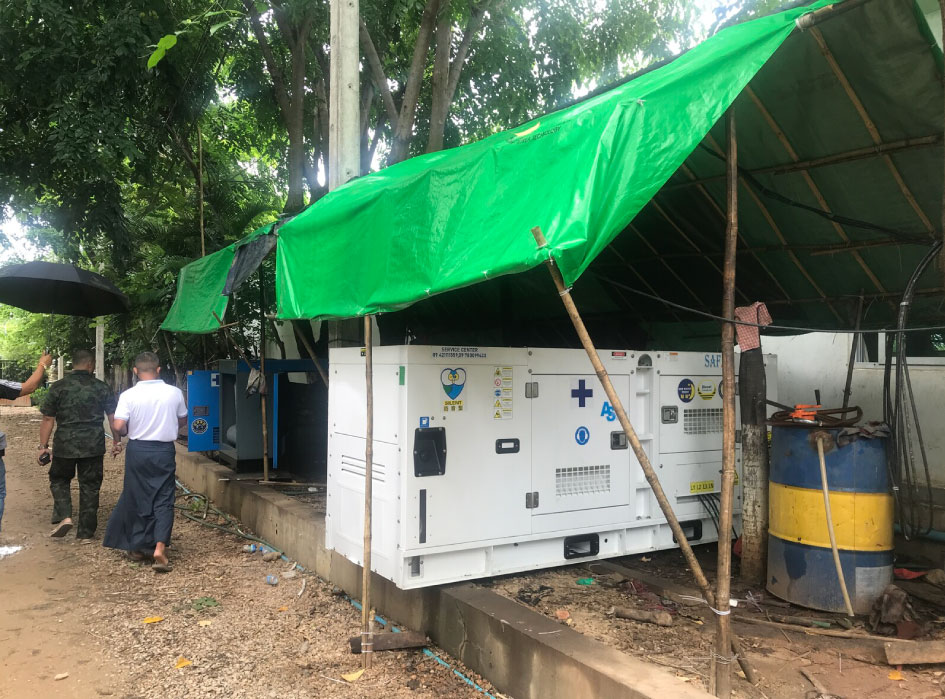
Meters away, a containerized, sound-attenuated generator (“genset”) whirs tirelessly under a shelter.
Powering notorious Shwe Kokko
Fifteen kilometers up north in Shwe Kokko, lies a notorious scam hub that is part of a total planned area of 120 km² and valued at US$15 billion. Young laborers work their 8-hour shift in what they call a “studio” room, where they sit along three rows of twenty in a high-rise building in a bustling downtown. Their techniques include using AI-generated content to lure their prey.
“We work across languages using AI. Scripts generated with the help of AI. We have different teams for the script, text, and messaging, and the dialogue,” Reported Htet*, another young Karen man, who just finished high school in Thailand.
As a child of migrants in Thailand, he had the opportunity for a good education and even became proficient in English and in using new tech. He still felt he was unable to secure a decent job .
Htet is not a legally naturalized citizen of Thailand; he can’t even leave the border town he lives in for a better opportunity without permission.
“I can’t see myself ending up on the construction sites for a $9 daily wage with skills I worked so hard for,” said Htet. For his role in initiating a romance scam targeting victims in both Asia and the US, he was paid $1,000 per month, ten times what his countrymen typically earn.
According to Dr. Franchesini, however, there is a common misconception that the workers in the cybercrime industry are highly educated, speak English or another global language, and are tech-savvy. Such overgeneralizations can also mean that authorities are not tackling the root causes of labor in this underground economy.
In an interview with a sample of 62 former scam workers, Dr. Franchesini’s found that almost half of them only have a middle school education, 15% a primary school education exclusively, and all speak only their mother tongue.
In a 2023 report on combating telecom and online fraud, China’s own Supreme People’s Procuratorate noted that cyber scammers exhibit the “three lows” (三低 ): low age, low income, and low educational attainment.
Like other scammers, they steal pictures, videos, and even personal identities of people they can find online and make fake accounts, then start reaching people and pig butchering them day and night.
In Htet’s own office, which spans two entire floors, electricity is available for every computer terminal and hundreds of cellphones, while air conditioners generously cool the work area. He knows it comes from giant diesel generators down the road. Htet says dozens of generators are placed directly next to his building, but he has no idea which ones belong to his office.

Prachatai found that among the generators located in residential areas are 450 kVA GESAN DPR 45 – high-end Spanish “soundproof canopy” diesel gensets. These gensets boast a sound level of under 70 decibels, lower than the voice of road traffic, and have a shell that protects them from rain and dust.
Such a generator has a capacity of about 200–250 liters of diesel in its built-in base tank. At 75% capacity, which is ideal for offices with light machines like computers, cell phones, and air conditioners, it could last over 30 hours.
While in the business area of Shwe Kokko, large Chinese generators with capacities exceeding 800 kVA have been installed under shelter. These are much louder than the Spanish devices and require protection from the elements.
Such a coordinated use of up-market generators could very well be further evidence of a highly professional operation.
“In one big business, they have over a hundred of this kind of generator,” one worker in Shwe Kokko told Prachatai. It is difficult to independently verify these claims because of lack of physical access to the scam centers, but before the Thai government cut off power to the region, the town had been supplied by a 8-megawatt power station, which was on the verge of increasing to 10 MW.
“It’s so straightforward; burning causes carbon emissions. Any kind of burning works that way,” says Yossapong Laoonual, an associate professor in mechanical engineering and a long-time advocate for clean energy.
A row of diesel generators and fuel stock at one scam center/ Credit: Myo Naing Ans
According to the United States Environmental Protection Agency, every liter of diesel releases 2.5 kilograms of carbon dioxide into the environment.
Lt. Col. Zhaw from BGF told Prachatai that diesel for each generator has been supplied from cities in Myanmar’s interior. What he didn’t mention was that many have been sneaked across the river from Thailand, where over 50 piers, big and small, lie. Thai border patrol intercepts only some of them.
A Thai national who was arrested while attempting to smuggle thirty barrels of diesel admitted that he had purchased the diesel at roughly $1 per litre, but could sell it for as much as $2.50 once it arrived on the other side of the narrow river. The business is in high demand, he informed Prachatai.
But for Dr. Yossapong, it comes with a huge cost. He refers to particulate matter pollution, a major public health threat, as one of the main culprits. “We have encountered a problem with the PM2.5 particles across the region due to burning. Burning diesel is hazardous. It’s an outdated technology that relies on fossil fuels, which the world is trying to phase out,” he said.
A typical diesel generator and its byproduct / Credit: :r/Generator subreddit on Reddit.
A medical meta-analysis found that people who breathe air with high levels of PM2.5 for years have a higher chance of getting and dying from lung cancer.. Even a small increase in PM2.5 — just 10 micrograms per cubic meter — can raise the risk by about 8 to 1%.
To Wan Wiriya, an associate professor of chemistry and a researcher at the Environmental Science Research Center, Chiangmai University, the most concerning aspect of diesel generators is not PM2.5, though.
Rather, mercury, a potent neurotoxin that can damage the brain and nervous system, is his concern.
“Mercury is an airborne substance that is highly volatile and stable. It can remain in the atmosphere for up to a year before depositing on land or water. Particle-bound also tends to settle faster—within hours to days, depending on particle size,” Dr. Wiriya said. Mercury can often travel up to hundreds of kilometers while suspended in the air.
In late October, following media reports about scammers in KK.Park using Starlink satellite internet terminals, the BGF accompanied the Myanmar military in confiscating 30 of the terminals, or dishes, and announced the operation a success. A few days later, SpaceX, Starlink’s parent company, cut internet service to all the dishes in town, which amounted to 2,500 in residential and commercial use – more than 80 times the number the scammers allegedly operated. During the week that followed the military raid on the surrounding town, thousands of locals fled to Thailand.
Nevertheless, hundreds of diesel generators remain. A brief video obtained by Prachatai shortly after the raid showed a number of generators and barrels of diesel in fine condition at one scam center.
In Myanmar, it would appear that no matter how sophisticated the technology and professional the organization, elaborate cybercrimes are committed with dated engineering run on the dirtiest of energy. The harm to the world at large is no longer limited to financial loss and a torn social fabric.
Back in Mae Sot, the border district on the Thai side, Kannavee Suebsang, a Thai lawmaker who long worked to stop human trafficking, stood on the bank of the river complaining to accompanying members of the media.
*Names have been changed for the safety of the sources interviewed.
The report was produced with support from Internews’ Earth Journalism Network as part of the “Dark Side of the Boom” collaborative reporting project on resource-intensive digital technology in Asia. It was lightly edited for length and clarity. The original story can be found here in Thai at Prachatai and here in Burmeseat The Irrawady.




