

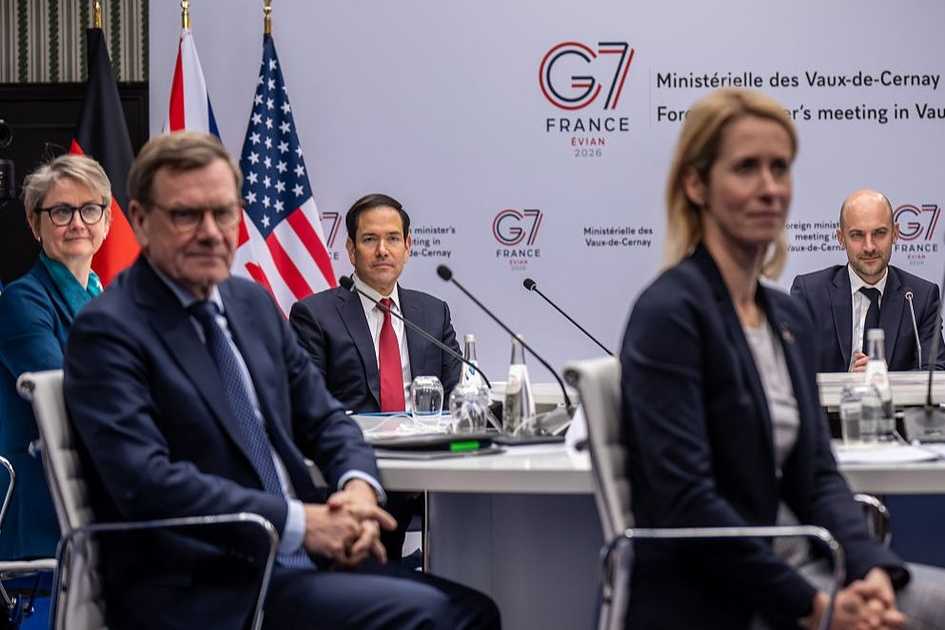



France avoided climate discussions at the G7 meeting in Paris to maintain unity with the United States, prompting criticism from activists who warn it weakens global climate leadership.
Climate change was deliberately sidelined at a Group of Seven meeting in Paris as host France sought to avoid friction with the United States, a move that has drawn sharp criticism from environmental groups.
The office of France’s ecology minister Monique Barbut said the G7 would instead focus on “less contentious issues” in a bid to accommodate its most powerful member.
Barbut defended the approach, saying the G7 “must remain a forum for convergence” and that France was prioritising unity at a time when environmental protection was slipping down the global agenda.
“I hope we can send a strong message of unity and ambition,” she said at the opening of the meeting.
Environment ministers from Italy, Canada, Japan, Germany and the United Kingdom travelled to Paris for the talks, while Washington sent Usha-Maria Turner, an assistant administrator at the US Environmental Protection Agency.
Discussions are set to cover ocean conservation, biodiversity financing and desertification, among other broad environmental themes.
Barbut’s office said it “chose not to address the climate issue head-on because the United States’ positions on this subject are well known”.
President Donald Trump’s administration has withdrawn the United States from global climate agreements and rolled back environmental protections since returning to power in 2025.
Activists warned the decision risked undermining global efforts to tackle the climate crisis.
“A G7 moving at the pace of the United States cannot claim to respond to the crises of the century,” said Gaia Febvre from Climate Action Network, an alliance of advocacy groups.
“By yielding to pressure, it weakens collective action and renounces its potential leading role,” she told AFP.
The meeting comes just days before more than 50 countries gather in Colombia for the first-ever global conference dedicated to phasing out fossil fuels, the primary driver of climate change.
France is also pushing an initiative to mobilise public and private financing for biodiversity protection and is seeking backing from other G7 members.
According to sources close to the matter, Barbut’s ministry aims to announce 800 million dollars in funding for national parks across around 20 African countries.
Jean Burkard, advocacy director at WWF France, welcomed the inclusion of biodiversity funding on the agenda but cautioned that any financial commitments “must be additional and not compensate” for cuts elsewhere in state budgets for nature.
The G7 meeting is also expected to seek agreement on a political declaration linking desertification and security, while ocean-focused sessions aim to strengthen cooperation on marine protected areas.
Further discussions will address water pollution, and delegates are scheduled to visit the Fontainebleau forest south of Paris on Thursday as part of a session focused on woodlands.
Source: France 24




