

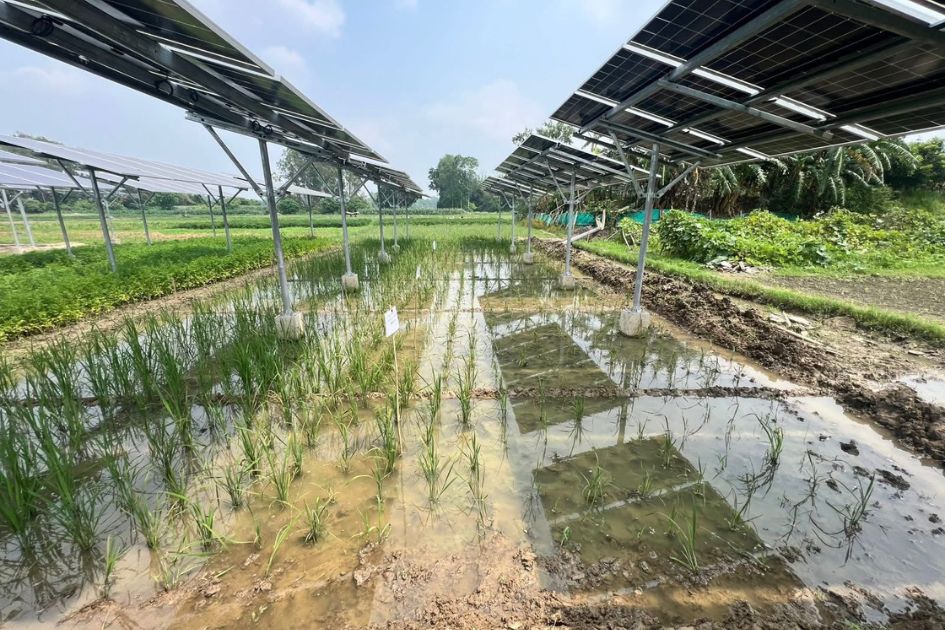

Fuel shortages expose risks to Bangladesh’s agriculture, prompting interest in agrivoltaics as a dual solution to sustain irrigation, protect yields and strengthen resilience across energy and food systems.
The recent global fuel crisis has exposed critical vulnerabilities in Bangladesh’s energy and food security systems, raising fresh concerns for the country’s agriculture-dependent rural economy just ahead of the crucial boro harvesting season.
As fuel shortages disrupted supply chains and limited irrigation access in several regions, small and marginal farmers have been among the hardest hit, intensifying fears of reduced yields and income losses at a critical time in the agricultural calendar.
Experts warn that the overlap between energy insecurity and food production risks could deepen structural fragilities in the country’s rural economy if alternative systems are not scaled urgently.
Against this backdrop, a new initiative led by the BRAC Institute of Governance and Development, with funding from the H&M Foundation, is highlighting a potential pathway forward: agrivoltaics.
Agrivoltaics refers to the dual use of land for both agriculture and solar energy production, where solar panels are installed above crops, allowing farmers to continue cultivation while simultaneously generating electricity.
Under this model, farming remains the primary land use, while energy production acts as a secondary “harvest,” reducing dependence on diesel-based irrigation and grid electricity without reducing arable land availability.
Pilot projects in Manikganj have shown promising results. According to project findings, solar-powered irrigation systems continued operating even during regional fuel shortages and intermittent power outages, helping maintain agricultural activity when conventional systems were under strain.
Development practitioners say the model could offer a scalable solution for climate-vulnerable and energy-insecure regions, particularly in countries like Bangladesh where agriculture remains highly sensitive to energy price shocks and supply disruptions.
Sohanur Rahman, executive coordinator, said the approach reflects a necessary shift in thinking about resilience. “We cannot treat energy and food systems separately anymore. Solutions like agrivoltaics show how climate resilience, food security and clean energy can be addressed together in the same landscape,” he said.
However, experts also caution that wider adoption will require policy support, financing mechanisms and integration into national energy and agricultural planning frameworks to move beyond pilot-level impact.
As Bangladesh navigates overlapping pressures from climate change, global energy volatility and food security challenges, agrivoltaics is increasingly being viewed as a potential bridge between two critical sectors, energy and agriculture, at a time when both are under strain.




