

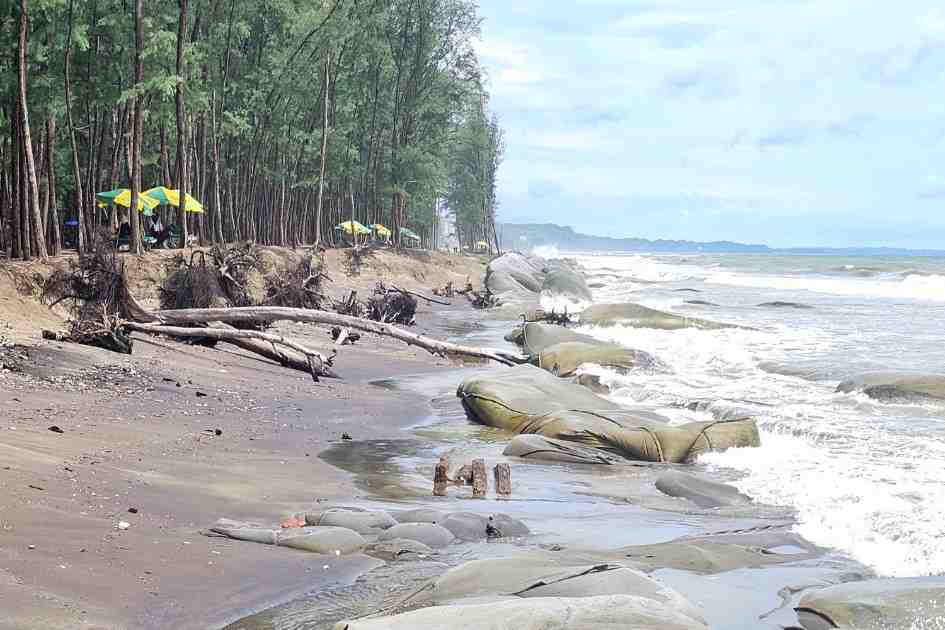



Rising sea levels and coastal erosion are displacing thousands in Cox’s Bazar, destroying homes, farmland, and livelihoods. With 60,000 people uprooted from Kutubdia alone, saltwater intrusion, mangrove loss, and tourism threats underscore Bangladesh’s escalating climate crisis and urgent need for action.
Standing on the fractured edge of a washed-out embankment in Khudiarthek, Kutubdia, South-eastern coast of Bangladesh, Mohammad Fayez (50) watches the sea with weary eyes. He has lost his home four times to coastal erosion. His current shelter, a makeshift hut wrapped in polythene, is his last stand against the tide.
“Each year the sea comes closer,” Fayez told The Climate Watch. “It has taken our land, our homes, even our people. Where do we go now?”
Fayez’s sister Razia Begum, widowed when her husband disappeared in the Bay of Bengal 16 years ago, now lives with him. “I have two daughters, but no home, no savings,” she said. “How will I marry them off?”
Their stories reflect a harsh reality for tens of thousands in Cox’s Bazar, where the sea is steadily swallowing coastlines and communities.
60,000 displaced in Kutubdia alone
According to the Cox’s Bazar Upazila administration, about 3,000 acres of land in Khudiarthek and Rajakhali have eroded into the sea since the 1991 cyclone. An estimated 60,000 people have been displaced, with over 40,000 settling in Cox’s Bazar town’s Ward-1.
Beyond Kutubdia, residents of Maheshkhali, Matarbari, Dhalghata, and Saint Martin’s Island also face rising risks from sea level rise and extreme weather.
The Internal Displacement Monitoring Centre (IDMC) reported in its 2024 Global Report that 2.4 million people in Bangladesh were displaced due to natural disasters in 2023, placing Bangladesh fifth globally in disaster displacement rankings (IDMC, 2024 Global Report on Internal Displacement).

Sea level rising faster than global average
A 2024 report by the Bangladesh Ministry of Environment, Forest and Climate Change, titled Estimation of Sea Level Rise in Bangladesh Using Satellite Altimetry Data, found that the sea level along the Chattogram-Cox’s Bazar coast is rising by 3.7 to 4.2 mm annually, higher than the global average of 3.42 mm, as cited by the IPCC Sixth Assessment Report (IPCC AR6, 2021).
The U.S. Earth Information Center estimates sea level along Cox’s Bazar coast rose 11.3 cm from 1993 to early 2024, and may rise 1 meter by 2100 under high-emission scenarios (NASA EarthInfo Center, 2024).
Salt invades land and livelihoods
Saltwater intrusion has devastated agriculture and fisheries—the backbone of Cox’s Bazar’s coastal economy. Government records show over 237,000 families rely on agriculture, 551,000 people on fishing, and 140,000 on salt production. Yet rising tides and soil salinity are making farming and salt harvesting increasingly difficult.
In Maheshkhali, farmer Nurul Amin said, “Three of my five plots are now useless because of salty water. The rice seedlings just rot.”
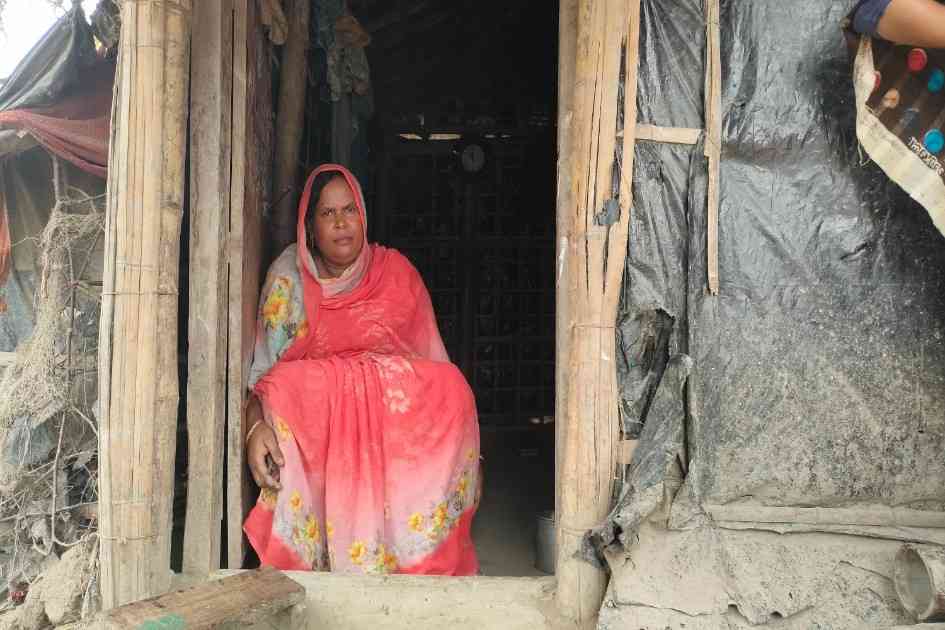
Salt producer Mohammad Helal Uddin added, “If a tide floods the salt beds, I lose 10–15 days of work. That’s up to Tk 60,000 gone.”
Fisherman Mohammad Tarek, displaced from Kutubdia, recalled recent storms. “Waves now rise so high that we see trawlers sink before our eyes. We can’t save them.”
Drinking water under threat
The Department of Public Health Engineering (DPHE) reports alarming levels of groundwater salinity in coastal areas. In Cox’s Bazar city, salt concentration in water reaches 600 ppm. In Teknaf’s Hnila, it’s 3,600 ppm, and in Kutubdia’s Koiarbill, 2,400 ppm—far above WHO’s safe drinking water limit of 250 ppm for sodium(WHO Guidelines for Drinking-Water Quality, 4th Edition).
DPHE engineer Abul Monjul warned, “If trends continue, these areas will face major drinking water crises within two decades.”
Beach erosion and tourism at risk
Cox’s Bazar beach—the world’s longest natural sea beach—faces erosion of 3–10 meters per year, especially between Nazirartek and Inani, according to a 2022 World Bank report titled Enhancing Coastal Resilience in a Changing Climate(World Bank, 2022).
Tourism, which contributes Tk 37,500 crore annually and supports over 500 hotels and resorts, is in jeopardy.
“We need to study how erosion will affect tourism in the next 20 years,” said Cox’s Bazar Chamber President Abu Morshed Chowdhury Khoka.
Mangroves gone, protection lost
Mangrove forests once shielded the coast. Now, they’re being destroyed to make way for shrimp enclosures and salt beds. The Forest Department confirms that 900 acres in Kutubdia and 5,000 in Maheshkhali have been cleared.
Environmental groups say up to 40,000 mangrove trees have been felled in Sonadia and Ambashyakhali.
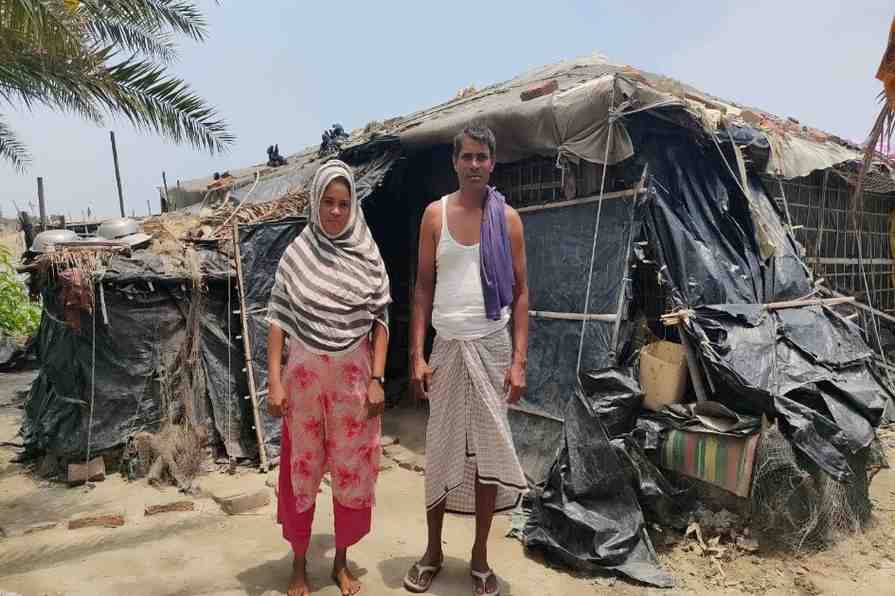
“Without these trees, the coastline has no buffer,” said M. Shahidul Islam of local environmental group Dhara. “Tides erode the land faster.”
State response and the need for Nature-based solutions
The government has initiated several large-scale projects: A 6-km coastal protection dyke in Nazirartek; An 18-km super dyke in Matarbari (Tk 3,818 crore); A 6.5-km dyke in Kutubdia (Tk 980 crore)
“We’re designing these with 10-meter height due to rising sea levels,” said Executive Engineer Nurul Islam of BWDB.
Agricultural Extension officials are also promoting 10 salt-tolerant rice varieties and 5 new crops across 6,000–8,000 hectares of salinized land.
But experts stress that engineering alone won’t save the coast, “We must protect mangroves and explore bioengineering solutions,” said Dr. Shah Newaz Chowdhury. “Concrete walls are not a long-term answer.”
BAPA Secretary General Kalim Ullah added, “In climate-vulnerable countries like Bangladesh, coal use must decrease. Developed nations must also reduce emissions and support sustainable adaptation.”
As the sea rises, so do the stakes. In Khudiarthek, Fayez still lives with the fear of the next wave.
“We’re losing our homes, our past, and our future,” he said. “We don’t want to leave but the sea is giving us no choice.”




