

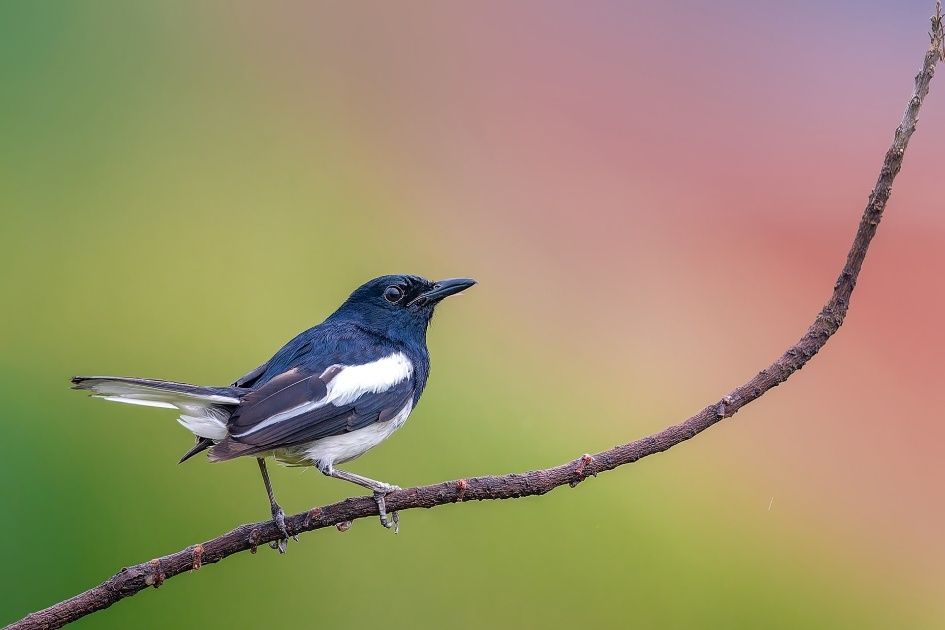



As urban growth reshapes courtyards, campuses and residential streets, the Doel’s survival points to the importance of keeping ordinary green spaces within Bangladesh’s changing landscapes.
On a rainy morning in the village of Lautali, in Begumganj, Noakhali, Amena Begum finished her Fajr prayers and opened an old trunk. She is seventy, a widow who lives with her eldest son, Rafiq, in a three-room tin house. Among the accumulated belongings of a long life, she found a two-taka note from an earlier era, still bright. On its face perched a Doel, the Oriental Magpie-robin, Bangladesh’s national bird, rendered in clear black and white. She held the note for a long moment, and the years rearranged themselves around her.
There had been a palm tree in the yard once. In the mornings of her girlhood, the Doels came to it, hopping along the ground or perching in the fronds, their songs clear and varied, sometimes incorporating the calls of other birds as if trying on different voices. Those mornings were full of birdsong. The landscape around Lautali has changed. The palm is gone. Buildings have risen in its place. The morning walks Amena still takes no longer carry the same chorus. “When I was young,” she says, “I used to watch the Oriental Magpie-robin for a long time because it was our national bird. Birds often came to the palm tree in our yard. It is not like that anymore. The palm tree is gone too, as buildings have been constructed.”
Her memory is particular, but it points to a wider alteration. Across Bangladesh’s villages and cities, old green spaces are contracting. Trees disappear; roads and buildings expand; the familiar habitats of birds are rearranged or erased. The question that follows is quiet but persistent: as the country transforms, what becomes of the bird it once chose as its national emblem?
The Oriental Magpie-robin, Copsychus saularis, of the family Muscicapidae, has always seemed companionable. Males are glossy bluish-black above and white below, with a long, expressive tail; females trade the black for softer browns and greys. They forage mostly on the ground for insects, snails, earthworms, centipedes, the occasional small lizard, and some plant matter. They live alone or in pairs and are not shy of human settlements. During the breeding season, which in Bangladesh runs roughly from February to July and peaks in April and May, the males grow territorial, and their songs lengthen and grow more inventive, clear, lively phrases repeated and sometimes interwoven with imitations of other birds. For generations the Doel has moved easily between courtyard and garden, village edge and city fringe. Its morning whistle is woven into the ordinary soundscape of Bengal and into its literature, songs, and folk culture. That long proximity to people, together with its distinctive appearance and voice, is why it was named the national bird.
Bangladesh is rich in avian life. Different surveys and lists place the number of recorded species somewhere between seven hundred and more than eight hundred, a mix of residents, migrants, and occasional visitors. Among that diversity, the Doel occupies a special place, not only as a bird but as a symbol of a particular relationship between people and the natural world that once surrounded them more closely.
Cities are not uniformly hostile to that relationship. Urbanization fragments habitats, reduces trees and open ground, and changes the availability of food and shelter. Yet the Oriental Magpie-robin can persist where suitable conditions remain. A survey conducted between October 2022 and June 2023 on the main campus of Chattogram Veterinary and Animal Sciences University recorded it among the more frequently observed species, alongside House Crows, House Sparrows, Common Mynas, Asian Pied Starlings, Red-vented Bulbuls, and Rock Pigeons. In winter, the researchers identified thirty-nine species; in spring and summer, thirty-three. Planned green space, the study suggested, can still function as habitat. In other words, the question is less whether cities can support the Doel than what kind of cities are being built.
A 2022 study from Wuhu, in China’s Anhui Province, offers a sharper distinction. Researchers led by Yanhong Chen compared three kinds of urban environment: parks, low-rise residential areas, and high-rise residential areas. Density of Oriental Magpie-robins was highest in the low-rise zones, approximately 0.89 birds per hectare, against 0.42 in parks and only 0.19 in high-rise districts. Males in the low-rise neighborhoods also produced longer and more varied songs. Low buildings, residual open ground, and the small discontinuities that allow foraging and perching appear to suit the bird better than continuous vertical concrete. As Bangladesh’s cities lean toward higher and denser construction, the findings raise a quiet question about the environments being created for a species that has long lived near people.
In Halishahar, another part of Chattogram, Delwar Hossain’s house stands ringed by hundreds of old trees, a small green island amid the concrete. Bird numbers have declined, he says, yet the Doels still come. “Bird activity has decreased a lot. But because my house has so many trees, Oriental Magpie-robins still come here. We can still hear their calls in the morning.”
It is difficult to say that the Oriental Magpie-robin is disappearing. Field observations and the available studies make a simpler point: the bird needs suitable habitat. Where trees, bushes, open spaces, food sources, and safe perching sites remain, it can continue even in urban settings. Where those elements are removed or replaced by structures that offer little of them, its presence thins. There is no evidence that the species is vanishing from cities entirely; it is recorded on green campuses and around tree-filled houses. The China study shows that not all urban forms are equally hospitable. The bird appears capable of adapting to human-made environments, but there are limits to that adaptation.
The more precise question, then, may not be whether the Doel is disappearing. It may be whether the intermediate landscapes that once sustained it, the yards with palms, the low residential streets with their residual bushes and open soil, are themselves disappearing faster than the bird can follow. High-rise development continues. Green cover shrinks in some places and is carefully preserved in others. The bird’s presence becomes a kind of quiet referendum on the kind of country being built.
Morning will arrive again over Lautali and over Chattogram’s campuses and over the high new towers. Whether the clear, inventive whistle of the national bird will still thread through those mornings depends less on the resilience of the species than on how much ordinary, untidy, livable green space a changing Bangladesh decides to leave standing.




