

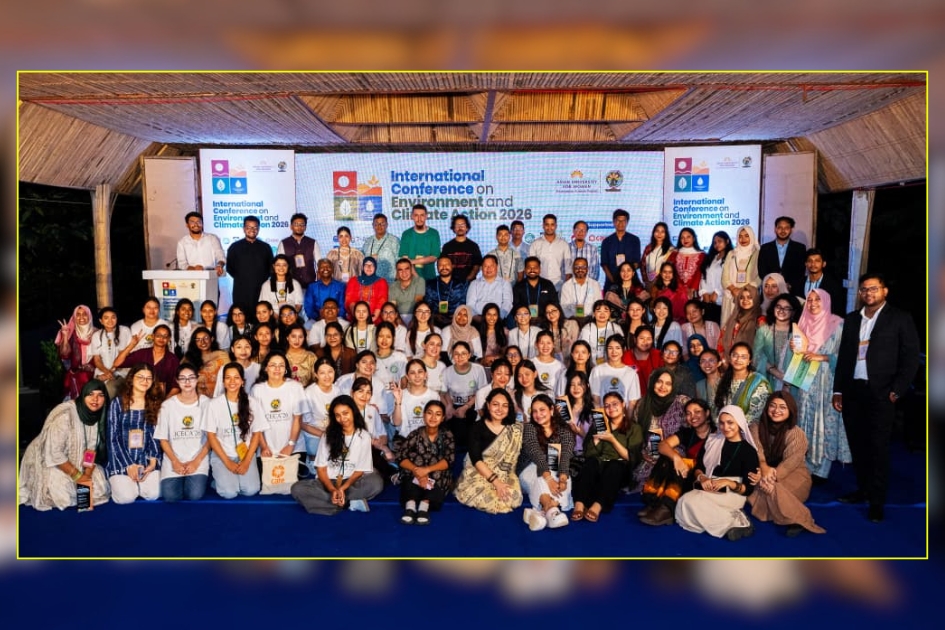



ICECA2026 brought scientists, policymakers and students together to examine climate justice, community-led governance, climate finance and evidence-based action ahead of COP31.
More than 150 researchers, policymakers and students from across the Global South and beyond gathered in Bangladesh this week for the second International Conference on Environment and Climate Action (ICECA2026), where speakers called for climate policies that place justice, community leadership and evidence-based decision-making at the centre of global action.
Hosted by the Asian University for Women (AUW) from Aug. 7 at the Sonapahar Farmhouse Resort, followed by a field visit on Aug. 8, the conference was organised by AUW’s Environmental Sciences Program in collaboration with the Green Bangle Movement, SONAPAHAR, KFL, YPSA and Change Initiative, with support from MTB. The event was held under the theme “Commoning Our Futures with Climate Justice.”
The conference brought together participants to discuss environmental challenges through the interconnected themes of culture, health, rights, biodiversity and digital justice.
Opening the conference, student secretary of ICECA2026 welcomed participants. In his opening address, Organising Chair Dr Mosae Selvkaumar Paulraj urged senior leaders, industrialists, policymakers and politicians to prioritise sustainable development.
“Give absolute priority to sustainable development now, so we do not bankrupt the future of the generations coming after us,” he said.
Paulraj also called on COP31 to ensure carbon credit financing reaches “the true custodians of our planet,” including farmers, environmental activists and local women working to protect forests.
In a message to participants, AUW Vice Chancellor Professor Sangita Rayamajhi wished delegates productive discussions and networking opportunities during the conference.
A recurring message throughout the conference was that climate governance should be shaped by affected communities rather than imposed through top-down approaches.
“The deeper injustice: those who suffer most are excluded from governing the response,” Dr Nancy Mock of Tulane University said in her keynote address. “Commoning our futures means putting affected communities, and the women who lead them, inside the rule-making, not merely consulted after the rules are written.”
Drawing on research from the Mississippi River Delta and Bangladesh’s Ganges-Brahmaputra Delta, Mock said women in both regions often hold communities together during displacement and recovery despite having limited recognition in engineering and climate finance decisions.
In a pre-recorded keynote delivered virtually, M Zakir Hossain Khan, co-founder and chief executive of Change Initiative, Bangladesh, advocated “Natural Rights-Led Governance” to strengthen energy sovereignty and community stewardship.
He criticised anthropocentric approaches to governing natural systems and argued that nature should be recognised as a rights-bearing companion, based on the seven pillars outlined in his recently published book, Sovereignty for Nature, Survival for All: Natural Rights Led Governance Towards Sustainable Future.
The conference’s opening plenary, “Natural Science for Climate Action: Charting Ways Forward”, examined how scientific innovation could strengthen climate resilience in the Global South.
Moderated by environmental anthropologist Dr Elizabeth Eklund of Purdue University, the session featured scientists from Türkiye, India, Thailand and Bangladesh.
Dr Ismail Bezirganoglu of Erzurum Technical University presented research on drought-tolerant endophytic bacteria and their potential to improve crop resilience.
Dr Muthukumar Nadar of Karunya University, India, discussed the effects of climate change on infectious diseases, saying rising temperatures and changing rainfall patterns were expanding the range of vector-borne pathogens.
Dr Prakash Bhuyar and Dr Rapeephun Dangtungee of Maejo University, Thailand, presented climate-smart agricultural strategies incorporating carbon monitoring and nature-based solutions. Their research examined methane and carbon dioxide emissions from rice paddies and the use of LI-COR technologies for field-based carbon assessments.
Dr Mohammad Jakir Hossain of the Bangladesh Forest Research Institute presented research on agarwood induction techniques, describing biological approaches that could support climate-resilient livelihoods while reducing pressure on natural forests.
A second plenary, “Evidence-Based Climate Policy: A Vision for COP31”, focused on international climate finance and policy.
Moderated by Mofazzal Hossain, research coordinator at Change Initiative, panellists discussed restructuring adaptation and mitigation financing to better support Least Developed Countries and reduce sovereign climate debt burdens.
Tanzina Dilshad, programme manager at the Delegation of the European Union to Bangladesh, called for blended financing models that enable local communities to become owners rather than recipients of climate initiatives.
Shamsuddin Illius, bureau chief of The Business Standard and editor of The Climate Watch, urged stronger investigative climate reporting to amplify frontline voices before COP31 and emphasised the media’s role in scrutinising international climate finance.
A poster presentation was also held in Hall 2, where Shamsuddin Illius served as a judge, evaluating research presentations alongside the conference activities.
Abul Bashar of Bangladesh Agricultural University and a chapter scientist for the Intergovernmental Panel on Climate Change’s Seventh Assessment Report said limited data from the Global South continued to constrain effective climate action.
Nazifa Rafa, senior instructor at AUW, examined the social and economic consequences of classifying all displaced people under the single label of “climate migrant”, arguing that such broad categorisation oversimplifies diverse realities and weakens targeted policy responses.
A special panel on women in environmental sciences featured AUW graduates studying or conducting advanced research at institutions including the University of Oxford, the University of Sussex, Banaras Hindu University and the University of Science and Technology Beijing.
Moderated by Tanusree Das Gupta, the discussion included Afla Musharrat, Sidratun Nur Chowdhury, Farzana Fayeza, Arpa Das and Sal Sabila, who reflected on careers in environmental science through mentorship, perseverance, intergenerational dialogue and institutional support.
Research presentations throughout the conference highlighted topics ranging from wetland education and women’s vulnerability in coastal polders to ecological knowledge, Black Soldier Fly bioconversion, mangrove health, urban green space, climate anxiety among university students and sustainable packaging.
The programme also included documentary screenings produced by AUW students covering climate injustice affecting informal sector workers, food waste reduction through Black Soldier Fly projects and the Green Bangle initiative focused on forest restoration, coastal resilience and women’s leadership.
Awards for oral presentations went to Dr Md. Masud-All-Kamal, associate professor at the University of Chittagong, for “Displacement and Dispossession in Climate Adaptation: Evidence from the Bengal Delta”, and Afra Nawar Rahman for “Investigating Mangrove Health and Coastal Ocean Darkening Adjacent to the Sundarbans of Bangladesh Over 21 Years”. Runner-up awards were presented to Naima Akter of the National University of Bangladesh and Ayesha Shafika Bhuiyan of AUW.
Poster presentation awards were presented to Tasnuva Ahmed of AUW for “A Survey of Artificial Intelligence for Climate Justice: Opportunities and Challenges in Climate-Vulnerable Communities of Bangladesh”; Denazia Da Silva and Tawsia Ajrin of AUW for “Leaves and Ink That Leave an Impression: Developing Sustainable Dye for Palm Leaf Card Products”; Shilpi Kairi of AUW for “Prevalence and Determinants of Smokeless Tobacco and Its Association with Oral Health Among the Tea Workers in Sylhet, Bangladesh”; and Tapas Ranjan Chakraborty, Md. Shahinuzzaman and Abu Sadat Moniruzzaman Khan of BRAC for “Early Ecological Outcomes of a Newly Established Mangrove Forest.”
The organisers also recognised Dr Tuhin Biswas and Nazifa Rafa with the Best Young Researcher Award after they were named among Stanford University’s World’s Top 2% Researchers. Unuching Marma received the Best Student Volunteer award, while Marziah Habib served as master of ceremonies.
On the second day, participants visited Dulahazara Safari Park and the coastal shoreline of Cox’s Bazar to observe climate adaptation challenges and initiatives.
The conference concluded with participants calling for climate justice to be pursued through inclusive governance, intergenerational dialogue and the active participation of communities, particularly women and marginalised groups.
Speakers said natural science alone could not solve the climate crisis but remained essential to developing effective solutions. They also stressed that evidence-based policymaking should ensure data serves the communities it is intended to protect and called on COP31 to move beyond rhetoric by redesigning governance structures around justice, equity and community leadership.




