

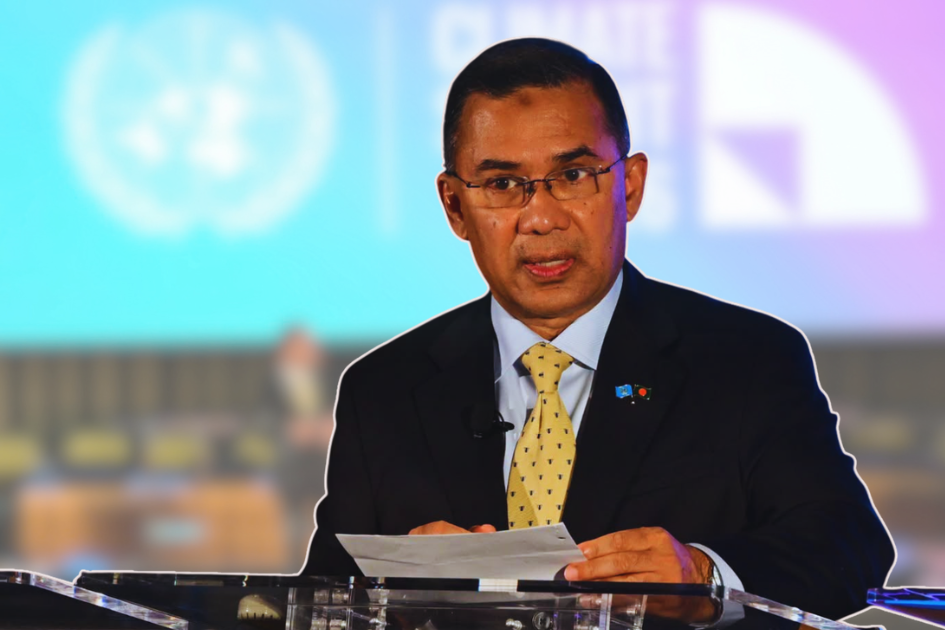



At UNGA81, Rahman linked Bangladesh’s domestic climate plans with calls for stronger global action on emissions, adaptation finance, technology, renewables and loss and damage.
Bangladesh Prime Minister Tarique Rahman has put five urgent demands before the international community, calling for deeper emission cuts, predictable adaptation finance, equitable access to green technology, greater support for renewable energy and sustained financing to address loss and damage.
Addressing the high-level event on Climate Action and the Just Transition during the 81st session of the United Nations General Assembly (UNGA81) in New York on Wednesday, Rahman also outlined Bangladesh’s domestic climate plans, including planting 250 million trees over five years, dredging around 20,000 kilometres of rivers and canals, strengthening water management and expanding renewable energy.
Five demands for global action
Setting out Bangladesh’s priorities before world leaders and international partners, Rahman called for strict global emission reductions in line with the Paris Agreement and efforts to keep the 1.5°C temperature goal within reach.
“We must keep the 1.5°C goal alive through strict emission reductions,” Rahman said, stressing the need for stronger action from the international community.
His second demand focused on predictable, reliable and accessible adaptation finance, particularly for countries highly vulnerable to climate impacts.
Rahman also called for greater and more equitable access to green technologies, saying technology access would be essential for delivering a just climate transition.
On renewable energy, he urged international partners to support expansion through accessible finance, capacity building and systematic technology transfer.
As his fifth priority, Rahman called for the global fund responding to loss and damage to be fully implemented and regularly replenished to support countries and communities already facing severe climate impacts.
“We need predictable and accessible adaptation finance, equitable access to green technology and a fully operational and regularly replenished loss and damage fund,” he said.
The priorities reflected key themes of the UN climate summit, including accelerating the renewable energy transition, mobilising affordable finance for developing countries and strengthening adaptation and resilience.
250m-tree drive, water restoration
Alongside his global demands, Rahman outlined a series of measures Bangladesh plans to undertake at home.
The prime minister said his government plans to plant 250 million trees over the next five years as part of a major afforestation drive.
“The reason why we want to plant 250 million trees is to bring down the heat, to bring down the temperature by about one to two degrees Celsius,” Rahman said.
Water management also featured prominently in his address.
Rahman said Bangladesh plans to dredge approximately 20,000 kilometres of rivers and canals to improve water retention, mitigate flood risks, revive wetlands and help recharge groundwater.
He also highlighted plans involving the Padma and Teesta, two major river systems critical to Bangladesh’s water management, including a proposed barrage on the Padma and implementation of the Teesta Barrage Master Plan.
“We want to optimise water retention, mitigate flood risks, revive our dying wetlands and recharge our underground water tables,” he said while outlining the measures.
Renewables and green growth
Turning to energy, Rahman said Bangladesh aims to meet 20 percent of its total electricity demand from renewable sources by 2030.
He also highlighted plans to promote environmentally friendly jute products, expand electric vehicle transport networks, develop waste-to-energy facilities and advance circular economy initiatives.
Bangladesh is also developing a national carbon market aimed at encouraging private-sector investment in green and low-carbon development, the prime minister said.
Rahman stressed that Bangladesh’s domestic efforts alone could not address a crisis that requires coordinated international action.
“No country can tackle the climate crisis alone,” he said, calling for collective action based on the principle of common but differentiated responsibilities and respective capabilities.
Climate action in focus ahead of COP31
The high-level event on Climate Action and the Just Transition was convened by UN Secretary-General António Guterres as world leaders gathered in New York for UNGA81.
The meeting focused on accelerating climate action and the energy transition, mobilising affordable finance and investment for developing countries, and strengthening adaptation and resilience.
It also came at a crucial point in global climate diplomacy ahead of COP31 in Antalya, Türkiye, in November.
For Bangladesh, Rahman used the UN platform to link the country’s domestic climate programme with its call for stronger international cooperation on emissions, finance, technology, renewable energy and loss and damage.
Concluding his address, the prime minister appealed for partnerships capable of turning climate commitments into implementation.
“Bangladesh seeks partnerships that help us implement our plans,” Rahman said. “Let us act together to build a safer and more sustainable future for generations to come.”




