




Bangladesh’s new parliamentary platform brings lawmakers together to support policy discussions, community engagement and resilience efforts on climate-related displacement.
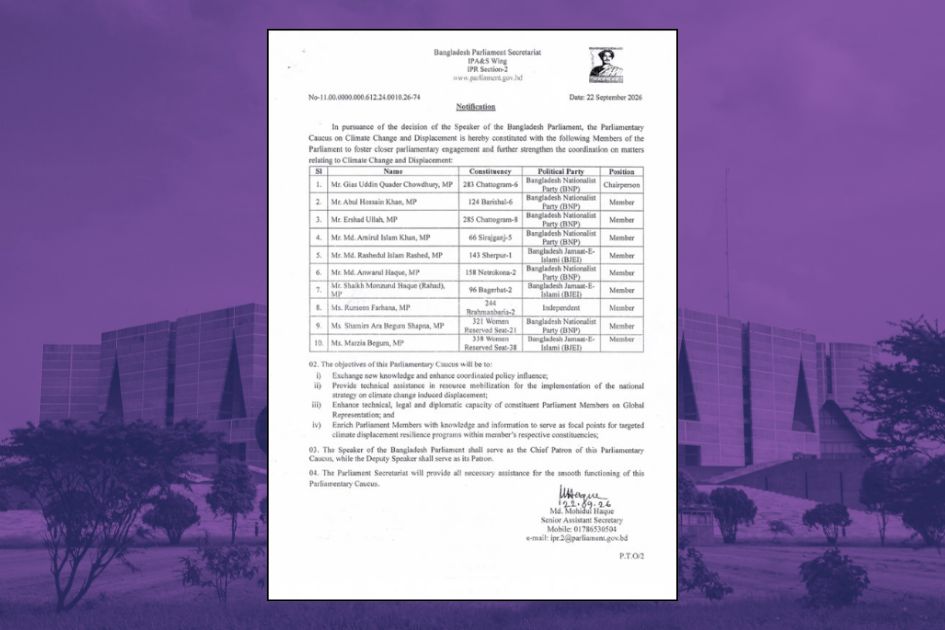
The Jatiya Sangsad has formed a cross-party Parliamentary Caucus on Climate Change and Displacement to strengthen lawmakers’ engagement in developing policy responses to climate-induced displacement, according to a notification issued by the Bangladesh Parliament Secretariat.
The Bangladesh Parliament Secretariat announced the formation of the caucus on September 22, 2026, under directives from the Speaker. The 10-member platform brings together lawmakers from different political parties to address challenges linked to climate change and human mobility, including displacement and migration associated with climate impacts.
Gias Uddin Quader Chowdhury, a BNP lawmaker from Chattogram-6, has been appointed as the chairperson of the caucus.
The members include Abul Hossain Khan (Barishal-6), Ershad Ullah (Chattogram-8), Md. Amirul Islam Khan (Sirajganj-5), Md. Rashedul Islam Rashed (Sherpur-1), Md. Anwarul Haque (Netrokona-2), Shaikh Monzurul Haque Rahad (Bagerhat-2), Rumeen Farhana (Brahmanbaria-2), Shamim Ara Begum Shapna (Women Reserved Seat-21) and Marzia Begum (Women Reserved Seat-38). The members represent the Bangladesh Nationalist Party (BNP), Bangladesh Jamaat-e-Islami and an independent lawmaker.
According to the parliamentary notification, the caucus will focus on exchanging knowledge among parliamentarians, strengthening coordinated policy influence, providing technical support for implementing the national strategy on climate change-induced displacement, enhancing lawmakers’ technical, legal and diplomatic capacity on global climate negotiations and supporting climate resilience initiatives in their respective constituencies.
The platform will also provide space for parliamentarians to engage with experts, stakeholders and communities affected by climate impacts while contributing to discussions on policy responses to climate-related displacement.
As a low-lying delta country, Bangladesh faces significant climate risks, including sea-level rise, coastal erosion, riverbank erosion, cyclones and flooding. These impacts are increasingly contributing to internal displacement, affecting communities’ homes, livelihoods and access to essential services, particularly in coastal and riverine areas.
Climate-induced displacement has become a growing concern as vulnerable communities face repeated climate shocks. Loss of land, damage to housing, reduced agricultural productivity and disruption of traditional livelihoods are among the factors pushing many people to relocate from areas where sustaining their lives and incomes has become increasingly difficult.
The formation of the caucus comes as climate-vulnerable countries continue to call for stronger global cooperation on adaptation, climate finance and support for communities facing climate impacts.
The new parliamentary platform provides lawmakers with a dedicated avenue to discuss climate-induced displacement, strengthen coordination among policymakers and stakeholders and support constituency-level resilience efforts.
Through greater parliamentary engagement, the caucus could contribute to Bangladesh’s ongoing efforts to address the social, economic and humanitarian dimensions of climate change at both national and international forums.




