

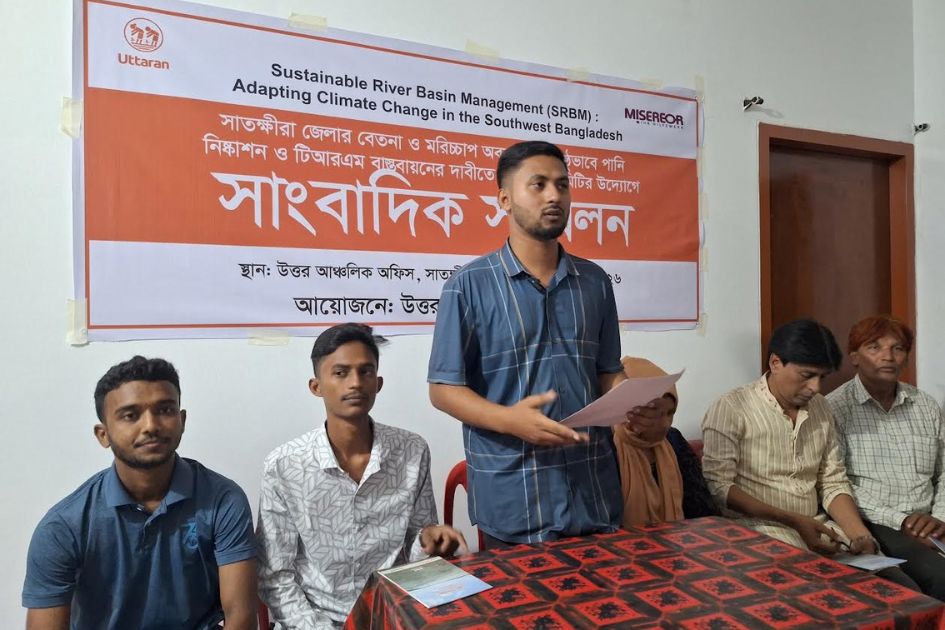



A youth committee in Satkhira highlights sediment buildup, failed drainage measures and calls for tidal river management to protect water systems and livelihoods.
A youth water committee in southwestern Bangladesh’s Satkhira district has called for the immediate introduction of tidal river management (TRM) to address long-running waterlogging in the Betna and Morichchap river basins, warning that newly completed infrastructure projects may not provide lasting benefits without the measure.
The Youth Water Committee said Wednesday that if TRM is not implemented while the rivers remain active, sediment could accumulate again within the next one or two dry seasons, reducing navigability and threatening the sustainability of a recently completed project costing 4.75 billion taka ($475.26 million).
The demands were made at a press conference on Wednesday (Sept 23) afternoon at the regional office premises of Uttaran in Satkhira town. The committee’s president, Mohammad Hossain Ali, read out a written statement at the event.
According to the statement, around 48,765 hectares across 25 unions of Satkhira Sadar, Kalaroa, Tala, Assasuni and Debhata upazilas have been affected by prolonged waterlogging since the 1990s, creating difficulties for more than 600,000 people living in the basin.
The committee said various government initiatives, including river and canal excavation, construction of sluice gates and coastal embankment repairs, have failed to bring a permanent solution to the problem.
It said the Betna and Morichchap rivers receive between four and six feet of sediment every year, causing upstream sections to become filled and reducing the rivers’ navigability. The statement also identified river and canal encroachment, uncontrolled shrimp farming and problems in sluice gate management as factors obstructing water drainage.
The group said even minor rainfall floods homes, roads, and agricultural land, disrupting production and employment and forcing many families to become displaced.
At the press conference, speakers referred to a study by the Institute of Water Modelling (IWM) under the Water Resources Planning Organisation and the Bangladesh Delta Plan 2100. They said dredging rivers alone would not provide a permanent solution in the sediment-rich region.
They said TRM would allow tidal water to enter designated wetlands, creating opportunities for sediment deposition. This would raise the elevation of wetlands and reduce the pressure of sediment accumulation in rivers.
The committee said the Bangladesh Delta Plan 2100 has identified 11 wetlands in the Betna-Morichchap basin for TRM implementation. These include Sukhdebpur, Ticket, Jhilmari, Durgapur, Srirampur, Bagmara, Gobindapur, Hajikhali, Amodkhali, Chapra and Matiadangha.
The committee also cited an IWM study that found the rate of river re-filling during the dry season was 60.88 percent.
However, the youth leaders said a recently completed four-year project under the Bangladesh Water Development Board for polders numbered 1, 2, 6-8 and 6-8 (extension), costing 4.75 billion taka, did not include TRM. They said this raised questions about long-term planning to keep the rivers functional.
The speakers said local fish farms and embankments had blocked water flow in many areas. As a result, they said, even after river and canal excavation or embankment repairs, water could not drain quickly.
They called for removing all obstacles to water movement alongside infrastructure-based measures to resolve the waterlogging crisis.
The press conference issued four demands: immediate implementation of TRM in designated wetlands of the Betna and Morichchap river basins, removal of all barriers to water drainage, freeing rivers and canals from encroachment and reopening water channels blocked by fish farms.
The committee also called for effective participation and coordination among local communities, government agencies and non-government stakeholders in efforts to address waterlogging.
Those present at the press conference included Youth Water Committee General Secretary Mohammad Ibrahim Khalil, publicity secretary Mohammad Mokarram Billah Emon, members Sajidul Islam, Karimun Nessa Shanta, Lamia Sultana, Rabia Khatun, Azmira Khatun, Abu Taher and Milon Kumar.
Officials from Uttaran, including Advocate Monir Uddin, were also present, along with central water committee member Mir Zillur Rahman, Sadar Upazila Water Committee President Mofizur Rahman, General Secretary Abdur Rauf Babu, Uttaran’s Nazma Akter and representative Golam Hossain, as well as journalists from various media outlets.




