

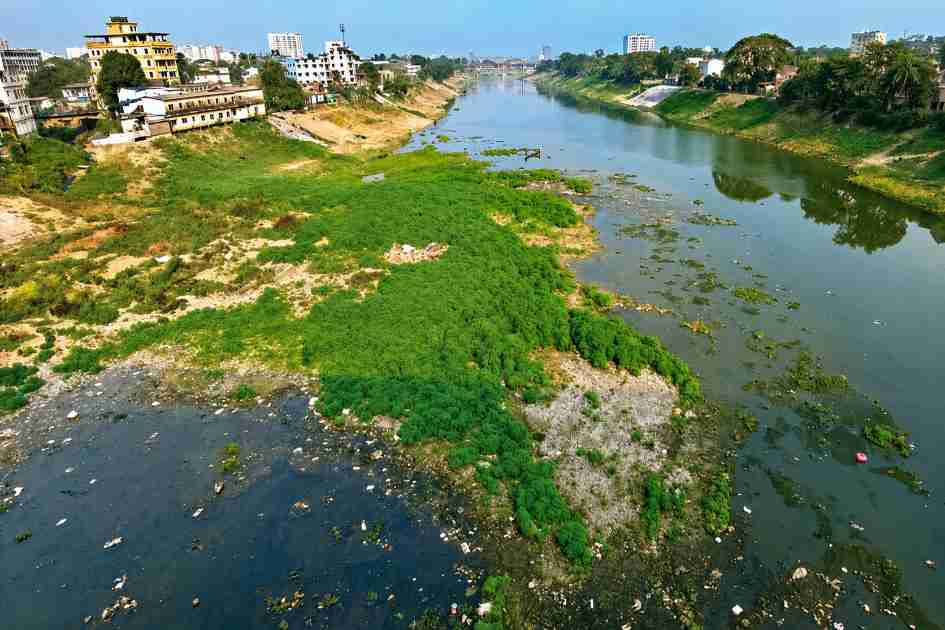

A new study reveals Sylhet has lost 77 percent of its wetlands since 2000 while urban areas expanded fourfold, heightening risks of flash floods, waterlogging, biodiversity loss and climate vulnerability.
Sylhet, one of Bangladesh‘s most flood-prone regions, has lost nearly 77 percent of its wetlands in just over two decades while urban areas have expanded more than fourfold, raising fresh concerns over climate resilience, environmental sustainability and disaster risks in the country’s northeast, according to a new study.
The research, published in the international journal Scientific Reports, found that water bodies and wetland areas in Sylhet district shrank from 34.25 percent of the total land area in 2000 to just 7.87 percent in 2023.
Located in northeastern Bangladesh, Sylhet is known for its extensive wetlands, haors, tea gardens and river systems. The region regularly experiences flash floods triggered by heavy rainfall and upstream water flows from neighbouring India, making natural water retention systems crucial for disaster risk reduction.
Researchers say the rapid loss of wetlands, combined with unplanned urban expansion, is increasing the region’s vulnerability to flash floods, waterlogging and climate-related disasters.
The study was conducted by researchers SM Nazmul Haque of Ahsanullah University of Science and Technology and Md Zahir Uddin of Khulna University of Engineering and Technology (KUET). Using satellite imagery from 2000 to 2023, the researchers analysed changes in land use and land cover across Sylhet district through Google Earth Engine, Landsat satellite data and Random Forest classification techniques.
The findings show that urban land coverage increased from just 4.64 percent in 2000 to 18.46 percent in 2023. Major urban expansion was recorded in Sylhet Sadar, South Surma, Golapganj, Bishwanath and Beanibazar upazilas.
Beanibazar experienced the most dramatic urban growth, with built-up areas increasing by nearly 1,500 percent during the study period. Urban expansion in Fenchuganj exceeded 1,000 percent while Sylhet Sadar recorded an increase of around 240 percent.
Researchers attribute the rapid transformation to population growth, migration from rural areas, housing developments, commercial infrastructure, hotels, shopping centres and road construction.
The study also revealed that approximately seven percent of wetlands present in 2000 had been converted into urban land by 2023, while another 5.5 percent had turned into barren land.
Bishwanath upazila recorded the highest decline in water bodies, losing nearly 90 percent of its wetland area. Significant reductions were also observed in Beanibazar, South Surma, Golapganj, Zakiganj and Sylhet Sadar.
According to the researchers, the loss of wetlands is reducing the region’s capacity to store excess rainwater during the monsoon season. As a result, floodwaters spread more rapidly across low-lying areas, increasing the risk of flash floods.
Environmental activists say the region’s unique geography has often been overlooked in development planning. They point to decades of hill cutting, wetland encroachment and land filling as major contributors to the current environmental challenges.
Abdul Karim Chowdhury Kim, a prominent environmental activist in Sylhet and member secretary of Surma River Waterkeeper, said the city has grown in a largely unplanned manner, with little regard for its natural landscape and ecological characteristics.
“Both public and private urban development projects have ignored Sylhet’s unique geography. Hills and mounds have been cut down while wetlands have been filled one after another to make way for infrastructure and housing,” he said.
Chowdhury noted that Shahjalal Upashahar, one of Sylhet’s major residential areas established through a government initiative in the 1980s, was developed by filling wetlands.
“Over the past decade, large portions of Baghar Haor have also been filled. Efforts to encroach upon and reclaim wetlands have never truly stopped,” he added.
He warned that the continued destruction of natural water retention areas is undermining the region’s ecological balance and increasing its vulnerability to flooding and waterlogging.
The study identified Balaganj, Sylhet Sadar, Companiganj and Golapganj as major hotspots of land-use change, driven by rapid urbanisation and human intervention. In contrast, parts of Kanaighat, Jaintiapur and Zakiganj remained relatively stable and were classified as “coldspots” of land transformation.
Researchers also linked unusual land-cover changes observed in 2005 to the severe floods of 2004, which damaged agricultural land and vegetation across the region.
Experts warn that the continued destruction of wetlands could have long-term consequences for both urban resilience and biodiversity.
Md Zahir Uddin, a researcher from KUET, stressed the need for sustainable urban planning, protection of natural water bodies and stronger regulation against unplanned land filling.
“Preserving wetlands and restoring natural drainage systems are essential to reducing future disaster risks in Sylhet,” he said.
Sohanur Rahman, executive coordinator of YouthNet Global, described the findings as a serious ecological warning.
“Wetlands are not merely water storage areas. They play a critical role in flood regulation, groundwater recharge and biodiversity conservation,” he said.
“The loss of 77 percent of Sylhet’s wetlands alongside rapid urban expansion is not merely a land-use change. It is a warning that development cannot be sustainable if natural ecosystems are sacrificed. Wetland protection and restoration must become a core element of future urban planning.”
He added that cities may continue to expand, but without protecting natural systems they will become increasingly vulnerable to waterlogging, heat stress and climate-related disasters.
The researchers conclude that without stronger protection of wetlands, improved drainage infrastructure and more sustainable urban planning, Sylhet’s exposure to floods, waterlogging and other climate-related hazards is likely to intensify in the coming decades.




