

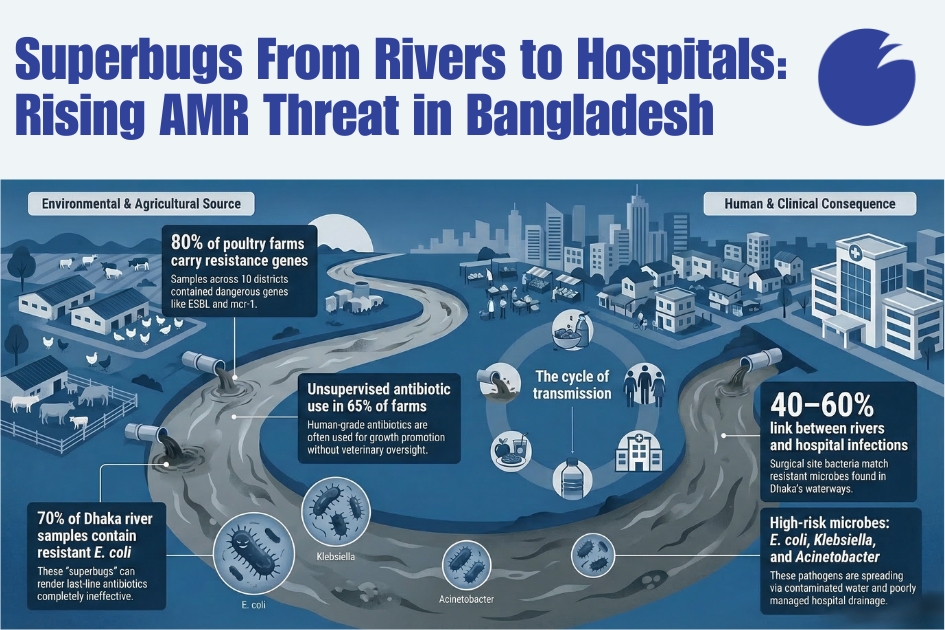



Polluted rivers, hospital waste and antibiotic misuse in farms are spreading antimicrobial resistant bacteria in Bangladesh, raising fears that common infections and routine surgeries may soon become harder to treat.
Contaminated water in rivers, canals, and drains is carrying antimicrobial resistance (AMR) “superbugs”, posing a serious risk to both human health and the environment in Bangladesh.
Experts say these resistant microbes are spreading into the environment through hospital waste and sewage systems. As a result people and aquatic life that come into contact with polluted water are increasingly exposed to dangerous bacteria.
The impact is already being felt in hospitals, particularly among surgical patients. In many cases infections are no longer responding to commonly used antibiotics, making treatment more complex and expensive. Recent research and environmental monitoring reports highlight this growing concern.
According to AMR surveillance data published in 2023 by the Institute of Epidemiology Disease Control and Research (IEDCR) and the Directorate General of Health Services (DGHS), 40 to 60 percent of bacteria detected in surgical site infections in hospitals are genetically similar to antimicrobial resistant microbes found in water from rivers canals and drains in Dhaka.
The bacteria include Klebsiella Escherichia coli and Acinetobacter. The findings suggest that a significant portion of hospital infections may originate from resistant microbes present in the environment.
Experts say inadequate sanitation untreated hospital and industrial waste and poorly managed urban drainage systems are major environmental drivers of AMR spread.
A joint water quality monitoring report by Dhaka Water Supply and Sewerage Authority (WASA) and the Department of Environment in 2023 found extended spectrum beta lactamase (ESBL) and carbapenem resistant E. coli in about 70 percent of water samples collected from rivers in Dhaka. These bacteria can render last line antibiotics ineffective.
Farm management practices are also playing a major role in the spread of AMR.
A 2022 study by the International Centre for Diarrhoeal Disease Research Bangladesh (icddr,b) found that 80 percent of samples from poultry farms across 10 districts contained bacteria carrying resistance genes such as ESBL and mcr-1. These genes are similar to those found in resistant bacteria detected in hospitals.
Waste from poultry farms often enters nearby canals and rivers. The bacteria can then re-enter the human body through contaminated food or water creating a cycle of transmission.
The Food and Agriculture Organization (FAO) says around 65 percent of farms in Bangladesh use antibiotics commonly prescribed for humans including ciprofloxacin azithromycin and colistin without veterinary supervision. This practice creates an AMR cycle linking humans animals and the environment.
In Suryakandi village in Sarail upazila of Brahmanbaria district several small and medium poultry farms operate side by side. Farm owners said they regularly use antibiotics in poultry production.
There is no designated system for disposing of farm waste. In many cases the waste is dumped into nearby ponds which remain open for public use. Local residents use water from the same ponds for daily activities.
Farmers said antibiotics are often used to prevent disease or promote rapid growth in poultry. In many cases antibiotics are mixed with feed while fish farms also apply antibiotics to prevent disease and accelerate growth.
According to farmers some antibiotics were previously used for a long period to increase poultry weight. These commonly included tetracycline group drugs such as oxytetracycline macrolide antibiotics such as tylosin bacitracin and some sulfa drugs mixed with feed.
Experts say these medicines do not directly increase growth. Instead they suppress harmful and beneficial bacteria in the poultry gut allowing nutrients to be absorbed more efficiently which results in faster weight gain. For this reason farmers once used them as growth promoters.
The most serious consequence of such practices is antibiotic resistance. When antibiotics are used at low doses for long periods bacteria gradually become stronger. If these resistant bacteria or their genes reach humans common antibiotics may no longer work.
As a result ordinary infections could become far more dangerous and difficult to treat in the future. The World Health Organization and other international agencies consider this a major public health threat.
In cattle farming antibiotics are also used for different purposes including disease treatment and sometimes for fattening.
Veterinarians typically prescribe antibiotics when cattle suffer from bacterial diseases such as pneumonia diarrhoea mastitis uterine infections or wound infections. Commonly used antibiotics include penicillin tetracycline such as oxytetracycline cephalosporins macrolides and sometimes fluoroquinolones. These drugs are used to eliminate harmful bacteria and restore the animal’s health.
Cattle farms generate different types of waste every day including manure urine wastewater from cleaning leftover feed and sometimes residues from medicines or chemicals.
In many farms this waste is dumped in open areas near the farm. Others release it into nearby canals ponds or low lying land. In some cases manure is piled beside roads or fields allowing rainwater to wash it into surrounding areas. Such poor waste management is particularly common in small and medium sized farms.
Experts warn that if residues of antibiotics used in farms enter the environment through waste they can contribute to antibiotic resistance among microbes in soil and water. This could make future treatment of diseases in both humans and animals more difficult.
Poor waste management in cattle farms therefore poses a serious risk not only to nearby communities but also to the wider environment and public health.
In Bangladesh most hospitals and clinics still burn medical waste in open areas or in low quality incinerators. District and sub district government hospitals small clinics and diagnostic centres often lack modern incineration facilities.
Sharps and infectious waste are sometimes burned behind hospital buildings on vacant land or in open waste bins. In other cases waste is handed over to city corporations or third party collectors but final disposal is not always carried out safely.
Although a few large hospitals in Dhaka operate improved incinerators their capacity is limited and cannot handle waste from all healthcare facilities.
According to the World Health Organization sharps waste includes items such as injection needles intravenous tubes with needles scalpels razor blades lancets and broken glass that may be contaminated with blood or other infectious materials.
These wastes are extremely hazardous because they can easily transmit infections.
Health experts say that relying solely on medicines is not enough to tackle AMR.
Instead the key lies in integrated One Health actions that address infection prevention responsible antibiotic use antibiotic stewardship safe water and environmental protection as well as improved management of healthcare and farm systems.
Strengthening water sanitation and hygiene systems ensuring rational antibiotic use in farms and improving infection control in hospitals are essential steps to curb AMR.
Experts warn that without urgent and coordinated action even routine surgical procedures could become high risk treatments in the future with serious consequences for public health economic stability and poverty levels.
Compiled by: Farin Jahan Sigma
Analysis by: Dr Maliha Shifa
This article is republished from The Daily Bonik Barta.




