

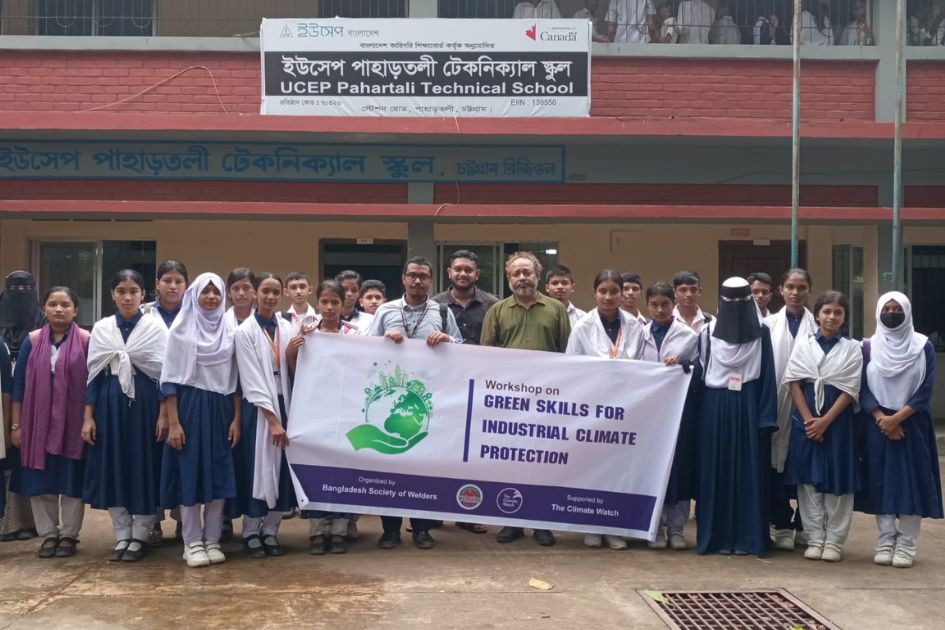



The workshop highlighted how technical professionals can support climate protection through green skills, resource efficiency, waste management and environmentally responsible industrial practices.
A workshop focusing on the role and responsibilities of technically skilled students in protecting the environment and climate was held in Chattogram under the title “Workshop on Green Skills for Industrial Climate Protection.”
The day-long workshop was organised on Wednesday at UCEP Pahartali Technical School in Chattogram city by Green Technical Education and Voluntary (G-TEV). The programme was implemented by Bangladesh Society of Welders (BSW), an affiliated organisation of G-TEV, with technical support from The Climate Watch, an online open-data platform on climate issues.
Md. Shamsul Alam, Head of Technical School at UCEP Pahartali Technical School, attended the workshop as the chief guest. S.A.M. Shoriat Ullah, Instructor, Foundational Skills, and Md. Tauhidul Islam, Head of the Organisational Division of G-TEV, were present as special guests. Md. Mashiur Islam, Instructor at UCEP Pahartali Technical School, also attended the programme as a guest.
The workshop was facilitated by Mashiur Islam Raju, Head of the Health and Service Division of G-TEV, and BSW community member Didar Khan.
Speakers at the workshop said technically skilled people are among the key drivers of industrial production and development. However, various industrial processes and work practices can also have impacts on the environment and climate. They emphasised the need to raise awareness in workplaces and promote environmentally responsible work practices.
They further noted that environmental protection should not remain limited to factories or workplaces. Alongside workplace practices, greater awareness is needed in everyday life regarding efficient use of resources, waste reduction and segregation, water and energy conservation, and the adoption of safe work practices.
The workshop covered green skills, environmentally friendly work practices in industries, efficient use of resources, waste management, water and energy conservation, and the role of technical professionals in climate protection through discussions and participatory activities.
In the concluding session, participants took part in an interactive activity titled “Learning Waste Management Through Play.” The activity introduced participants to waste segregation, proper disposal of waste, and the concept of recyclable waste through games and interactive learning.




