




Two solar parks on Pabna’s Padma char lands are generating 164 MW of clean electricity, transforming local infrastructure and land markets while raising concerns over farmland loss and compensation.
Two large solar power projects built on former shoal lands along the Padma River in western Bangladesh are supplying 164 megawatts of electricity to the national grid, transforming the landscape of Pabna’s riverine communities while raising concerns over the loss of farmland and livelihoods.
For decades, the Padma River gradually receded in parts of Pabna, exposing vast stretches of char land that initially appeared seasonally before being cultivated by local farmers for crops such as bananas and vegetables.
Today, sections of that once-agricultural terrain are being used to generate renewable energy.
The larger of the two facilities is a 100-megawatt solar park at Char Bhabanipur in Pabna Sadar upazila, developed by Dynamic Sun Energy Private Limited, a subsidiary of Paramount Textile PLC. Built across around 400 acres of former shoal land, the project contains more than 274,000 solar modules and 760 inverters.
The plant began commercial operations on October 23, 2024 and currently supplies up to 100 MW of electricity to Bangladesh’s national grid each day, according to project officials.
Backed by a $121.55 million financing package led by the Asian Development Bank, the facility uses solar photovoltaic technology that produces no direct emissions. It is expected to generate approximately 193.5 gigawatt-hours of electricity annually while offsetting about 93,654 tonnes of carbon dioxide emissions every year.
“We are consistently supplying around 100 MW of green power to the national grid,” Plant Director Jahurul Islam said.
The second project, a 64-MW solar park in Sagarkandi under Sujanagar upazila, entered commercial operation on August 26 last year. Constructed on 205 acres of shoal land, it is equipped with around 147,000 solar modules and 11 inverters.
The project was developed by Bangladesh-China Renewable Energy Company Limited, a 50:50 joint venture between the North-West Power Generation Company Limited and China National Machinery Import and Export Corporation.
The partnership has previously implemented renewable energy initiatives, including the 68-MW solar plant in Sirajganj.
Project Director Md Tanbir Rahman said the solar park is helping drive broader socio-economic changes in the area, which was once among the most remote riverine settlements in Pabna.
Both facilities form part of Bangladesh’s target of generating 40 percent of its electricity from renewable energy sources by 2041.
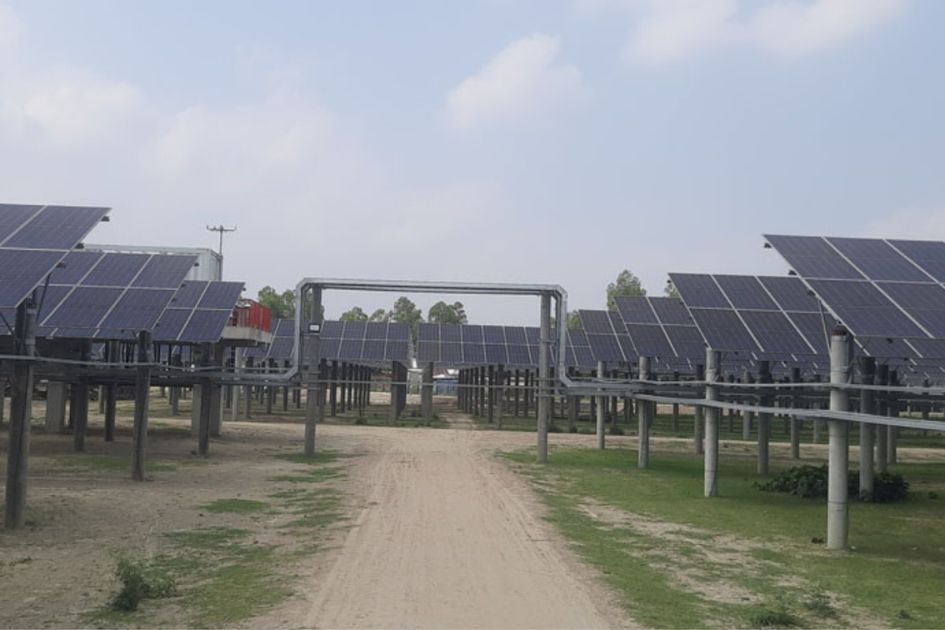
The impact of the projects is visible across the surrounding communities.
Residents say Char Bhabanipur, once without paved roads and largely cut off after sunset, now has concrete roads and round-the-clock transport activity. Permanent brick houses and shops are increasingly replacing seasonal agricultural structures.
Land prices have also risen sharply. Plots that sold for around Tk 2 lakh to Tk 3 lakh per bigha only a few years ago now command Tk 7 lakh to Tk 8 lakh, while prime highland plots can fetch more than Tk 12 lakh. Locals attribute much of the increase to the arrival of the solar park.
Yet the transformation has also sparked concerns among farmers whose land was acquired for the projects.
“I had to give up five of my seven bighas to the electricity project,” said farmer Shofi Molla. Although he received compensation and invested the money in small businesses for his family, he said he is no longer involved in farming.
Another resident, Mobarak Bepari, who lost all four of his bighas, said hundreds of farmers had been affected.
“Because so much arable land was acquired, farming space has shrunk and land prices have gone up sharply,” he said.
In Sagarkandi, some villagers allege the situation has been more contentious, saying several farmers who cultivated shoal land for decades have yet to receive compensation.
Pabna Deputy Commissioner Aminul Islam said the land used for the Sagarkandi Solar Park was government-owned and had been leased to the project authority through the proper procedures.
“As it is government land, so there is no scope to compensate,” he said.
This post is republished from The Daily Star.




