


Women in Nepal’s Dang district are transforming traditional forest skills into sustainable livelihoods, gaining financial independence while promoting eco-friendly enterprises through cooperatives, handicrafts, and leaf plate production supported by FAO.
Women in Dang are finding new confidence and independence through small savings and forest-based enterprises. In Dangisharan Rural Municipality-2, local women and a cooperative are promoting nature-based solutions by turning forest resources into sustainable livelihoods and environment-friendly enterprises.
Luma Chaudhary of Gana Tole in Dangisharan-2 saves around NPR 1,500 every month in cooperatives and women’s groups.
For people earning thousands of rupees in cities, this amount may seem small. But for Luma, it has brought confidence, independence, and a new beginning in life.
“Earlier, whenever I needed money, I had to ask my husband,” Luma said. “Sometimes he would give it, but I always felt afraid and dependent. Now, I earn some money through my own work and save regularly. I feel confident and independent. This is a big achievement for me.”
She recalled that in the past, even attending women’s group meetings was difficult.
“When I wanted to go to meetings, my husband used to ask, ‘Why do you need to go there? You don’t even have money to save,’” she said. “Now, I no longer have to hear such questions.”
Dangisharan Rural Municipality lies in western Nepal. Ward No. 2 is located in the remote Chure region where many Indigenous Tharu families live. The area has limited job opportunities. The Chure forest lies to the south while the Babai River flows along the north.
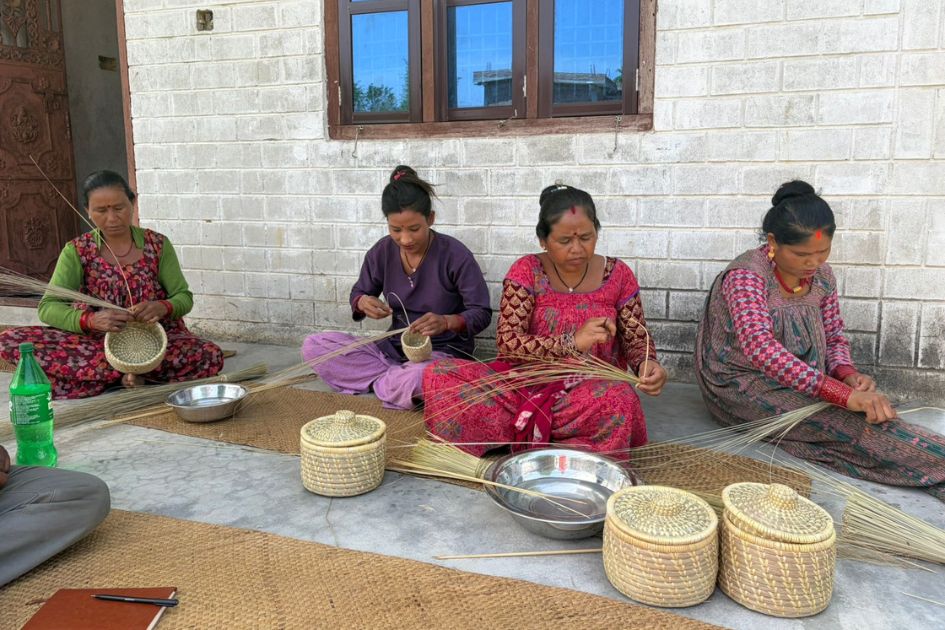
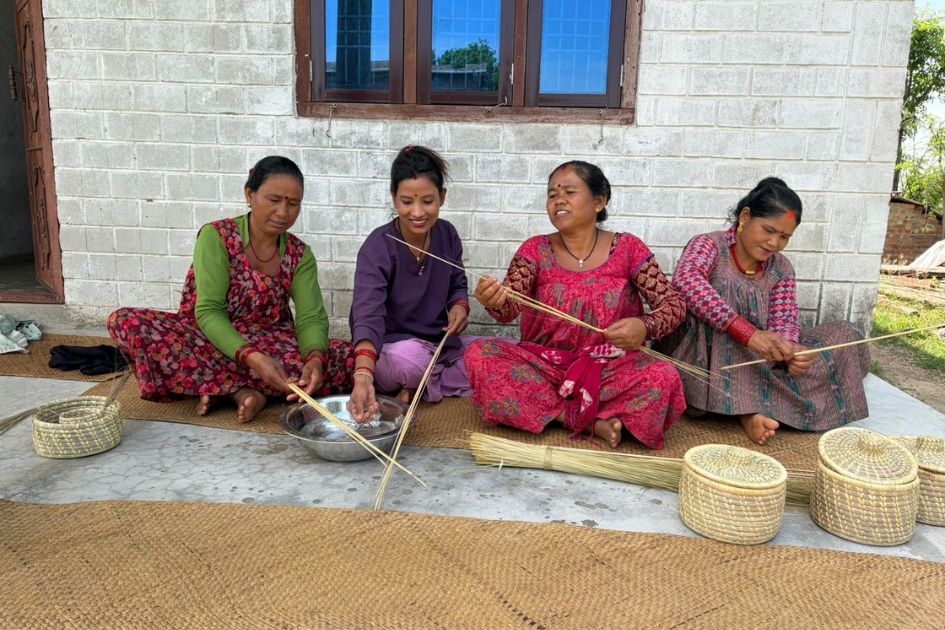
The change in women’s lives became possible after several non-governmental organizations provided training and market support to local women. Many women from Tharu and other Indigenous communities started making handicraft products. Luma earns an average of NPR 2,000 to 2,500 per month through handicrafts.
Income from handicrafts has helped women like Luma become financially independent and improve their daily lives.
Women from Indigenous Tharu communities have become more capable by using natural resources freely available along riverbanks and in nearby forests.
According to local residents, around 32 women like Luma Chaudhary have improved their livelihoods by making handicrafts from Saccharum spontaneum (Kans grass) and other species found along riverbanks.
Sharda Chaudhary said she sold handicrafts worth around NPR 50,000 in a year.
“I make dhakiya and other handicraft products in my leisure time,” she said. “We don’t need extra investment, just time.”
Cooperative’s role
In the Tharu community, making dhakiya and other handicraft products from natural resources has long been a traditional skill passed down through generations. The raw materials used for these products are commonly found in the wild. However, according to Budhani Chaudhary, a resident of Gana Tole, modernization has caused many traditional practices to fade.
She said people had gradually forgotten how to make items such as pen holders, dhakiya, and other household products using Saccharum spontaneum and similar natural materials.
The situation began to change after the establishment of the “Our Rajakot Multipurpose Cooperative,” which is based on agroforestry practices. The cooperative has played an important role in reviving traditional knowledge and improving livelihoods in the community.
Chakra Milan B.K., manager of the cooperative, said the main objective of the cooperative is to support livelihoods through forest- and agriculture-based activities.
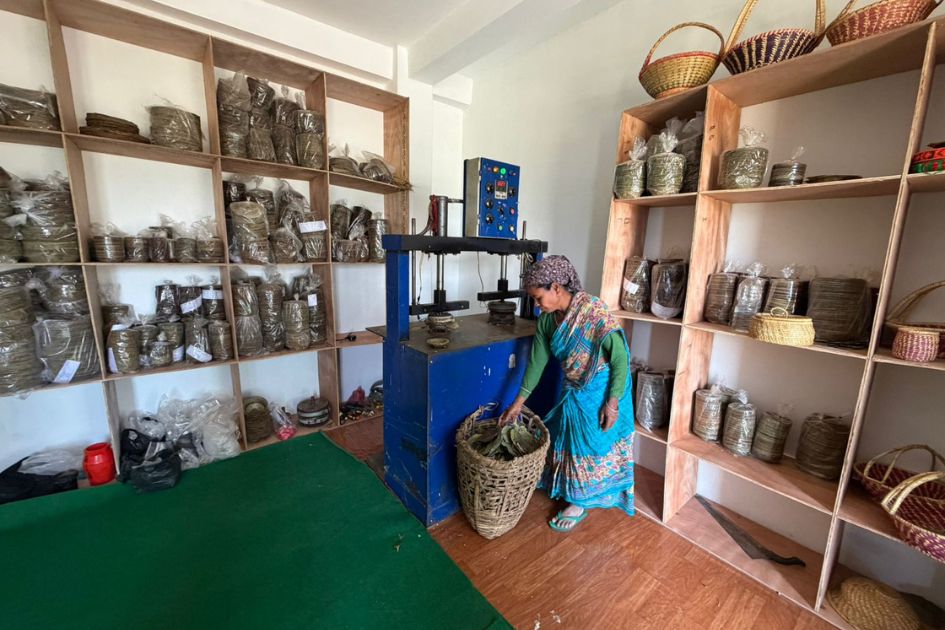
“Female members of the cooperative received training to make handicrafts, but they faced problems selling their products,” he said. “The cooperative then took the initiative to support marketing and sales. Now, their products are collected here and sold in places such as Pokhara, Kathmandu, and other cities. Demand is now very high.”
The “Our Rajakot Multipurpose Cooperative” also produces leaf plates as an environmentally friendly alternative to plastic plates. According to the manager, the cooperative has been producing leaf plates for the past two years.
“Our aim is to create job opportunities in the village while also reducing the use of plastic, which harms the environment,” he said.
Currently, five people are engaged full-time in producing leaf plates. They collect Sal leaves from the forest and use machines to produce plates of different sizes.
Last year, the cooperative produced leaf plates worth around NPR 200,000. This year, production is expected to exceed NPR 300,000.
The cooperative’s innovations and activities have been supported by the Forest and Farm Facility (FFF) programme of the Food and Agriculture Organization (FAO). According to the cooperative, it has received NPR 3.1 million under the FFF programme.
With this support, the community has established a collection center and installed machinery for leaf plate production, helping create sustainable income opportunities for local people.
The Forest and Farm Facility supports forest and farm producers in improving livelihoods and building climate-resilient communities. The programme has been operating in Nepal since 2018 and also contributes to achieving the Sustainable Development Goals (SDGs) and Nepal’s climate commitments under the Paris Agreement.




