

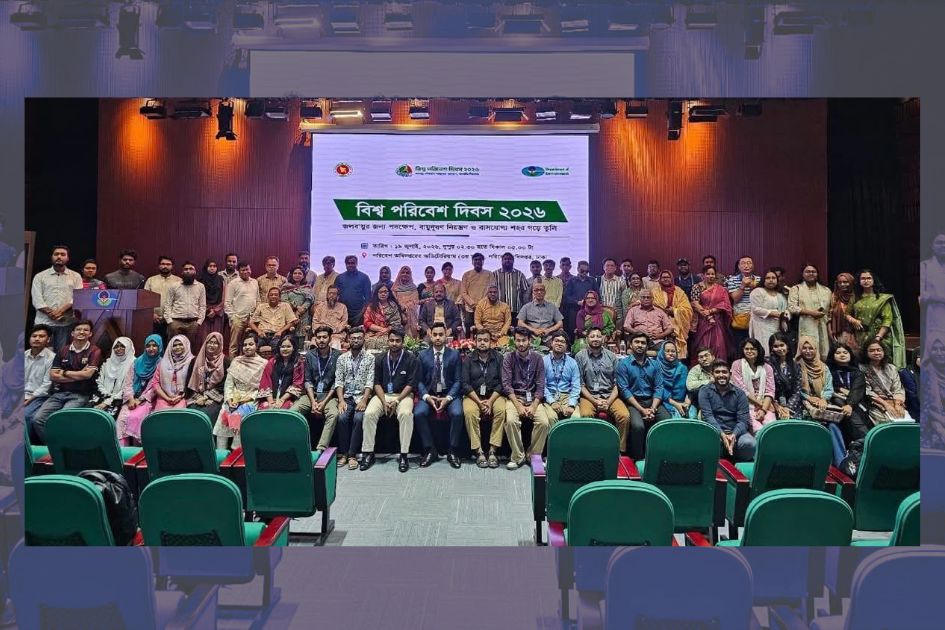



Experts urged stronger action on waste burning, urban greening, safer mobility and ministry capacity as Bangladesh struggles to reduce the health burden of polluted city air.
Speakers at a seminar in Dhaka said air pollution is killing 242 people every day in six major cities of Bangladesh, with Dhaka and Chattogram accounting for 48 percent of the total deaths linked to polluted air.
The seminar, titled “Taking action for climate, controlling air pollution and building liveable cities”, was held at 2:30pm on Sunday, July 19, 2026, at the auditorium of the Department of Environment to mark World Environment Day 2026.
It was organised by the Department of Environment, Centre for Law and Policy Affairs, WBB Trust, University of Liberal Arts Bangladesh, Dhaka International University, Earth Foundation, IWB, Ark Foundation, Grambangla Unnayan Committee, Center for Atmospheric Pollution Studies and Citizen Network.
Md Ziaul Haque, additional director general of the Department of Environment, attended the seminar as chief guest.
Discussants included Professor Md Akter Mahmud of the Department of Urban and Regional Planning at Jahangirnagar University; Dr Rumana Huque, professor of economics at the University of Dhaka and executive director of Ark Foundation; Advocate Syed Mahbubul Alam, secretary of the Centre for Law and Policy Affairs; architect and urban planner Khandaker Niaz Rahman; WBB Trust director Gaus Peary; Grambangla Unnayan Committee executive director AKM Maksud; and Professor A.S.M. Sarwar, adviser to the Centre for Law and Policy Affairs.
The programme was moderated by Kamrunnissa Munna, senior policy analyst at the Centre for Law and Policy Affairs.
Papers were presented by Professor Dr Ahmad Kamruzzaman, dean of the Faculty of Science at Stamford University Bangladesh and founder and chairman of the Center for Atmospheric Pollution Studies, and Naima Akter, project manager at WBB Trust.
Aminul Islam Bakul, executive director of Earth Foundation, delivered the welcome remarks. More than 100 students from different universities, Supreme Court lawyers, development organisation officials and journalists also attended.
Speakers said around 68,703 people die annually in Dhaka and around 11,202 in Chattogram due to air pollution. They said green areas in Dhaka have declined by 9 percent over the past 28 years, while concrete coverage has increased to 82 percent over the past two decades and wetlands have fallen to just 2.9 percent.
They said people who rely on walking or non-motorised transport every day are among the worst affected by air pollution.
The speakers said household waste, polythene and other rubbish are being burned at waste dumps across the country, worsening air pollution. Floating populations who take shelter in Dhaka are heavily involved in waste management work, putting their health at risk, they said.
They also said electronic waste is a cause of environmental pollution. Although some people have proposed generating electricity from such waste, they said that also increases air pollution. All forms of waste burning must therefore be stopped, they said.
Air and environmental pollution have become one of the causes of children being born with disabilities in the country, the speakers said.
They said Tk 283,000 crore is being spent worldwide because of air pollution, while Bangladesh is spending 8.3 percent of its GDP on air pollution. They called for lower import duties on products used to reduce air pollution and said the capacity of different government ministries must be strengthened to tackle the problem.
Emphasising walking and cycling as two modes of transport with zero carbon emissions, the speakers said 45 percent of people worldwide travel to workplaces or educational institutions by bicycle every day, while the figure in Bangladesh remains very low.
They said it is urgent to use construction materials that absorb less heat, promote green infrastructure and develop green walking and cycling corridors along canals, lakes and railway areas.




