

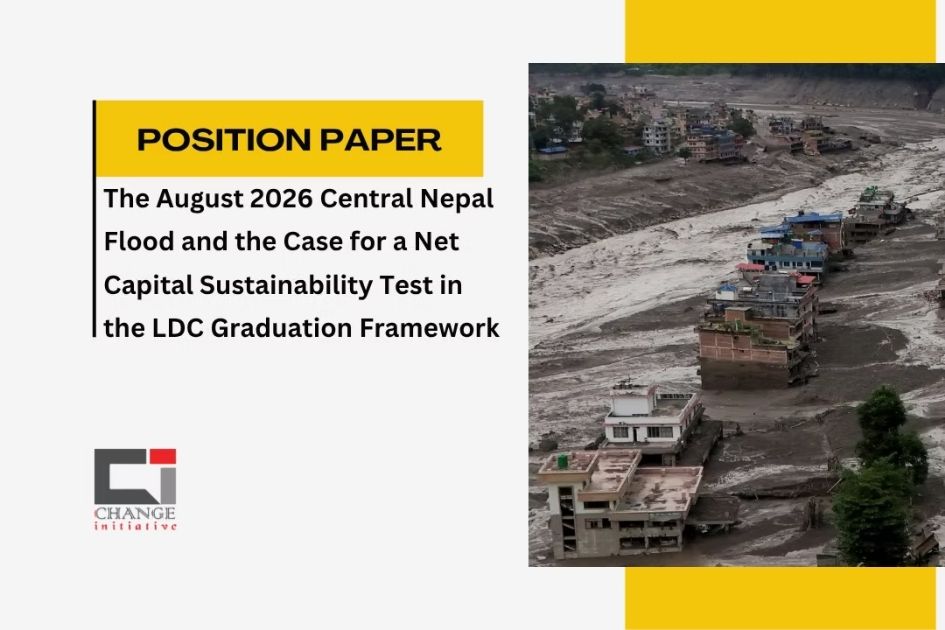



Nepal’s planned LDC graduation faces renewed scrutiny as the disaster highlights weaknesses in measuring losses to infrastructure, ecosystems and resilience capacity.
A devastating debris avalanche and flash flood in central Nepal has exposed what a new policy paper describes as a critical gap in the framework used to assess least developed country graduation, arguing that rising income and human-development indicators can coexist with severe depletion of the physical and natural capital needed to sustain those gains.
The 26 August 2026 disaster began with a rapid slope failure involving glacier ice in Langtang National Park near the Chinese border. The United States Geological Survey located the failure on the north side of Langtang Lirung and estimated that the collapse generated seismic energy equivalent to a magnitude 5.2 earthquake. The resulting debris and flood wave travelled nearly 100 kilometres through the Lhende/Bhote Koshi-Trishuli system, devastating settlements, transport links, hydropower assets and the Rasuwagadhi-Gyirong border corridor.
As of 30 August, 734 bodies or human remains had been recovered in Nepal, 2,498 people remained unaccounted for and 242 were injured, while 8,186 people had been rescued. Nepal had mobilised 19,895 security personnel. Chinese authorities separately reported 16 deaths and 546 people missing in Gyirong County. The figures remained provisional and subject to change.
The Change Initiative position paper estimates preliminary damage and foregone economic losses from the disaster at US$1.38 billion to US$2.70 billion, with a central estimate of US$1.95 billion, equivalent to about 4.3 percent of GDP. The estimate was constructed on 28 August using Post-Disaster Needs Assessment conventions and is described as an early order-of-magnitude assessment rather than a definitive national loss figure.
The estimate is separate from a subsequent government assessment. Finance Minister Swarnim Wagle said on 29 August that reconstruction and rehabilitation could require US$4 billion to US$5 billion. The paper says the two figures measure different things: its estimate covers damaged assets and foregone economic flows, while the government figure represents forward-looking reconstruction and rehabilitation requirements that may include replacement, relocation, resilience upgrading and build-back-better costs.
The paper argues that the scale of the disaster is not adequately captured by Nepal’s existing LDC graduation indicators. The Economic and Environmental Vulnerability Index contains no dedicated indicator for cryospheric or high-mountain mass-movement hazards, while its disaster-victims measure uses a 15-year average. The Committee for Development Policy’s enhanced monitoring mechanism can consider crises outside the formal indicators, but the paper says this requires a discretionary crisis-response process rather than an automatic update.
Nepal remains scheduled to graduate from the least developed country category on 24 November 2026 under General Assembly resolution A/RES/76/8. The government requested an extension of the preparatory period on 15 May. The CDP concluded that an extension would be appropriate if linked to a clear, time-bound plan to adjust and reprioritise Nepal’s smooth-transition strategy. On 21 July, the Economic and Social Council adopted draft decision E/2026/L.24 by consensus and recommended General Assembly action before 24 November. The General Assembly had not acted at the time of writing.
The paper stresses that the flood does not automatically reverse Nepal’s graduation eligibility. At the 2024 triennial review, Nepal’s three-year average gross national income per capita was US$1,300 against a graduation threshold of US$1,306. The 2025 monitoring report recorded US$1,404. Nepal nevertheless qualified for graduation on the Human Assets Index and the Economic and Environmental Vulnerability Index. The CDP’s revised time series subsequently placed the 2024 GNI figure at US$1,329.
Instead, the paper proposes a fourth assessment, called the Net Capital Sustainability Test, or NCST. It would complement rather than replace the existing graduation criteria and examine whether a country’s aggregate natural, physical and institutional capital is being maintained, accumulated or depleted over a defined period. The proposed test would produce one of three directional signals: accumulating, stable or depleting. Where evidence is insufficient, it would record an explicit evidence gap rather than force a score.
The paper says Nepal provides a clear test case. Its indicative assessment finds physical capital to be depleting, while natural capital is mixed. Hindu Kush Himalaya glaciers lost approximately 12 percent of their area and an estimated 9 percent of their ice volume between 1990 and 2020, with thinning of up to 27 metres since 1975 and ice loss running 65 percent faster in 2011-2020 than in the preceding decade. At the same time, forest cover increased from roughly 26 percent of land area in 1992 to about 45 percent by 2016 under community forestry.
Nepal’s adjusted net savings were 24.42 percent of GNI in 2021, with no negative year in the published 2010-2021 series used in the paper. But the authors argue that adjusted net savings is insufficient because the published series ends five years before the 2026 graduation decision, does not explicitly value cryospheric assets and has no institutional dimension covering anticipatory capacity, fiscal buffers and risk transfer.
The physical-capital assessment also points to repeated damage along the same strategic corridor. The Rasuwagadhi/Bhote Koshi-Trishuli corridor was damaged by a July 2025 glacial lake outburst flood and again by the August 2026 debris-avalanche flood. The 111-megawatt Rasuwagadhi hydropower project and border connectivity were hit in both episodes. At least 13 hydropower projects and major transmission, road and border-trade assets were damaged in the corridor, while Reuters reported that damaged power projects represented more than 12 percent of national generating capacity.
The paper distinguishes the August disaster from the July 2025 event. On 8 July 2025, a supraglacial lake on the Purepu/Pyurepu Glacier in China’s Tibet Autonomous Region breached and sent a destructive flood down the Bhote Koshi border corridor. The 2026 event originated inside Nepal near the border and involved a glacier and rock-slope failure rather than a classic glacial lake outburst flood. The paper says the two disasters demonstrate exposure to multiple high-mountain hazards across a shared mountain catchment.
The paper also cautions against attributing the August collapse directly to climate change. It says event-specific climate attribution has not been established, while ICIMOD had cautioned on the day of the event that it was too early to determine the role of climate change in the specific collapse. The paper instead treats deterioration of the regional cryosphere as the structural risk context.
It recommends that the CDP undertake an ex-post vulnerability reassessment of Nepal before the General Assembly decides on the graduation timeline. It also proposes a graduation-with-conditions option, under which graduation could proceed on an agreed timetable while concessional, climate-finance and transition support continues until defined reconstruction and resilience milestones are achieved. Any additional transition period, it says, should prioritise resilient infrastructure, high-mountain early warning, disaster-risk financing and concessional reconstruction finance.
Among its longer-term proposals are a standing procedure for major disasters occurring after the latest CDP assessment but before graduation, a dedicated cryospheric and high-mountain hazard indicator in the EVI, stronger treatment of recent disasters, adoption of the NCST as a fourth netting-stage criterion and a resilience-finance component within Nepal’s Smooth Transition Strategy. The paper also calls for stronger Nepal-China cooperation on upstream monitoring, data exchange, alert protocols, joint hazard assessment, emergency communication and risk-informed standards for critical infrastructure in shared river systems.
The paper says the proposed test is not intended as a verdict against Nepal’s graduation. Rather, it would identify which capital stocks and institutional capabilities need to be protected so that development gains remain durable. It argues that the current extension mechanism changes the amount of time available before graduation, while the NCST would change the content of that transition by identifying the assets and capabilities that need protection.




