

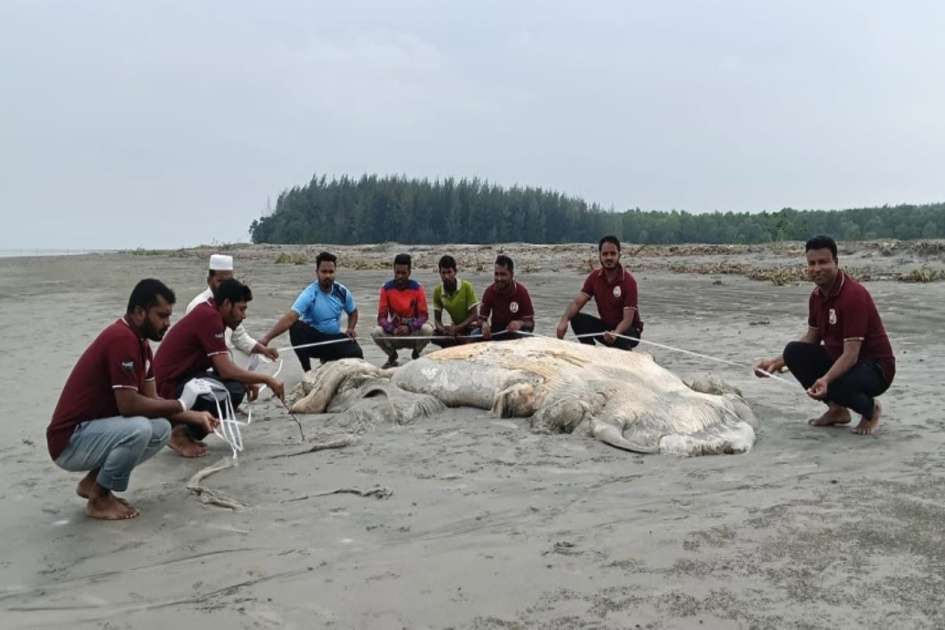

The discovery of another massive whale carcass along the Kuakata coast within less than a month has renewed concerns over Bangladesh’s marine ecosystem with experts calling for scientific investigations into the deaths.
A massive dead whale measuring about 56 feet washed ashore at Kuakata Sea Beach on Monday, just 26 days after another whale was found dead along the same coastline, raising fresh concerns about the country’s marine ecosystem and biodiversity
Members of the Coastal Environment Protection Movement discovered the carcass around 12:00pm near Kawarchar in the Gangamati area of Kuakata. The sighting quickly attracted local residents and tourists after news of the discovery spread.
KM Bacchu, convener of the movement and joint organising secretary of the Bangladesh Biodiversity Conservation Federation (BBCF), said local tour guide Tarikul Islam first spotted the whale while on duty at the beach in the morning and alerted the organisation. The Forest Department was subsequently informed.
According to Bacchu, the whale was about 56 feet long and 16 feet wide. Initial observations indicate that it may have died around a week ago although the exact cause of death has yet to be determined.
Environmental activists said the appearance of a second whale carcass within 26 days has intensified concerns about the condition of the marine ecosystem and underscored the need for scientific investigations to establish why the animals are dying.
Prof Rajib Sarkar of the Department of Fisheries under the Faculty of Biology, Genetics and Fisheries at Patuakhali Science and Technology University said the animal appeared to be a baleen whale based on its external characteristics.
“Baleen whales feed by filtering plankton and microscopic organisms from seawater. Environmental changes in the ocean, food shortages, disease, collisions with ships or strong ocean currents may cause such large marine mammals to wash ashore. However, scientific examinations are essential to determine the exact cause of death,” he said.
Rajib also recommended collecting samples from the carcass to identify the species and preserving its skeleton, saying such measures would make an important contribution to marine biodiversity research in Bangladesh.
Mahipur Range Officer of the Forest Department Moniruzzaman said officials were collecting samples and other relevant information to identify the whale species and determine the cause of death. They were also examining the carcass for any signs of injury.
Another dead whale washed ashore at Kuakata on June 3.
This article is republished from The Daily Star.




