




Human-caused climate change has accounted for about 4 kilometres, or roughly one-fifth, of the retreat of Antarctica’s Pine Island Glacier since the 1940s, according to the first attribution study to directly link greenhouse gas emissions with the retreat of an Antarctic glacier.
Human-caused climate change has been responsible for about 4 kilometres of the retreat of Antarctica’s Pine Island Glacier since the 1940s, representing roughly one-fifth of its total retreat, according to a new study that provides the first direct attribution of Antarctic glacier retreat to greenhouse gas emissions.
The findings, published in The Cryosphere, mark the first attribution study of glacier retreat in Antarctica. The research concludes that while the glacier likely would have retreated even without climate change, rising greenhouse gas emissions significantly intensified the process.
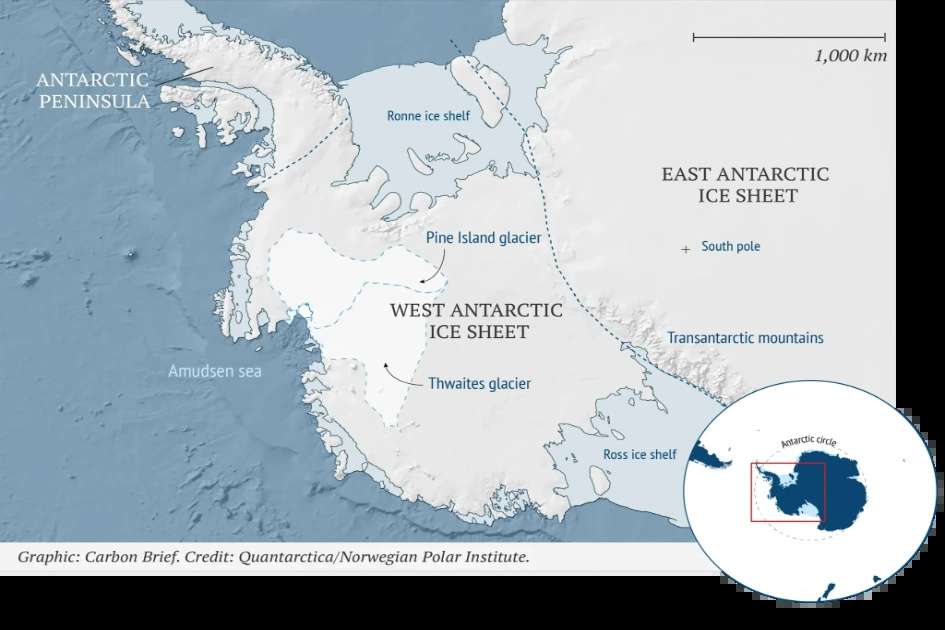
Pine Island Glacier, located in West Antarctica, is among the fastest-changing glaciers on Earth. Together with its neighbouring Thwaites Glacier, it accounts for nearly half of the sea level rise caused by melting Antarctic ice sheets.
Scientists have long known that the West Antarctic Ice Sheet, which includes Pine Island and Thwaites glaciers, has been retreating because relatively warm ocean water is melting the ice from below. However, until now it remained unclear how much of that retreat was driven by human-caused greenhouse gas emissions rather than natural climate variability.
“Our research looks at how human-caused warming has contributed to the retreat of the Pine Island Glacier since pre-industrial times,” the researchers said.
Glaciers are slow-moving rivers of frozen snow and ice that flow across land. They form both on high mountains and across continental ice sheets. Earth currently has two major ice sheets, one covering Antarctica and the other Greenland. Both developed over thousands of years as successive layers of snowfall compressed into dense ice.
Ice sheets naturally expand and shrink depending on snowfall and temperature. During the last ice age, when global temperatures were much lower than today, massive ice sheets also covered much of North America, Scandinavia and Patagonia.
Today, human-driven climate change is accelerating the retreat of ice sheets worldwide. The resulting melt contributes to rising sea levels while releasing large amounts of freshwater into the oceans, altering Earth’s climate system.
The Pine Island Glacier lies on the western side of the Antarctic Ice Sheet and ranks among the world’s fastest-melting glaciers. Previous research has shown that it accounts for about one-fifth of the total ice loss from the West Antarctic Ice Sheet, which itself has been responsible for nearly all Antarctic ice loss over the past four decades.
At the peak of the last ice age, known as the Last Glacial Maximum around 20,000 years ago, the West Antarctic Ice Sheet extended much farther than it does today. Since then, it has retreated by about 500 kilometres, roughly the distance between Paris and London.
Most of that retreat occurred between 10,000 and 20,000 years ago. During the past 10,000 years, however, the ice sheet has remained approximately its present size.
Sediment records beneath the Pine Island Glacier indicate that for several centuries until the 1940s, the glacier rested on a seabed ridge located about 30 kilometres ahead of its current position.
Those same sediment records show that the glacier began retreating during the 1940s. The timing coincided with a strong El Niño event, the recurring climate pattern in the tropical Pacific that raises global temperatures and delivered a large pulse of warm water beneath the ice sheet.
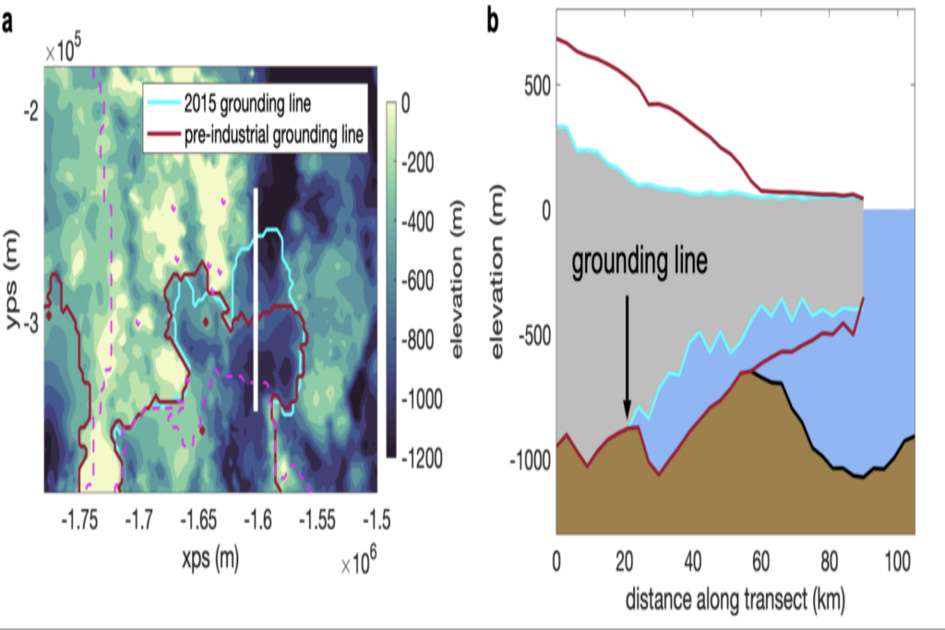
Researchers illustrated this change by comparing the glacier’s grounding line, the boundary between grounded and floating ice, from pre-industrial times to 2015.
Maps show the grounding line moving from its pre-industrial position, marked in red, to its 2015 location, shown in bright blue. A cross-sectional view along the glacier also demonstrates how the ice front contracted over time.
Climate reconstructions indicate that human-caused climate change only began increasing the volume of warm water reaching the West Antarctic Ice Sheet during the 1960s. That means greenhouse gas-driven warming started affecting melt rates about 20 years after the glacier’s retreat had already begun.
The researchers therefore sought to determine how much climate change contributed to the glacier’s overall retreat after the 1940s.
Scientists currently cannot precisely determine how much retreat of Earth’s ice sheets and the resulting sea level rise are directly attributable to human-caused global warming.
In attribution science, researchers routinely quantify links between climate change and extreme weather events including heatwaves, droughts and wildfires by comparing two simulated worlds. One represents today’s climate influenced by greenhouse gas emissions while the other is a hypothetical world unaffected by human-caused warming.
Applying this approach to Antarctica requires climate models extending back at least 200 years because ice sheets respond only gradually to climate changes with very small year-to-year variations.
That presents a major challenge because direct observations of Antarctic ice sheets only became available with satellite monitoring in the 1970s.
To reconstruct earlier conditions, scientists rely on limited palaeoclimate evidence, including sediment records and seafloor imprints that reveal where ice once existed.
For the new study, researchers combined physical climate modelling with machine learning to reconstruct the retreat history of the Pine Island Glacier.
They first performed numerous model simulations using different assumptions about key physical processes including how ice flows and how it interacts with the surrounding ocean.
The results were then compared with modern satellite observations and older sediment records. This allowed the team to identify the model settings that most closely matched available observations and produce a set of realistic simulations.
Running every possible simulation would have required too much computing time.
Instead, the researchers used machine learning to identify relationships between model settings and glacier retreat, allowing them to estimate all plausible retreat scenarios.
The approach enabled them to reconstruct how the glacier most likely evolved over the past 250 years.
Researchers then compared this reconstructed history with a counterfactual scenario representing a world without human-caused climate change.
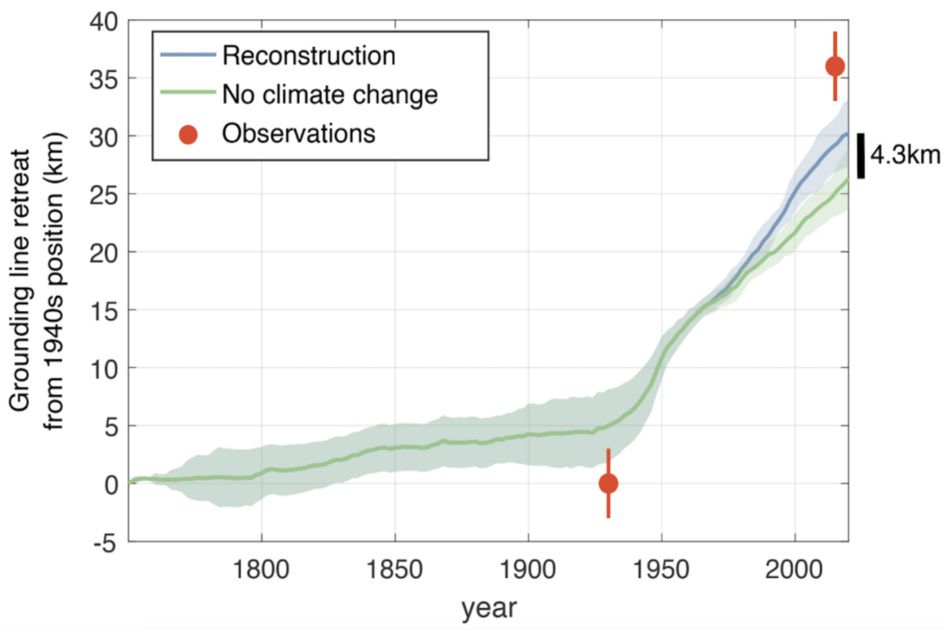
The comparison showed that greenhouse gas-driven warming accounted for approximately 4 kilometres of grounding line retreat since 1940, equivalent to about one-fifth of the glacier’s total retreat over that period.
The study presents this difference by comparing grounding line retreat in the reconstructed scenario with the counterfactual scenario. The reconstructed case shows substantially greater retreat while uncertainty ranges accompany both estimates. Observational data from approximately 1930 and 2015 align with the reconstructed changes.
The researchers said the findings provide the first direct quantitative link between greenhouse gas emissions and glacier retreat within Earth’s major ice sheets.
They also concluded that Pine Island Glacier probably would have retreated even in the absence of climate change, although the retreat would have been much smaller. The researchers compared this to extreme weather events such as droughts or heavy rainfall, which can occur naturally but become more frequent or more intense because of climate change.
One of the biggest remaining challenges is uncertainty about the glacier’s exact size before satellite observations became available.
Although sediment records identify where the glacier was grounded in the past, they do not reveal the precise volume of ice that existed at the time.
That uncertainty makes it difficult to determine the exact starting conditions for computer simulations and contributes to uncertainty in the projections.
The researchers said further work is underway to determine the best methods for establishing those initial conditions in future ice sheet simulations.
This article is republished from the Carbon Brief.




