

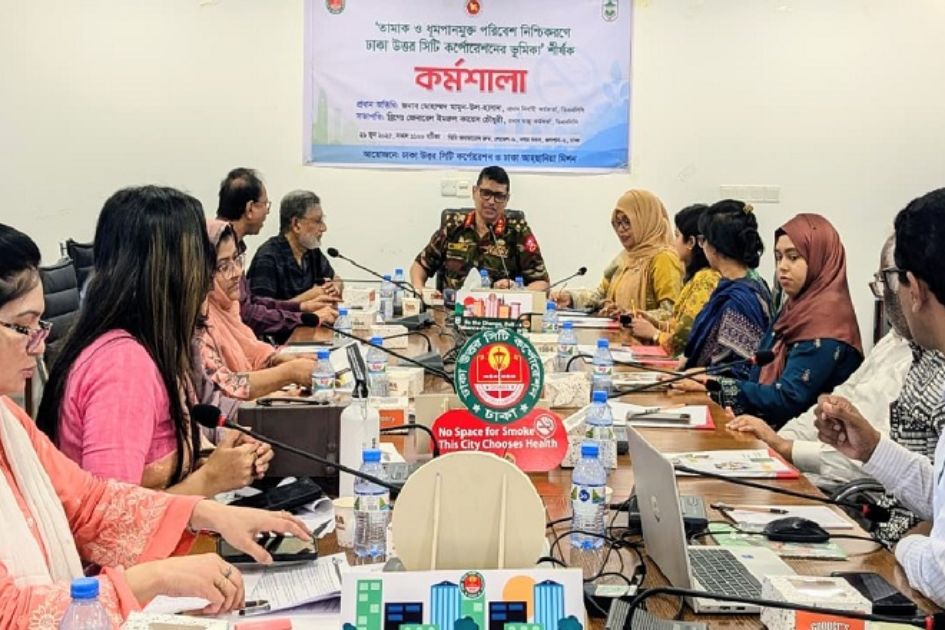

Dhaka North City Corporation pledged stronger tobacco control through awareness, enforcement and institutional support, partnering with Dhaka Ahsania Mission to promote smoke-free public spaces and healthier urban living.
The Dhaka North City Corporation (DNCC), which administers the northern part of Dhaka, the capital of Bangladesh, has pledged to strengthen efforts to ensure a tobacco-free and smoke-free environment across its offices, facilities and transport services as part of a broader initiative to protect public health and create a safer and healthier city.
The commitment was announced at a workshop titled “The Role of Dhaka North City Corporation in Ensuring a Tobacco-Free and Smoke-Free Environment”, jointly organised by DNCC and Dhaka Ahsania Mission at the corporation’s conference room on Monday.
As part of the initiative, DNCC said it would raise public awareness about the Tobacco Control (Amendment) Act 2026 and work to ensure tobacco-free and smoke-free environments in all of its offices, establishments and transport services. Participants at the workshop also said continuous initiatives involving relevant stakeholders would be undertaken to achieve the goal.
The workshop was chaired by DNCC Chief Health Officer Brig Gen Imrul Qayes Chowdhury.
Among those present were DNCC Deputy Chief Health Officer Dr Imdadul Haque, Health Officer Dr Mahmuda Poly, former Bangladesh Chemical Industries Corporation chairman Mostafizur Rahman, Dhaka Ahsania Mission Health Sector Director Iqbal Masud, representatives of various anti-tobacco organisations, senior officials from different DNCC departments and members of the Ahsania Mission Youth Forum.
Shariful Islam, coordinator of the Tobacco Control Project at Dhaka Ahsania Mission, presented the keynote paper. He outlined the current tobacco use situation in Bangladesh, the harmful effects of second-hand smoke and the Tobacco Control (Amendment) Act 2026. He also highlighted various measures taken by the government to strengthen tobacco control.
Citing the Global Adult Tobacco Survey (GATS) 2017, Shariful Islam said about 37.8 million people in Bangladesh use tobacco products, including nearly 19.2 million smokers. He said around 40 million people are exposed to second-hand smoke while tobacco-related diseases cause about 200,000 premature deaths every year. The annual economic cost of tobacco-related health and environmental damage is estimated at around Tk 87,000 crore.
Speakers at the workshop said increasing public awareness, strengthening DNCC’s capacity to implement tobacco and smoking control measures and ensuring coordinated action among stakeholders are crucial to building a healthier and tobacco-free city.
Dhaka Ahsania Mission said it would provide technical assistance to DNCC by strengthening institutional capacity, arranging training programmes and developing warning messages and informational materials to help establish tobacco-free and smoke-free environments across all DNCC offices, transport services and facilities.
The workshop concluded with an initial commitment from DNCC and Dhaka Ahsania Mission to work together in building a healthier urban environment free from tobacco and smoking.




