

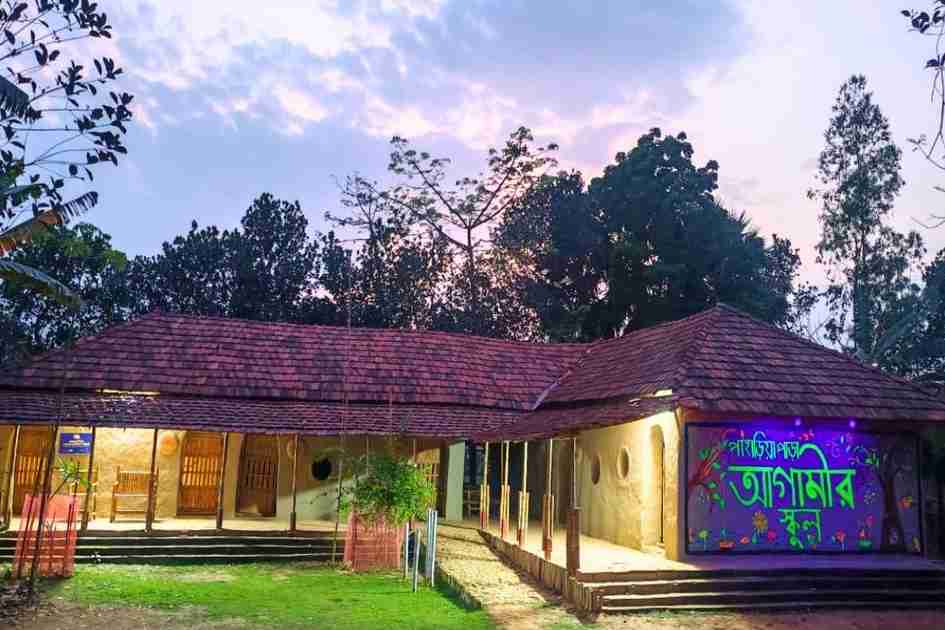



A community-built mud school in flood-prone Mymensingh is blending indigenous construction knowledge, climate resilience and locally rooted education to improve access for children isolated by seasonal flooding.
In the flood-prone riverine landscape of northern Bangladesh, villagers have built a functioning school using mud, bamboo and traditional construction techniques, offering a locally driven response to both climate vulnerability and longstanding barriers to education access.
Along the banks of the Akhalia River in Pahariapara village in Fulbaria upazila of Mymensingh, the Pahariapara Agamir School now stands as a climate resilient learning space created entirely through community effort and revived indigenous knowledge.
The village, home to 141 households, has long remained isolated during monsoon seasons due to seasonal flooding, poor road connectivity and distance from formal schools. Organizers say these challenges contributed to a literacy rate of around 20 percent, with girls and younger children among the most affected by dropout and delayed enrolment.
The school now serves 95 students with three teachers, operating classes in shifts to ensure access for children across different age groups.
The initiative emerged through sustained dialogue between villagers, the Grow Your Reader Foundation and Perceive, focusing on local experience and cultural practices rather than externally designed solutions.
That process led villagers to revisit traditional mud construction techniques that had gradually disappeared as brick and tin structures became associated with progress and modern living.
Resident Salim Ahmed said the idea evolved through reflection on local heritage.
“Through discussions with GYRF, villagers gradually rediscovered their own strengths and traditions. The decision to build with mud was not planned at the beginning. It came from reflecting on our own history,” he said.
The school was constructed using locally sourced soil, bamboo and community-contributed land and labour. Construction was led by 80-year-old traditional craftsman Gafur Chacha, who trained young people in mud-building techniques throughout the project.
Organizers say the structure reduced construction costs by nearly 70 percent and avoided an estimated 2,000 tonnes of carbon emissions compared with conventional construction methods. They also report that classrooms remain about 3 degrees Celsius cooler with lower humidity levels, based on project assessments.
Beyond infrastructure, the initiative integrates a curriculum inspired by UNESCO Greening Curriculum Guidance, combining agriculture, environmental awareness, seasonal knowledge and local cultural practices into classroom learning.
GYRF Chief Executive Officer Sadia Jahan said long-term sustainability depends on community ownership and the revival of local knowledge systems.
“Villagers themselves contributed land, labour and materials, creating a strong sense of responsibility towards maintaining and protecting the school,” she said. “Traditional mud-building knowledge is also being transferred to younger generations, ensuring these climate responsive skills are not lost.”
She added that linking education with local realities could help reduce dropout rates and improve participation, particularly among girls.
The organization follows a SALT approach, standing for Support, Stimulate, Appreciate, Listen, Learn, Link, Team and Transfer, focused on community-led development.
Development practitioners and educators are being invited to visit the site as a model for community-driven education and climate resilience.
The initiative highlights how vulnerable riverine communities are combining cultural heritage, climate adaptation and collective action to address both educational and environmental challenges while showing how local knowledge can shape sustainable solutions.




