

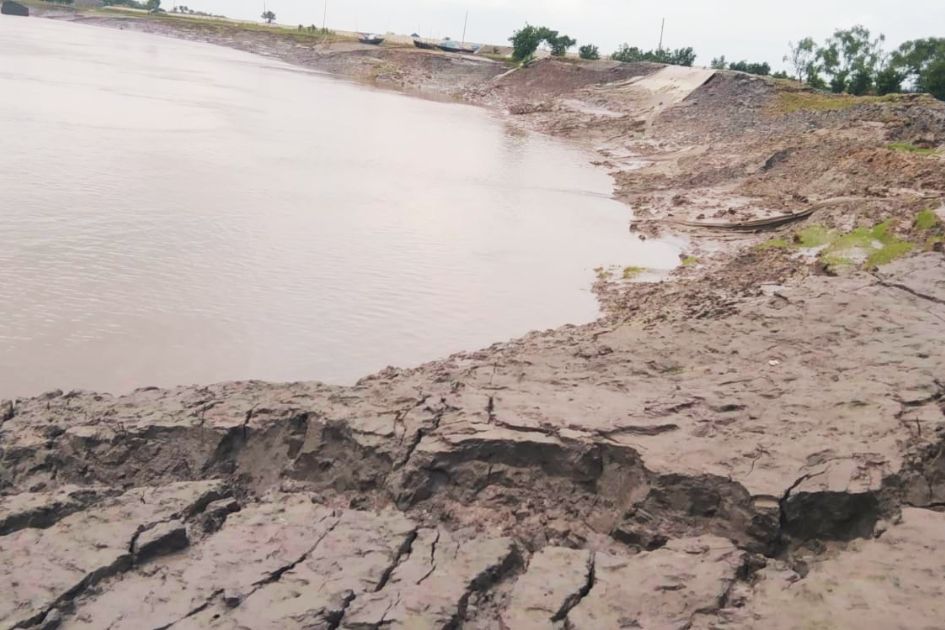



Officials say vulnerable stretches are being monitored and repaired, while residents warn repeated patchwork has left homes, farms, fish enclosures and roads exposed during monsoon and disaster seasons.
Concerns persist over coastal embankments in Satkhira, a southwestern coastal district of Bangladesh, due to tidal fluctuations, strong currents and natural disasters, compounded by the fact that they rapidly weaken even after repairs.
Various sections of the 683-kilometre-long embankment managed by two divisions of the Bangladesh Water Development Board (WDB), the government agency responsible for flood control and embankment management, remain vulnerable. Issues such as landslides, cracks and the risk of breaches caused by the pressure of tidal waters are evident in different areas. Consequently, whenever the monsoon season arrives or a disaster warning is issued, renewed panic grips the hundreds of thousands of people living near the embankments.
Meanwhile, locals allege that despite years of emergency repairs and renovations funded by the government, the measures often fail to provide a lasting solution. Complaints have arisen that substandard construction, irregularities in soil and geo-bag management and a lack of proper supervision lead to recurring erosion at the same sites even after repairs. This results in the expenditure of vast amounts of public funds while failing to ensure permanent safety for the people living in coastal areas.
According to the WDB, there are 383 kilometres of embankments under Satkhira Division-1 and 300 kilometres under Division-2.
Stretching along the banks of the Kopotaksho, Kholpetua, Madar, Chuna, Betna, Golgesia, Morichchap, Kalindi and Ichamati rivers, these embankments play a vital role in protecting the homes, agricultural lands, fish enclosures and communication infrastructure of the coastal population.
Every year, various sections of the embankments are damaged by the monsoon, high tides during full and new moons, low-pressure systems, cyclones and storm surges. While emergency repairs are carried out in some places and major renovation projects are undertaken in others, locals complain that, due to questions regarding the quality of the work, erosion resumes in some areas within just a few months or a year of the repairs being completed.
Golam Rasul, a former Union Parishad member from Chakla village in Pratapnagar Union of Ashashuni Upazila, said durable repair of the embankment requires proper soil filling and stabilization, the creation of correct slopes and the implementation of necessary protective measures, such as the use of geo-bags. If the work is not executed properly, the embankment quickly weakens under the pressure of tidal fluctuations, leading to renewed breaches at the same location even after repairs.
Ali Ahmed, a resident of Nawabeki village in Shyamnagar Upazila, a coastal area adjacent to the Sundarbans, said that news of a river embankment breach in the locality spells panic for residents. Repairs are carried out using government funds, but when the breach recurs at the same spot shortly after, people are left wondering: where is the permanent solution? Instead of repeated patchwork repairs, the work needs to be done properly once and for all.
Anis Sardar from Sriula village in Ashashuni Upazila said, “To us, the river embankment is not merely a barrier of earth; it represents the safety of our homes, land, fish enclosures and livelihoods. Whenever even a minor crack or collapse appears in the embankment, people stay awake at night to keep watch. The risk escalates manifold, especially during storms or tidal surges.”
Ashraful Alam, executive engineer of the Satkhira Water Development Board Division-1, said there are 383 kilometres of embankments under their jurisdiction. Of this stretch, 10 to 15 points across a five-kilometre section have been identified as vulnerable. Repair work is already underway at the most critical locations, while other vulnerable points are being closely monitored.
He said emergency preventive measures are taken if sudden damage occurs at any location due to tidal pressure or natural causes. At the same time, initiatives are being undertaken to identify vulnerable areas and carry out necessary repairs and maintenance.
Abdur Rahman Tazkia, executive engineer of Satkhira Water Development Board Division-2, said there are 300 kilometres of embankments under their jurisdiction. Of these, a stretch of approximately 15 kilometres covering the Pratapnagar and Anulia unions of Ashashuni and the Padmapukur union of Shyamnagar is considered relatively more vulnerable. Repair work is currently underway on a five-kilometre section of this area.
He further said an allocation of funds is required to repair the remaining 10.88 kilometres of the embankment; once the funds are secured, work will be carried out in those areas as well. Erosion of coastal embankments is an ongoing issue caused by natural river currents, tidal pressure, heavy rainfall, storm surges and various natural disasters. Therefore, vulnerable locations are being regularly monitored and necessary measures are being taken.
Amjad Hossain, chairman of Padmapukur Union Parishad in Shyamnagar Upazila, said long-term planning is essential to enhance the durability of the embankment, rather than relying solely on repairs after breaches occur. Unless strict quality control is ensured in construction, incorporating appropriate soil and materials according to the design, installing geo-bags and implementing protective measures that account for river flow dynamics, it will be difficult to reduce the risks faced by coastal residents, even with repeated repairs.
Meanwhile, coastal residents fear that if any of the vulnerable points along the coast breaches during the monsoon and disaster season, saline water could instantly flood their localities. Such an event would not only cause extensive damage to agricultural land, fish enclosures, homes and road networks but could also spell disaster for the lives and livelihoods of the coastal population.




