

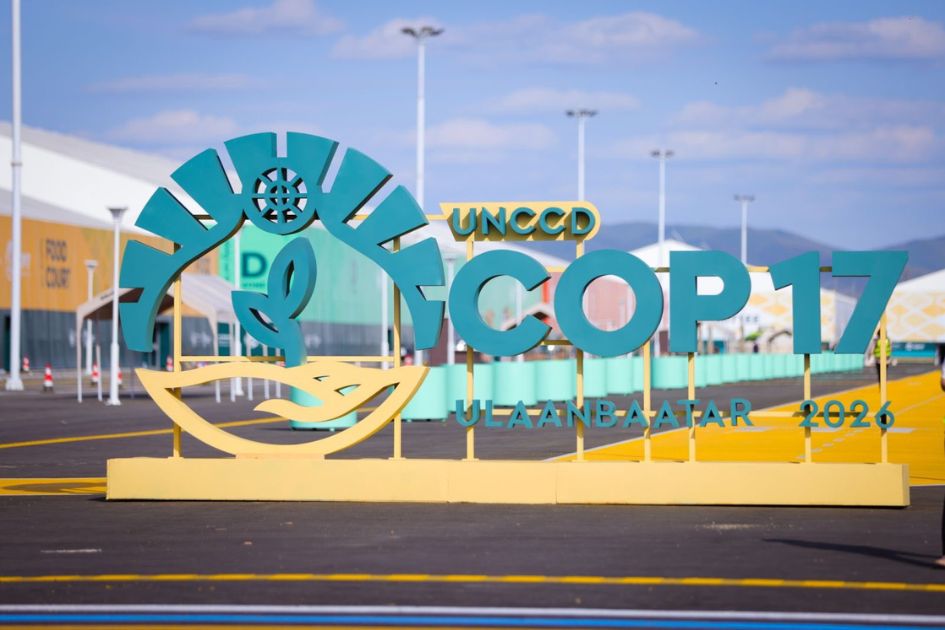



Negotiators in Ulaanbaatar face pressure to match drought pledges with finance while ensuring pastoralists, Indigenous Peoples, youth and civil society help shape land restoration decisions.
UNCCD COP17 puts drought finance and Rio Convention synergies in focus as a dispute over gender, civil society participation and inclusion tests the summit’s ambitions
The first week of the 17th session of the Conference of the Parties to the UN Convention to Combat Desertification (UNCCD COP17) has closed with rangelands and drought resilience emerging as major themes, while negotiators grapple with how to turn years of commitments into finance and action on the ground.
The UNCCD COP17 opened in Ulaanbaatar on August 17 and will run through August 28, 2026, under the theme “Restoring Land. Restoring Hope.” It has brought together delegates from across the UNCCD’s 197 Parties, alongside scientists, Indigenous Peoples, pastoralists, smallholder farmers and civil society, to address the interconnected challenges of desertification, land degradation and drought.
But the opening week has also exposed a political fault line over who gets to participate in shaping that response.
Drought crisis drives the agenda
Land degradation affects up to 40 percent of the world’s land, according to the UNCCD, threatening food production, water security, livelihoods and economic stability. COP17 is seeking to strengthen drought resilience and accelerate investment in sustainable land management.
A central focus is how to operationalise more than $12 billion pledged through the Riyadh Global Drought Resilience Partnership to support 74 vulnerable countries.
The pledged funding, however, remains far below estimates of the investment needed to address the scale of the global drought and land crisis. The gap leaves a central question for COP17: can political commitments be converted into finance, national plans and measurable action?
Drought is increasingly interacting with extreme heat, erratic rainfall and degraded ecosystems, putting additional pressure on agriculture, water supplies and rural livelihoods.
For negotiators, drought resilience is therefore not simply a matter of responding to rainfall deficits. It is increasingly about restoring the health of landscapes so they can better retain water, withstand climate shocks and support communities through periods of stress.
COP17 is also revisiting the unresolved question of how the international community should strengthen its global approach to drought after negotiations at COP16 in Riyadh failed to produce agreement on a legally binding drought framework.
Rangelands take centre stage
Held during the UN-designated International Year of Rangelands and Pastoralists, COP17 has placed rangelands firmly at the centre of the global land agenda.
Grasslands, savannahs, shrublands, deserts and pastures cover about half of the planet’s land surface and sustain the livelihoods of hundreds of millions of people.
Long overshadowed by forests in global environmental policy, rangelands are increasingly being recognised for their role in drought resilience, biodiversity, soil health and carbon storage.
“Globally, when you look at rangelands, it’s a very important ecosystem, often underappreciated,” said Amy Ganguli, a professor of rangeland ecology at the University of Arizona.
Healthy rangelands can stabilise soils and vegetation, help retain water and strengthen resilience to drought and extreme rainfall. Their soils also store significant amounts of carbon, making their protection relevant to both climate adaptation and mitigation.
But rangelands face growing pressure from land conversion, invasive species, degradation, competing land uses and policies that can undermine traditional land-management systems.
Mongolia’s vast pastoral landscape has given particular weight to COP17 discussions on rangeland stewardship, sustainable pastoralism and the relationship between pastoral mobility, drought resilience and peace.
Many pastoralists depend on mobility, moving livestock according to seasonal conditions and the availability of grazing and water.
Yet customary mobility is under growing pressure from competing land uses and, in some cases, policies favouring settlement over traditional grazing patterns.
“Governments have also attempted to sedentarize pastoralists,” said Fiona Flintan, a senior scientist with the International Livestock Research Institute, noting that mobility has often been treated as a problem by centralised administrative systems.
The debate at COP17 therefore extends beyond restoring grasslands and soils. It also concerns land tenure, customary mobility, Indigenous and pastoralist rights, local knowledge and meaningful participation in decision-making.
Dispute over inclusion tests summit’s credibility
Those questions have become particularly relevant after a dispute over the formal COP17 agenda.
At the opening of the summit, the Russian Federation objected to an agenda item concerning the Intergovernmental Working Group on the Future Strategic Framework of the UNCCD, while the United States objected to three other agenda items concerning synergies with other conventions and international organisations, gender, and civil society engagement. The COP17 president subsequently proposed provisionally adopting the agenda while deferring four contested items for further consultations.
Civil society organisations described the development as a serious setback for inclusive multilateralism. In a statement issued on August 18, Indigenous Peoples, local communities, pastoralists, smallholder farmers, women and youth groups said substantive items on gender, civil society and Indigenous Peoples’ engagement, Rio Convention synergies and the future strategic framework had been deferred following objections from the United States and Russian Federation.
More than 340 civil society organisations and networks have subsequently called for a transparent, time-bound process to address the deferred issues.
The controversy has created an unusual tension at a summit that is simultaneously emphasising community participation and integrated implementation.
The official COP17 programme continues to include activities involving civil society, Indigenous Peoples, local communities, youth and gender constituencies, as well as discussions on Rio Convention synergies. The question is whether those voices will have meaningful influence over the formal decisions emerging from the negotiations.
Sohanur Rahman, Executive Coordinator of YouthNet Global, said the dispute goes to the heart of the credibility of global land governance.
“You cannot claim to restore land while sidelining the people who live on, work with and protect that land. Gender equality, civil society participation, Indigenous and pastoralist voices, and cooperation across the Rio Conventions are not side issues. They are essential to climate justice and effective land restoration.”
For advocates, the issue is not simply who attends a conference, but whether the people most affected by land degradation and drought can influence the policies and investments intended to address them.
Bridging the Rio Conventions
A parallel track during the first week, the Ulaanbaatar Technical Dialogue on Rio Synergies, brought representatives from 23 countries and the European Union together to explore closer coordination among the three Rio Conventions.
Held under the theme “Land as the Common Ground,” the dialogue focused on moving the discussion from broad commitments towards practical, country-led implementation.
In practical terms, the approach would mean designing climate, biodiversity, drought and land-restoration policies so that one investment can deliver benefits across several environmental goals.
Participants argued that countries do not necessarily need new institutions or additional reporting systems. Instead, they should better connect existing national processes, including Nationally Determined Contributions, National Biodiversity Strategy and Action Plans, Land Degradation Neutrality targets, National Adaptation Plans, restoration strategies and drought plans.
The objective is to break down the policy silos separating climate, biodiversity and land action.
“Land is where climate, biodiversity, food, water, livelihoods and resilience come together,” said Muralee Thummarukudy, director of the G20 Global Land Initiative hosted at UNCCD.
Land restoration provides one of the clearest opportunities for such cooperation. Restoring degraded landscapes can simultaneously support biodiversity, climate adaptation, drought resilience, food and water security and livelihoods.
The proposed voluntary, country-led Rio Synergies Group for Action is intended to help countries identify practical actions and connect them with technical expertise, partnerships and finance.
The dialogue will continue through the 2026 “Triple COP Year”, with CBD COP17 in Yerevan followed by UNFCCC COP31 in Antalya.
Finance must follow commitments
The first week has also highlighted the gap between international commitments and the financial and institutional systems needed to deliver them.
The question increasingly comes down to three things: who pays, who implements and who decides.
Fragmented financing can produce fragmented action. Countries therefore need stronger links between national priorities and international finance, including better use of existing funding mechanisms, blended finance and private investment.
But finance alone will not guarantee successful restoration.
Indigenous Peoples, local communities, youth, civil society and other stakeholders need meaningful involvement from planning through implementation. Local knowledge can be critical to determining which restoration approaches are ecologically effective and socially sustainable.
Better monitoring and data systems are also needed to track multiple benefits across climate, biodiversity and land agendas without creating unnecessary reporting burdens.
The challenge for the second week is clear: countries must bridge the gap between commitments, money and implementation while ensuring that those most affected have a meaningful role in shaping the solutions.
From Ulaanbaatar to Yerevan and Antalya
The outcomes of the first week now set the stage for the second half of COP17 and the wider 2026 “Triple COP Year.”
The process will continue at CBD COP17 in Yerevan, where biodiversity conservation, ecosystem restoration and nature-based solutions will receive greater emphasis.
It will then move to UNFCCC COP31 in Antalya, Türkiye, where climate action is expected to serve as an accelerator for implementation.
The longer-term objective is to strengthen cooperation among the three Rio Conventions beyond 2026 while allowing countries to pursue integrated solutions according to their national circumstances.
Why it matters for Bangladesh
The debate has relevance far beyond Mongolia’s pastoral landscapes.
Bangladesh faces interconnected pressures from drought, heat, erosion, salinity and land degradation, with consequences for agriculture, water security and climate-vulnerable livelihoods.
Although Bangladesh does not have Mongolia’s vast rangelands, the broader lesson from COP17-that healthy land and community-led management can strengthen resilience-has direct relevance for the country.
For Bangladesh and other climate-vulnerable developing countries, land restoration is inseparable from climate adaptation, food security, livelihoods and social justice.
As COP17 continues through August 28, the summit’s second week will test whether countries can mobilise adequate finance, translate commitments into national and local action, protect the rights and knowledge of pastoralists and local communities, and ensure that civil society has a meaningful voice in shaping the response.
For a world facing worsening drought and a rapidly expanding land crisis, restoring land will require more than restoring soil and vegetation.
It will require finance, locally grounded implementation and meaningful participation from the people who depend on and manage the land.




