

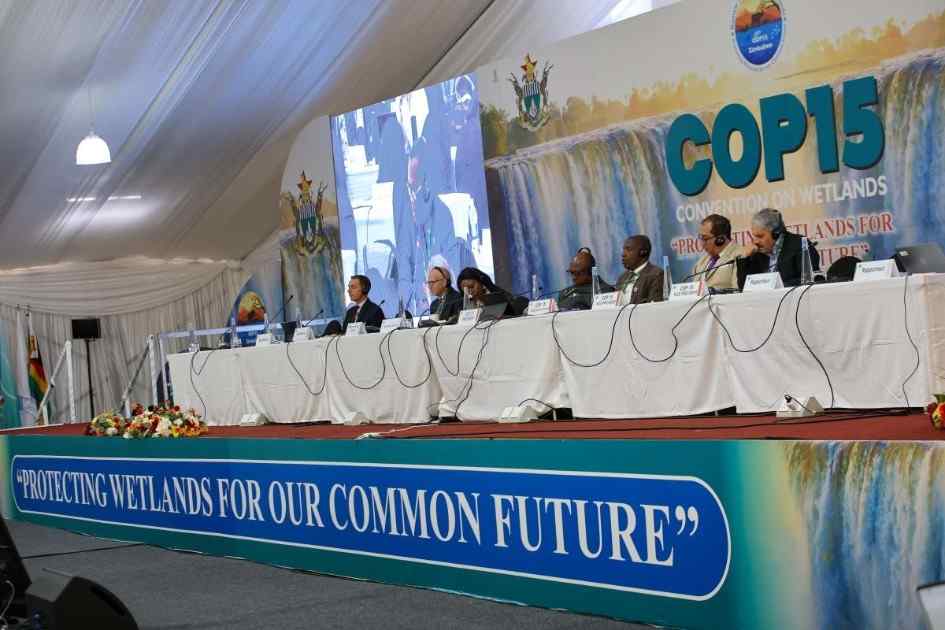



Russia exited the Ramsar Convention citing “politicisation,” while Saudi Arabia joined during COP15 in Zimbabwe. Leaders urged urgent wetland protection as global degradation accelerates. Bangladesh’s wetlands face severe threats, prompting local restoration efforts and calls for climate finance and youth inclusion.
In a dramatic turn of events at the Ramsar COP15 in Zimbabwe, Russia has formally withdrawn from the Ramsar Convention on Wetlands, accusing the global treaty of “politicisation.” Meanwhile, Saudi Arabia has officially joined the Convention, marking a stark contrast in global engagement with one of the world’s most critical environmental agreements.
The developments unfolded on the second day of the conference, as global leaders called for urgent action to halt the rapid decline of wetlands—ecosystems vital for flood control, clean water, biodiversity, and carbon sequestration.
Evelyn Ndlovu, Zimbabwe’s Minister of Environment, Water and Climate, was elected President of COP15, while Tadeous Chifamba, the country’s Permanent Secretary for Environment, Climate and Wildlife, was named Alternate President. During the plenary, Ukraine urged fellow parties to expand Resolution XIV.20 to address the ecological devastation of its wetlands following Russia’s invasion. The European Union and United Kingdom echoed the condemnation, citing the war’s catastrophic environmental fallout.
Wetlands in crisis
According to Ramsar Convention estimates, global wetland degradation could result in the loss of economic benefits worth $39 trillion by 2050. Wetlands—from inland peatlands and rivers to coastal mangroves and coral reefs—have been disappearing faster than any other ecosystem, with 22% lost since 1970.
“Wetlands are our natural lifelines, but we are destroying them faster than we can protect them,” said Sohanur Rahman, Executive Coordinator of YouthNet Global, speaking on the sidelines of the summit. “Bangladesh cannot afford to lose these ecosystems when they safeguard cities from flooding, provide livelihoods to millions, and serve as a shield against climate disasters.”
Bangladesh’s fragile wetland heritage
Bangladesh currently hosts three Ramsar-designated wetlands of international importance: the Sundarbans, Tanguar Haor, and Hakaluki Haor. The Sundarbans—home to the endangered Royal Bengal Tiger—is the world’s largest mangrove forest. Meanwhile, the haors of northeastern Bangladesh are lifelines for rural livelihoods, agriculture, and biodiversity.
Yet these vital ecosystems are under severe threat. Tanguar Haor, despite its Ramsar protection, has seen a sharp decline in ecological health. Two decades after scrapping the controversial lease system, the area remains plagued by unregulated tourism, pollution, and habitat destruction. Once a haven for 200,000 migratory birds, the haor has seen those numbers plummet amid continued neglect.
Urban wetlands are faring no better. In Dhaka, Gulshan–Banani Lake—one of the capital’s key wetlands—is facing encroachment, waste dumping, and pollution driven by rapid urbanization. Conservationists warn that unless urgent action is taken, the city will lose its last remaining natural buffers against flooding and heatwaves.
A local solution with global potential
Bangladesh’s ReWET Project (Climate Impacted Dwellers-led Agroecological Stewardship for Restoring Wetlands) is spearheading a locally-led movement to revive these ecosystems. Combining community stewardship and agroecological practices, the initiative is restoring wetlands in both rural and urban settings.
Recent economic valuation studies under ReWET estimate that restoring Gulshan–Banani Lake alone could yield benefits exceeding Tk 300,000 crore (USD 25 billion) over the next two decades. Advocates say this makes a strong case for increased climate finance and positions Bangladesh as a global leader in nature-based solutions.
The ReWET model is also being touted as a blueprint for wetland restoration that Bangladesh aims to showcase at COP30 in Belém, Brazil, to advocate for enhanced nature finance in global climate negotiations.
Call for finance and youth inclusion
Environmental experts and youth delegates at COP15 called for the urgent mobilization of climate finance to support nature-based solutions, especially in developing countries vulnerable to wetland loss.
“Youth must be given a seat at the table,” said Sohanur Rahman. “It’s our future that’s at stake. Wetlands must not be treated as wastelands—they are our last line of defence against the climate emergency.”
As Russia walks away and Saudi Arabia steps in, the fate of the world’s wetlands now hinges on how seriously nations take their Ramsar commitments—and whether they are willing to invest in ecosystems that are as economically valuable as they are ecologically irreplaceable.




