

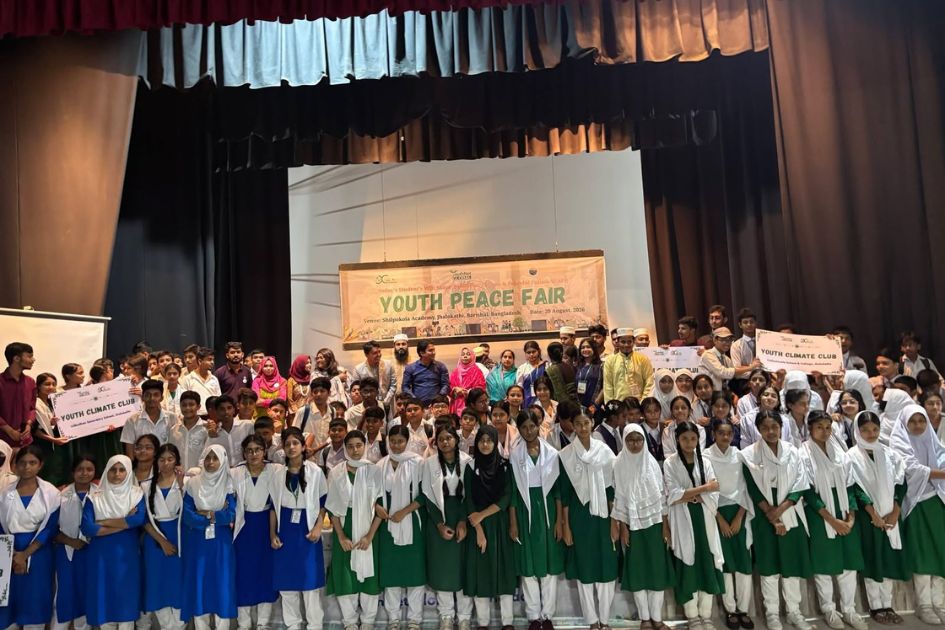



A youth-focused fair in Jhalakathi highlighted student innovations and creative campaigns addressing climate risks, disaster preparedness, environmental protection and community resilience.
Students from climate-vulnerable district present innovations, street theatre and creative campaigns on river erosion, floods, heatwaves and community resilience.
Students from one of Bangladesh’s most climate-vulnerable districts gathered on Thursday to showcase locally driven solutions to climate challenges threatening community security, livelihoods and peace.
YouthNet Global and Pace e Bene Nonviolence Service jointly organised the Youth Peace Fair at Jhalakathi District Shilpakala Academy under their “Youth Actions for Climate and Peace” initiative, creating a platform for young people to present their ideas on building climate-resilient communities.
Located in Bangladesh’s climate-vulnerable coastal region, Jhalakathi faces growing risks from river erosion, tidal flooding, salinity intrusion, extreme heat and environmental degradation. These impacts are increasingly affecting education, health, livelihoods and the wellbeing of local communities.
Around 150 students from climate clubs at five educational institutions participated in the fair, presenting models, wall magazines, videos, street theatre and creative displays focused on river protection, flood preparedness, pollution reduction, heatwave awareness and livelihood resilience.
More than 300 students, teachers, government officials, journalists, civil society representatives and youth leaders from 10 educational institutions attended the programme.
Jhalakathi Deputy Commissioner Md Momin Uddin inaugurated the event as chief guest and praised the students for turning climate concerns into creative action.
“Students’ creativity and leadership can help build a climate-resilient society. Climate clubs should be strengthened in educational institutions,” he said.
The Civil Surgeon of Jhalakathi highlighted the growing health risks linked to climate change, urging greater environmental awareness and protection measures for children and young people.
Organisers said the fair aimed to shift the narrative around climate change by recognising young people not only as those affected by the crisis but also as leaders developing solutions.
They said climate change is increasingly becoming a challenge to human security, as extreme weather events, displacement, livelihood losses and resource pressures affect social stability and community wellbeing.
YouthNet Global General Secretary Arifur Rahman Shuvo said climate change cannot be separated from broader issues of education, health, livelihoods and peace.
“Young people should not remain observers of climate challenges; they should become partners in creating solutions. Their ideas, creativity and leadership are essential for building resilient communities,” he said.
Sohanur Rahman, Executive Coordinator of YouthNet Global, said young people living on the frontlines of the climate crisis must be empowered as decision-makers.
“Climate change goes beyond environmental damage; it affects human security, peace and justice. Young people who experience these impacts firsthand must be equipped with knowledge, skills and opportunities to lead climate solutions in their communities,” he said.
Bangladesh Youth Change Maker grantee Sazid Mahamud said the fair marked the beginning of a broader youth-led climate movement in Jhalakathi.
“The Youth Peace Fair has created a platform to amplify young people’s climate ideas and innovations. This is only the beginning of new youth-led initiatives for climate resilience and peace,” he said.
Students presented a range of creative solutions, including awareness campaigns on climate risks, models demonstrating disaster-resilient communities, ideas for protecting rivers and wetlands, and performances highlighting the links between climate change and social challenges.
The event concluded with a call for stronger collaboration among government institutions, educational organisations, youth groups, civil society and development partners to support locally led climate action.
Organisers said the ideas and innovations developed by students will be shared at an international platform on August 22, connecting local experiences from Jhalakathi with wider discussions on climate resilience and peace.
The Youth Peace Fair highlighted a growing reality in Bangladesh’s climate-affected regions: young people are not merely facing the consequences of climate change but are actively shaping solutions through creativity, leadership and collective action.




