

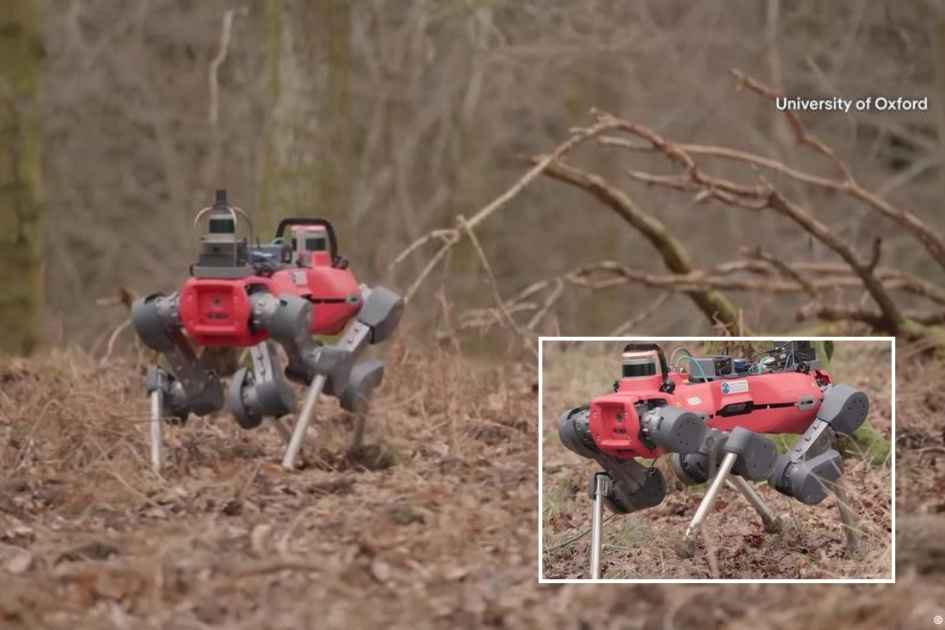



An AI-powered robotic dog is being tested by Oxford researchers to map forests, monitor tree health and biodiversity, and support sustainable forestry amid climate and environmental pressures.
A four-legged robotic dog is being developed as an innovative solution to help protect forests threatened by natural disasters, climate change and commercial logging activities. Researchers at the Oxford Robotics Institute are testing the advanced technology, which could transform how scientists monitor and manage large forest ecosystems.
According to researchers, the robotic dog is equipped with sophisticated sensors, cameras and artificial intelligence that allow it to move through dense and uneven forest terrain where human access is often difficult and risky. The device is designed to collect detailed environmental data, helping scientists map large forest areas and analyse the structural condition of trees.
The robot uses advanced laser-based scanning technology, commonly known as LiDAR, to create high-resolution three-dimensional maps of forest landscapes. This technology enables researchers to measure tree height, density, spacing and overall forest structure with high accuracy. Scientists say such information is crucial for monitoring forest health, tracking biodiversity and assessing carbon storage capacity.
Forests worldwide are increasingly under pressure from deforestation, climate change and extreme weather events. Global environmental studies show forests absorb nearly one-third of the world’s carbon emissions, making their protection essential for climate stability and ecological balance.
The technology is being further tested under the European Union-funded DigiForest project, which aims to support sustainable forestry management through digital monitoring tools. The project involves researchers from the Oxford Robotics Institute and has deployed robotic dogs in forest areas across the United Kingdom, Finland and Switzerland.
Field trials have been conducted in the historic Forest of Dean in Gloucestershire, England, where the robot navigates through dense vegetation, fallen leaves and uneven terrain to generate detailed three-dimensional maps of forest environments. Researchers say the digital mapping helps forestry managers make evidence-based decisions to maintain forest health and improve biodiversity protection.
The collected data can help identify areas where trees may need selective removal, allowing forestry operations to minimise environmental damage while supporting sustainable timber production. Experts say such precision monitoring could help balance commercial forestry practices with conservation priorities.
Maurice Fallon, Professor of Robotics at the University of Oxford and research lead of the DigiForest project, said the robot is designed to withstand harsh environmental conditions. He noted that the system is waterproof and is continuously being upgraded to improve stability, durability and navigation capability in challenging forest environments.
Experts involved in the research believe the robotic system could also support disaster response efforts. Following wildfires, storms or floods, the robot can be deployed to assess damage quickly and safely. By providing real-time data, it may help authorities, researchers and conservation organisations plan restoration and recovery initiatives more effectively.
The project reflects a growing global effort to integrate robotics and artificial intelligence into environmental conservation. Automated monitoring tools are expected to improve data accuracy while reducing costs, time and safety risks associated with manual forest surveys.
Although the technology is still undergoing research and field testing, scientists believe robotic monitoring systems could play a significant role in promoting sustainable forest management in the future. As forests continue to face mounting threats from climate change and human activities, combining traditional conservation approaches with emerging technologies may strengthen global efforts to protect biodiversity and enhance climate resilience.




