

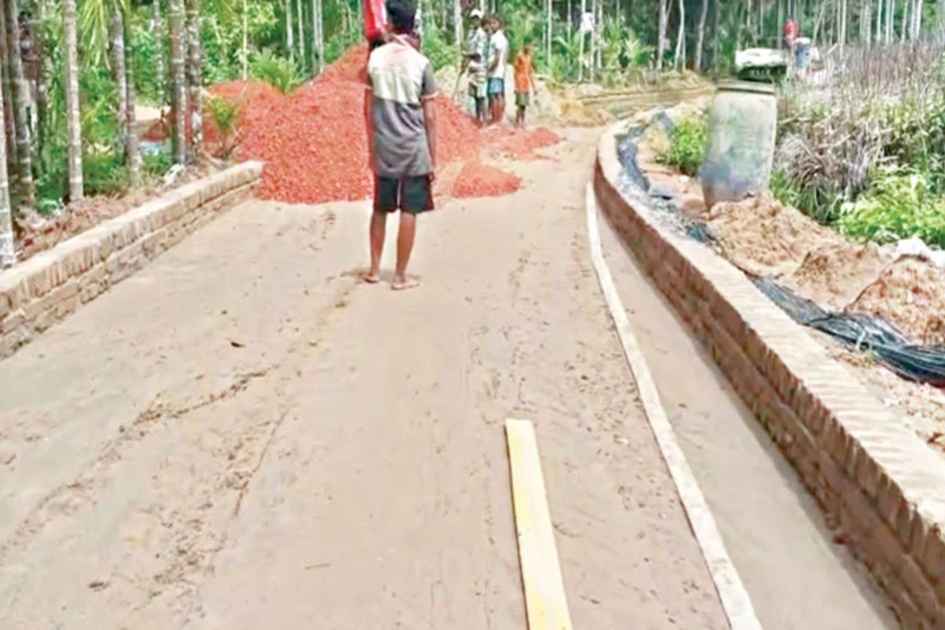



Forest officials, environmental groups and legal experts say the proposed road projects could fragment protected habitats, increase human access to sensitive forest areas and undermine existing conservation laws despite unresolved approval disputes.
Plans to build two roads through protected forests in Bangladesh’s southeastern Cox’s Bazar district have triggered a dispute between the Forest Department and the Local Government Engineering Department (LGED), with conservationists warning the projects could threaten critical wildlife habitats and accelerate forest destruction.
One of the projects involves constructing a nearly five-kilometre road through the Madhushia Garjan Forest in Chakaria, an important elephant corridor, while the other would pave a 4.8-kilometre road through protected hill forest in Maheshkhali, home to deer, monkeys, endangered hill turtles and pythons.
According to sources familiar with the projects, the dispute has intensified after LGED sought approval from the Forest Department to proceed with construction inside protected forests. Local members of parliament have also issued demi-official (DO) letters urging the Forest Department to facilitate the projects. The department, however, has refused, arguing that constructing paved roads inside protected forests violates the law and cannot proceed without approval from the prime minister.
Despite strong objections from the Forest Department, protests by environmental groups and legal concerns, work on both projects is continuing.
Environmental experts say the new roads would open up protected forests to unrestricted human access, creating opportunities for land grabbing, illegal settlements, wildlife hunting and further forest degradation.
Asked about the projects, Md Rayhan Kawsar, secretary of Bangladesh‘s Ministry of Environment, Forest and Climate Change, said applications seeking no-objection certificates for road construction inside the forests had been submitted but no approval had yet been granted.
According to LGED in Cox’s Bazar, the Khutakhali-Eidgah road is being built under the South Chattogram Regional Development Project. The approximately 11-kilometre road from Khutakhali to Eidgarh in Ramu has an estimated cost of more than 190 million taka.
Construction began on Feb. 26 last year and is scheduled for completion by Feb. 26 next year. Around six kilometres of the road, stretching from Khutakhali Bazar to Madhushia and from Eidgah to Kalapara, have already been completed. The remaining section is the nearly five-kilometre stretch passing through the Madhushia Garjan Forest.
The Forest Department alleges that LGED sought a no-objection certificate only after completing nearly half of the project, although prior approval is mandatory before implementing any project inside forest land.
Maruf Hossain, divisional forest officer of the Cox’s Bazar North Forest Division, said the Madhushia Garjan Forest is a critical elephant movement corridor.
“If a road is built here, elephants’ natural movement will be disrupted. At the same time, human-elephant conflict will increase and this ancient Garjan forest will be put at risk,” he said.
Faridul Alam, assistant engineer of Chakaria Upazila LGED, said between 50 percent and 70 percent of work under the two project packages had already been completed and construction was continuing at both ends.
He said construction had not yet started in the forest section where the Forest Department had raised objections.
“The sections where construction has already been completed are not forest land. They consist of markets, settlements and agricultural land. Therefore, no-objection certificates from the Forest Department were not required there. We have now applied for approval for the forest section,” he said.
The International Union for Conservation of Nature (IUCN) conducted a survey between 2013 and 2016 to identify elephant corridors in Bangladesh. Its study, titled “Atlas: Elephant Routes and Corridors in Bangladesh,” identified 12 elephant corridors in Chattogram and Cox’s Bazar, including eight in the Cox’s Bazar region.
One of the key corridors identified was the Khutakhali-Medhakachhapia corridor, much of which passes through the Madhushia Garjan Forest.
In Maheshkhali, a road running through protected forest stretches from JM Ghat in Shaplapur Union to Kalarmarchhara. LGED plans to pave the 4.8-kilometre road under a project costing about 220 million taka with funding from the Japan International Cooperation Agency (JICA). Concrete paving and culvert construction are already underway in some sections.
The Forest Department said the forest through which the road is planned was declared a protected forest in 1957. Under government law, paved roads cannot be built inside protected forests because they would threaten both the forest ecosystem and wildlife.
The department said the area is home to numerous tree species as well as deer, monkeys, pythons and other wildlife, and that afforestation programmes are also being carried out there.
Meanwhile, Alamgir Muhammad Mahfuzullah Farid, the member of parliament for Cox’s Bazar-2 (Maheshkhali-Kutubdia), submitted a DO letter to the Forest Department seeking a no-objection certificate for road construction through the protected forest.
He wants to build 30 roads through protected forests. In the letter, dated May 20, he requested the Ministry of Environment and Forest to take the necessary steps to implement the projects.
Commenting on the matter, Farid said roads were essential for local transport and for moving agricultural products.
“How will people travel if roads are not built? The tenders have already been completed, but work is stalled because of the Forest Department,” he said.
The Forest Department rejected his request, stating that constructing paved roads inside protected forests is unlawful and cannot proceed without approval from the head of government.
Maheshkhali Upazila Engineer Bani Amin Jony said the road was being upgraded to meet public needs, but progress had been hindered by objections from the Forest Department.
Sheikh Abul Kalam Azad, assistant conservator of forests at the Cox’s Bazar Coastal Forest Division, said footpaths could exist inside protected forests but paved roads could not.
“If paved roads are built, timber smugglers will destroy the forest and the forest land will be occupied,” he said, adding that legal action would be taken if LGED failed to stop construction.
Mahfuz Russel , a conservation activist, said the Madhushia Garjan Forest was rich in biodiversity and that forest land could not legally be used for non-forest purposes.
“The Constitution also states that the government must protect forests and biodiversity for present and future generations. Respecting the Constitution and the law, these projects should be abandoned,” he said.
The Forest and Tree Conservation Act 2026 states in Section 7 that natural forests cannot be used for non-forest purposes. If no alternative exists, such use requires cabinet consent and government approval. Environmental and social impact assessments, compensatory afforestation and biodiversity risks must also be considered.
Bangladesh’s National Forest Policy 2025 discourages the use of forest land for non-forest purposes, while the National Land Use Policy 2001 emphasises forest conservation. Article 18A of the Constitution directs the state to protect natural resources, biodiversity, forests and wildlife.
On July 1, the Bangladesh Environmental Lawyers Association (BELA), along with several environmental organisations, wrote to the relevant government authorities demanding cancellation of the Khutakhali-Eidgarh road project.
They said the Madhushia Garjan Forest was not only an elephant corridor but also an important habitat for wild boar, foxes, monkeys, jungle fowl, numerous bird species and reptiles.
Environmental groups warned that opening the new road would increase unrestricted access to the forest, raising the risks of deforestation, illegal occupation, wildlife hunting and timber smuggling.
Syeda Rizwana Hasan, chief executive of BELA and a former adviser, said existing laws did not permit road construction in either of the two protected forests.
“The two road projects have neither approval from the Department of Environment nor from the Forest Department. Even after the Forest Department clearly raised objections, other ministries are ignoring its authority. They are using political influence,” she said.
The article is republished form The Daily Samakal.




